Tuesday, April 13, 2021

2021 Offensive Line Prospects

This is a pretty good year to be in need of an offensive lineman. There are a couple of elite prospects at the very top of the class, plus some decent depth to be found elsewhere in the first round. A couple of the players may spend most of their careers playing guard, but if that’s the case they will turn out to be superstar caliber guards.


Penei Sewell, OT, Oregon

Where is Oregon tackle Penei Sewell projected to go in the 2021 NFL Draft?  Six experts make their picks - oregonlive.com Sewell’s athleticism just really doesn’t make sense. He’s 330 pounds, and he moves like a tight end, another of those players who just moves differently from all the others at his position. He’s capable of making reach blocks that most linemen wouldn’t even consider attempting, and he covers so much ground with his pass sets that even the fastest pass rushers don’t have a chance to turn the corner of him. Most important of all, he is always in perfect balance. No matter what he does or is done to him, he is always capable of breaking in any direction in an instant, leaving him perfectly positioned to handle any counter moves a pass rusher might throw at him.

Sewell isn’t just a finesse player either. He has plenty of strength too, and the trick at the next level is going to be learning to harness it. Oregon ran a fairly lateral running game, but when they asked him to lower his shoulder and drive, he was capable of blowing defenders backwards off the ball. His punch is enough to stagger pass rushers, and my only criticism is that he doesn’t use it enough. I think he’s reluctant because his slightly short arms mean that he doesn’t land that punch as much as a typical offensive tackle, which is the only real negative holding him back from being the best offensive lineman I have ever scouted.

Sewell used a wide variety of pass sets in college, and he should have no trouble sliding immediately in as a left tackle for whichever team drafts him. He’ll be a capable starter from day one, and he still has room to grow, as he is only 20 years old. I’d like to see him become more aggressive in general, get better awareness for picking up stunts, and perhaps even add more strength so that when he gets his hands on a defender, they aren’t able to break away. I’m not sure there is a limit for how good Sewell can be, and he should absolutely be one of the first five players off the board on draft night.


Rashawn Slater, OT/OG, Northwestern

NFL draft: Rashawn Slater could be Northwestern's first first-rounder since  2005 Slater doesn’t quite measure up to Sewell in length and athleticism, but he is the clear next-best-thing in this draft class. He’s a very good athlete as well, and with the technical skill to slide in at any spot on the offensive line he should go off the board in the top ten as well. He gets excellent depth on his drops, and he has the lower body mobility to swing his hips around and seal a defender off from the play with ease. He’s a little more vulnerable than Sewell on inside moves, but generally he has the change of direction ability and upper body strength to recover against anything he sees.

The biggest concerns about Slater are his size. At 6-4 he is right at the cutoff for offensive tackle height, and his 33 inch arms are below the typical threshold for a tackle. For this reason some people think his long-term home may be at guard, and if that’s the case he will be a phenomenal guard, particularly in a zone running scheme. He has decent power as a run blocker, but he is especially gifted at blocking on the run, with phenomenal ability to reach defenders on a frontside gap and the agility to swallow linebackers at the second level. He’ll get called for holding a bit more often than you’d like, but it’s worth it for his ability to latch onto defenders and prevent them from even being a factor in the play.

As good as he’d be at guard, I think Slater should be given a chance at tackle at first. At times his arm length is an issue, when pass rushers can get inside his chest and go for a bull rush. He’s decent at anchoring to absorb the contact, and more importantly he has plenty of tools at his disposal to prevent that from happening. He has a wide variety of approaches to pass protection that he rotates through over the course of the game, the most useful of which is a one-armed jab that catches pass rushers off guard with the power to disrupt them before they can even get on him. He plays much longer than he actually is, and if he can continue to refine this technique there’s no reason he can’t be a top notch pass protector at the tackle position.


Alijah Vera-Tucker, OT/OG, USC

USC Football's Alijah Vera-Tucker Wins Pac-12's Morris Trophy - USC  Athletics As with Slater, there are questions about where Vera-Tucker will find his home in the NFL. He played only one season at tackle in college, and he was inconsistent in pass protection. He has the athleticism to play on the outside, but there are questions about his length as well, and he isn’t as far along in harnessing his athleticism as Slater is. He gets good depth on his initial drops, but his balance becomes shaky as the play wears on. He’s able to run speed rushers up the field as he needs, but he is consistently vulnerable against inside moves. 

With more reps on the outside, I think Vera-Tucker could develop into a decent starting tackle. He has the athleticism to play the position, and just needs more time to figure out his footwork. The larger challenge will be making better use of his hands. He has a decent punch when he can land it, but short arms are an issue again, and he seems reluctant to trust himself to land the desired blow. This means he spends a lot of time catching pass rushers rather than actively trying to engage them. When he does get his hands on, he latches very well, and the play is pretty much over for the pass rusher trying to get to the quarterback.

I think Vera-Tucker will probably play most of his career at guard, and the small upside of him becoming a quality tackle might be just barely enough to get him into the top half of the first round. He’s a powerful run blocker, capable of lowering his shoulder and blowing defensive linemen five yards backwards off the ball. Whatever position he ends up in, he’ll be the fulcrum of his team’s rushing attack. This has value, even if it doesn’t measure up to what a more sure pass protector might be able to provide.


Christian Darrisaw, OT, Virginia Tech

Christian Darrisaw - Football - Virginia Tech Athletics Darrisaw is a good enough athlete, when everything is running on schedule. He covers a lot of ground on his pass sets, and he can get deep enough to cut off speed rushers as they come up the field. Where his athleticism fails him is when the defender comes where he doesn’t expect it. He struggles to react to inside moves, and he doesn’t move his feet very well after his initial pass set is complete. He is rarely beaten off the initial snap, but he doesn’t hold up well on long-developing pass plays.

His hands are very good, and they help cover up some of the deficiencies of his footwork. He has a very strong punch that can stop pass rushers in their tracks, and he latches on to keep them from going anywhere after the initial contact is made. The problem here is that he tends to play high, and when his punch arrives off target or skips off a smaller pass rusher’s shoulders, he is basically dead in the water. He can get his shoulders turned by inside leverage, and he is vulnerable to bull rushes putting him back into the quarterback’s lap.

It’s a similar story in the running game. Darrisaw isn’t going to blow anyone off the ball, but he can pull off impressive reach blocks in a zone running scheme. He also struggles to react to defensive linemen who move laterally off the snap, and at times he can be left swiping at space while a lineman cuts behind him into the backfield. He does enough well that I think he’ll probably be a decent starting tackle, but never a dominant player. He’s worth a pick at the end of the first round, but he doesn’t have the upside to go in the top twenty.


Samuel Cosmi, OT, Texas

NFL Draft: Samuel Cosmi and his stock after explosive pro day showing If Cosmi can figure out what he’s doing at tackle, he could be one of the best in the NFL. If he can’t figure out what he’s doing, he could be out of the league in five years. He has the athleticism and fluidity to match the top tackles in the class, plus some of the length they lack. He also has regular lapses on the field that are difficult to watch. Sometimes he’s dominant, and sometimes he’s unplayable. He could go either direction in the NFL, or could remain frustratingly in the middle.

Cosmi is a headache to try to pin down because he is so inconsistent, not just from game-to-game but from play-to-play. Everything you could expect to see in an offensive line prospect you get watching Cosmi, both the good and the bad. Some plays he dances with perfect footwork on the edge to bar a pass rusher from the quarterback. Other plays he seems to stumble just getting into position and leaves lanes wide open on either side of him. Some plays he will strike a defender, latch on, and bury him into the ground. Other plays it’s like his arms are sticks of butter sliding off anything they come in contact with. He’s capable of blasting defenders back in the running game. He’s also capable of getting blown off the ball himself and destroying a play in the backfield.

The towering ceiling here still makes Cosmi worth a pick at the end of the first round, even if there’s a pretty good chance he will never become even a capable starter at the NFL level. He’s already 22 years old and spent four years at a major college football program, so he’s had the opportunity to develop already. The fact that he hasn’t suggests that this inconsistency may just be who he is, but it’s hard not to be tempted by the rare ability he possesses.


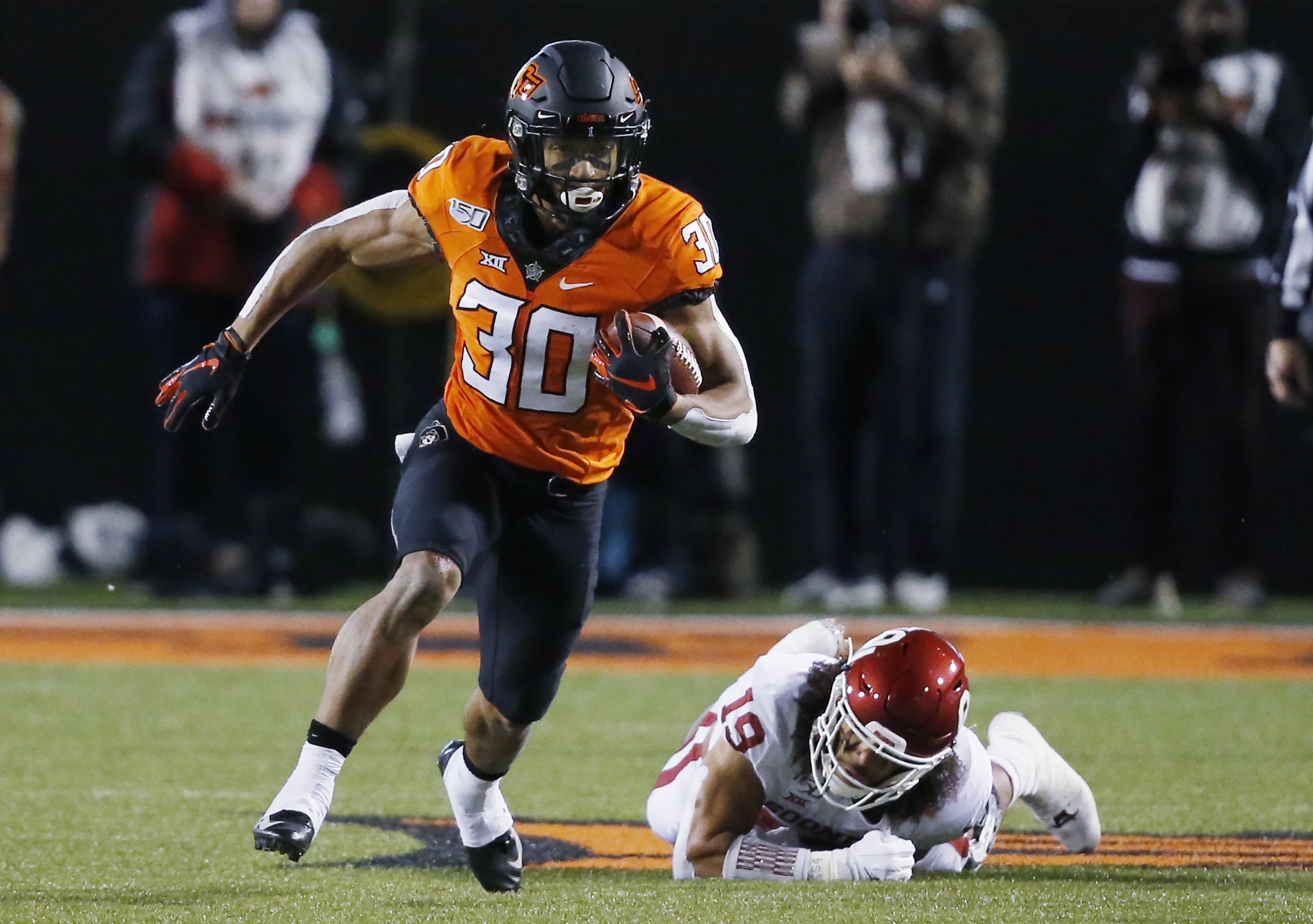
Teven Jenkins, OT/OG, Oklahoma State

2021 Chiefs Draft Prospect: Teven Jenkins - Full Press Coverage Of all the players I studied in this year’s class I don’t think there was any with as wide a divergence between how they played on film and how they performed in their workouts than Jenkins. Jenkins tore up his Pro Day, performing like he belonged in the same conversation with Sewell, Slater, and Cosmi in terms of pure athleticism. Yet on the field he looked like the least athletic of the linemen I studied. He doesn’t change direction well in his pass sets, he is often off balance, and he doesn’t cover much ground when playing up to the second level.

Before his Pro Day I was willing to write Jenkins off as not athletic enough to play on the outside, and likely someone destined for a guard position in the NFL. He certainly has the makings of a good guard. He’s a brutal run blocker, with the best combination of strength and nastiness in this year’s class, regularly driving defenders completely off the screen when he can get his hands on them. His hands are strong as well, and when he gets ahold of someone, there really isn’t much that can be done to break away, both in the running game and as a pass blocker.

The athleticism made me reconsider him somewhat, but I still think the two most likely outcomes for Jenkins are as a below average tackle or an above average guard. He’s as erratic as Cosmi in pass protection, but without the natural fluidity of movement to suggest there’s something more there he can harness.

I have some concerns with his pass protection at guard as well, particularly his vulnerability to letting his base get too wide and being driven backwards by a bull rush. This is something that can be smoothed over with practice if he moves to a position that has him in space less, but I’m worried that he may spend the early part of his career flipping back and forth between positions and never really getting comfortable in either. My prediction for his future will depend a great deal on which team selects him. If he’s drafted by a team comfortable with their tackles who wants to make him a guard right away, I can probably justify him being worth it at the tail end of the first round.


Jalen Mayfield, OT, Michigan

Michigan's Jalen Mayfield slides in new NFL mock draft from ESPN - mlive.com Mayfield is effective enough in pass protection when things don’t get too complicated. He gets good depth on his initial pass set and isn’t ever beaten off the snap of the ball. His positioning allows him to keep his body between the pass rusher and the quarterback, and he anchors well to avoid being knocked backwards. As long as he stays square, he’ll keep the pocket behind him clean.

Mayfield will be effective against the majority of NFL pass rushers, and I think he’ll be a solid starter once he adjusts to the speed of the professional game. His problems will come against the above average pass rushers in the NFL, all of whom have the versatility to attack him with more than just a traditional up the field rush. He doesn’t have the agility to react inside after his initial pass set, and even in college he was routinely beaten across his face to the interior. Good pass rushers can get beneath his hands and turn the corner on him as well, though he grapples well enough that he’ll probably avoid giving up too many clean sacks.

Mayfield’s limitations in space make me think he might be more comfortable as a guard, though he doesn’t flash any particularly impressive tools I look for at that position either. He’s just okay as a run blocker, and never really generates any push down the field. I think in the end the best place for him will be as a right tackle, for a team with a left tackle they can trust on an island so they slant more of their pass protection to Mayfield’s side. He might be able to eclipse this ceiling if he can develop his infrequent but effective punch to disrupt edge rushers, but in the end I don’t think he has a ceiling high enough to justify a pick before the second round.

Sunday, April 11, 2021

2021 Running Back Prospects

Running back is a fun position to evaluate, but it isn’t particularly meaningful. One or two of these players might go in the first round, but they shouldn’t. The other players on this list will go in the middle rounds and will have the chance to contribute right away. You draft running backs for what they can do right now, not what they might become in the future.

Najee Harris, RB, Alabama

NFL draft profile: Najee Harris of Alabama - Chicago Tribune

For a running back to be worth a first round pick, he needs to be the sort of player who can work in any scheme. You can’t win by designing your offense around a specific running back, but having someone versatile enough to plug into whatever scheme works best for the rest of the offense is certainly valuable. Unfortunately, Harris is not that guy. He can be very good in a downhill rushing attack behind a powerful offensive line, but any sort of zone scheme that relies on sharp cuts or lateral movement is going to run into trouble with him. So even though he is comfortably the best pure runner in this draft, I can’t justify taking him before the second round.

Trying to tackle Harris just seems exhausting. It isn’t just that he’ll lower his shoulder and pound defenders into the ground, though he certainly does plenty of that. He also is very good at bouncing off indirect contact and using his arm to shield himself to keep tacklers at bay. He has a very thick lower body, and it is almost impossible for a defender to get his arms around him. His balance is remarkable as well, and he absorbs most contact as if it isn’t there. 

Harris isn’t going to run away from people at the second level, but he has enough burst to be effective in short areas, and he’s very good at grinding out an extra five to ten yards once he reaches the second level. His ability as a receiver makes this useful as well. He shows some promise as a route runner, and he’s very good at transitioning from a receiver to a runner. It’s certainly good that he’s useful as a receiver, because otherwise he’d be a complete non-factor in the passing game. He’s a poor pass protector, and at least early in his career he will need to spend most of his time leaking out of the backfield rather than trying to pick up blitzes.


Travis Etienne, RB, Clemson

Travis Etienne 2021 NFL Draft Profile

Almost everything I said about Harris can also be said about Etienne. Ultimately the difference between the two probably comes down to personal preference. Do you want the between the tackles hammer who is impossible to bring down, or the lightning bolt that can run away from anyone? Etienne is fast, both with his initial burst and when he separates at the second level. He slices through holes on the interior faster than the defense can be ready for him, and he can outrun the entire defense to the edge when there’s nothing there in the middle.

His usefulness in the passing game is comparable to Harris’s as well. He’s nothing exceptional as a route runner, but he’s good enough to find open space underneath as a checkdown option. And when the ball does come to him, he has good hands to receive the pass and turn instantly into a runner. He’s a liability in pass protection as well, and early in his career he’ll likely have to come off the field in clear passing situations. 

I have Harris ranked above him mostly because I think Etienne needs more help around him. Harris can create when there is nothing there, dragging tacklers for a couple of yards to turn a negative play into something of a positive. Etienne doesn’t always go down on first contact, but more often than not if a tackler can catch him, he can bring him down. He isn’t particularly shifty in tight spaces, and he’s not going to leave defenders flailing at air behind him. If he has a line that can open things up to get him to the second level, he’s capable of taking any play to the house. But if he’s contained, he’s the sort of running back who can spend an entire game stuck in the backfield.


Michael Carter, RB, North Carolina

UNC Football: Michael Carter named Top 10 performer for Week 6

Carter is what you’d get if you took every trait Harris doesn’t have and turned it into a running back. He doesn’t have much power in him, and even glancing contact is usually enough to drag him down. But getting that contact is a challenge, since he is shifty in space and has excellent vision. He does a great job finding cutback lanes and accelerating upfield, and when he gets to the second level he has the speed to pull away from the entire defense.

Carter is a solid route runner who is occasionally let down by shaky hands. If he can become more consistent catching the ball, he will be a very dangerous weapon coming out of the backfield. Even if he doesn’t, he will still be an asset in the passing game thanks to his tremendous skill as a pass blocker. Despite his small size he is able of laying devastating blocks on blitzing linebackers, stepping up to meet them in the lane and stopping them dead in their tracks to keep the quarterback clean behind him.

There are better pure runners to be found farther down this list, but Carter’s ability to slide immediately into an NFL offense is what makes him the ideal third round running back pick. He isn’t a sensational athlete that is going to leave defenders on the field flummoxed as he runs away from them, but he has enough speed and quickness to be an average NFL starting running back for the next five years, with the bonus of the tools he brings in the passing game.


Javonte Williams, RB, North Carolina

2021 NFL Draft: Why Javonte Williams should be RB1 in this draft class

If Carter is the complement of Harris, then his teammate Williams is the complement of Etienne. Williams really isn’t the sort of running back who is going to run away from people. It takes him a while to get up to full speed, and even then he isn’t moving all that fast. What he is going to do is smack the defense in the face. He’s nearly as physical as Harris, and almost as slippery as well, letting arm tackles slide down his body and churning ahead so he always gets at least a couple yards after initial contact.

I don’t know what this North Carolina team is doing to teach their running backs pass protection, but I would like to see a whole lot more of it. Williams may not be as consistent as Carter in picking up pass rushers, but more often than not he does his job. And when he gets one really good, his size and physicality allows him to just demolish incoming linebackers, planting them into the ground on their backs.

Like Carter, Williams will be a good selection in the third round for a team looking for an immediate contributor and not necessarily huge long-term upside. He’s very good in short yardage situations, and his skills in pass protection would make him a good part of a rotation with another back who isn’t as useful in passing situations. He doesn’t have the route running skills of Carter, but his hands are excellent, and he’s very dangerous on vertical routes where he can get up to full speed in the second level before the ball reaches him.


Trey Sermon, RB, Ohio State

Trey Sermon is emerging as weapon for the Ohio State offense – The Athletic

Sermon can be an effective running back in a very specific set of circumstances. He isn’t the sort of back who is going to make people miss in space, or bowl over tacklers for extra yards. He isn’t even really the sort of back who is going to run away from people, though his speed is probably his greatest strength. Mostly he’s going to read the blocks in front of him, wait for a hole to get open, and then run straight forward until someone gets in his way again.

This makes Sermon the perfect running back for a zone blocking scheme, and not much else. This is fine for a running back who is likely to go in the fourth round. The team that drafts him will hopefully have a good plan in place for how to use him for the next two or three years, and after that he can find his way bouncing around between teams that want to run a scheme that fits his talents. He has the vision needed to be a good zone running back, and he gets up to top speed very quickly once he makes his cut towards the hole.

I’ll be interested to see how he develops in the passing game going forward. He wasn’t used much as a receiver at Ohio State his senior year, but if you go back to his first couple years at Oklahoma he put up some minor receiving production. He has the skills to be effective here, and I feel like it was more a case of usage that held him back. He’s still developing as a pass protector, and I think he’ll eventually reach the point of being serviceable there as well, to have a decent career as a back drifting around the league for teams that want his specific skillset.


Chuba Hubbard, RB, Oklahoma State

Gundy's OAN support angers star Oklahoma St RB Chuba Hubbard

Hubbard is probably the most technically advanced of all the running backs in this class, which explains how he was able to put up over 2000 yards rushing in 2019 despite limited physical tools. He’s smart and patient in the backfield, and he has very good vision, reading both the line right in front of him and the defenders on the second level. If there’s a hole, he’s going to find it. And behind a good offensive line, he can probably be a perfectly serviceable running back.

Hubbard just doesn’t do anything impressive physically. He doesn’t explode through the hole, and while his speed at the second level was enough to generate big plays in college, I expect he’ll get run down more often than not in the NFL. He doesn’t make people miss in space, and while he is good at falling forward after contact, he doesn’t have the strength or the balance to actually break away from tackles.

Hubbard offers next to nothing as a receiver, but he’s effective enough in protection to at least be on the field on passing plays. He isn’t going to physically overwhelm rushers, but he does a good job chipping edge rushers or lending support to interior gaps as needed. If a team just needs to plug a roster hole for a couple years until something better comes along, he’s probably worth selecting in the fifth round, though I feel like you could probably find someone just as capable by taking two or three swings at the undrafted free agent market.


Kenneth Gainwell, RB, Memphis

Kenneth Gainwell - 2019 - Football - University of Memphis Athletics

If I step back I can see why some people really love Gainwell as a sleeper in this draft. If you want a running back who can step in and contribute as a receiver, this is your guy. In one of the games I watched he had over 200 yards receiving, much of it coming split out as a wide receiver. He’s capable of winning separation running vertically down the field, and he adjusts well to the ball in the air, though I do have some concerns about him consistently completing the catch.

The problem is, Gainwell does pretty much nothing for me as a runner. He has good speed but nothing elite. He can occasionally drive forward for a couple extra yards, but the first guy almost always brings him down. He doesn’t make people miss in space, and in the backfield his vision is poor, leading him to occasionally run right into blockers. Some of these are skills that can be developed in the NFL, and he really only has one year of college experience under his belt. But right now he isn’t someone I would trust to hand the ball off to.

So what do you do with a player like this? There are uses of having a running back who can split out at wide receiver, but only if the defense respects him as a rushing threat and changes their personnel on the field as a result. Otherwise he’s just a mediocre wide receiver, usually outmatched by the cornerbacks and safeties assigned to cover him. A very clever coach can likely scheme up opportunities for him, but he doesn’t have the sort of physical ability to justify an offense being catered to him. He might be worth a flyer in the fifth round, in case he does develop the running skills to make his receiving abilities actually useful. But I think on the whole he is someone who is going to struggle to find his way onto an NFL field.

Tuesday, April 6, 2021

2021 Linebacker and Safety Prospects

Last week I broke down the top cornerbacks in this year’s draft. Of course, cornerbacks are only one piece of a secondary, partnering with the safeties that patrol the deep and middle parts of the field. If you’re in the market for a safety though, this really isn’t the year for it. So I’ve lumped them in with the top linebackers in this year’s class, a fascinating group with some excellent athletes of the sort that are flourishing in the modern NFL.

Jeremiah Owusu-Koromoah, LB/S, Notre Dame

If this is only the 'beginning' for Jeremiah Owusu-Koramoah, how good can  the end be? – The Athletic

The hardest, and most fun, part of scouting Owusu-Koromoah is trying to figure out what he is going to do in the NFL. He is certainly a special athlete, with the sort of tools that flash every time he steps onto the field. He has the size of a traditional linebacker with the movement skills of a safety, and he flies all over the place to deliver devastating hits, particularly when he comes downhill towards a ball in front of him. He can slide around blockers with ease, and he can keep up with wide receivers running from the slot, with long arms to break up passes in front of him.

Owusu-Koromoah can do so much on the field that it almost becomes a game to pick out what he can’t do. He isn’t great as a point of attack run defender in the box. He sometimes can get undisciplined holding his gap discipline, and he’s a shaky tackler in space, often moving too fast to get himself under control. For these reasons I’m not sure I like him as an every down player in the box, though he’s certainly capable of playing in there as the defense needs him.

The best role for Owusu-Koromah is likely the same one he played the most in college, and that is as a slot cornerback. He may not be able to stick to receivers over long developing routes the way a traditional cornerback can, but he’s good enough in coverage for teams to take advantage of everything else he brings to the table. He has the physicality to challenge tight ends, he demolishes screens thrown towards him, and he is lethal as a blitzer. In the right circumstances, he could be a true game changer on defense. These circumstances do matter however, and I have enough concerns that I would hesitate to take him in the top ten of the draft.


Micah Parsons, LB, Penn State

LB Micah Parsons tackles the challenges of being an impact player at Penn  State | Pittsburgh Post-Gazette

Parsons is a very similar athlete to Owusu-Koromoah, but with the skills of a more traditional linebacker. On the one hand this makes him easier to project, since he can plug into just about any defensive scheme. On the other hand, he provides less upside as a playmaker, which is why I would take a gamble on the more versatile player I have listed above. They should probably go in the same range in the middle of the first round though, and I would understand a team preferring the linebacker out of Penn State.

Parsons spent most of his time in college playing in the box, and he will do the same in the NFL. He’s fantastic at knifing through a gap and shooting into the backfield to drag down a ball carrier, particularly on the backside of the play. He struggles sometimes when blockers come straight at him, trying to duck around them rather than meeting them head-on and stuffing up the hole. He isn’t a pure physical run stopper, and he’ll allow a few yards after contact on most tackles.

But linebackers have to be quality pass defenders to be worth a first round pick in this day and age, and Parsons has the tools to be a great one. He may not be able to match up with wide receivers in the slot like Owusu-Koromoah, but he has the speed and physicality to be perfect in man to man coverage against tight ends. He’s rangy in zone coverage as well, and he is elite as a blitzer, capable of being in the quarterback’s lap before anyone even realizes he hasn’t dropped back into coverage. Most young linebackers struggle in coverage when they enter the NFL, and projecting this part of the game is always a challenge. But I expect within two or three years Parsons will be a very useful piece in the middle of the defense.


Jamin Davis, LB, Kentucky

Jamin Davis, LB, Kentucky - NFL Draft Player Profile | PFN

There’s a pretty clear drop between the top two players and the rest of this class. The other linebackers simply lack the raw athleticism of Owusu-Koromoah and Parsons, as well as their natural feel for playing in coverage. There are still some who will likely turn into solid starters, and that makes them worth a pick in the second round.

Davis is the one case I might be able to talk myself into at the end of the first round. He’s the best pure run defender in the class, and that will give him an easy role right away on first and second down while he develops his skills as a pass defender. He’s the surest tackler of all the linebackers I studied, rarely missing tackles in space and almost always sticking ball carriers exactly where first contact is made. He sometimes gives ground too readily against blockers, but he’s consistently able to disengage, and to work from there to bring down a running back cutting through the hole.

As I mentioned Davis is a work in progress when it comes to pass defense, but he has potential there. He rarely played in man coverage in college and I’m not sure he has the agility to keep up consistently in that scheme, but he’s the best of the second tier of linebackers I studied in zone coverage. He gets great depth on his drops, and his head is always darting around looking for a receiver coming into his space. There’s still work to do in actually moving his body to take away these passing lanes, but at the very least he’ll be starting from farther along than other linebackers below him.


Trevon Moehrig, S, TCU

2021 NFL Draft Player Profiles: TCU S Trevon Moehrig - Steelers Depot

Moehrig was the only pure safety I studied this year, and even after three games watching his film I wouldn’t say I have a great feel for him as a player. He’s undoubtedly an excellent athlete, with speed to cover a ton of ground and agility to break on a dime to keep up with a receiver in coverage. At times he can look like a true superstar out on the field, at others like just another run of the mill deep safety. The upside might be enough to justify a selection at the end of the first round, but I probably think he should go somewhere early in the second.

Moehrig is at his best playing back away from the line of scrimmage. When he’s forced to play man coverage in the slot, he can have trouble stopping quick-hitting routes. He benefits from having space and time to read and react to what’s in front of him. He’s very smart about where he positions himself and how to turn his body to be in position to come downhill and make a play on the ball. He sometimes struggles at the point of the catch, but he has the tools and the instincts to make some very nice plays on the ball as well.

He doesn’t do much for me when it comes to run support. He never really comes up in a hurry, and sometimes bites on misdirection plays. His angles are usually decent, and his speed helps cover up some otherwise slow reactions. This is fine if he’s going to stick as a deep safety, but he isn’t the sort of versatile player who can bounce between multiple roles and be a true gadget option for a clever defensive coordinator.


Zaven Collins, LB, Tulsa

Zaven Collins - Football - University of Tulsa Athletics

Collins may have the pure straight-line speed to match the top two in this class, but he isn’t at the same level when he is asked to change directions. He is a very linear athlete, and it shows up in every aspect of his game. When used as a rusher off the edge he can get a good burst up the field but never turns the corner to the quarterback. When running plays don’t come straight at him, he struggles to navigate through traffic. I’m not sure I saw him disengage from a block once, and his only real strategy seems to be hurling himself into a blocker and hoping this can stuff up the hole, usually to limited effect.

Collins’s speed allows him to be involved in plays most other linebackers wouldn’t have a chance at. He can chase the ball out to the sideline and across from the weak side of the field, provided nothing gets in his way and forces him to alter his route. When he sees a slow developing run play, he can knife into the backfield and bring the ball carrier down for a huge loss. He’s very useful as a spy against mobile quarterbacks, capable of chasing them anywhere they go on the field after they break out of the pocket.

His game against the pass is interesting. He didn’t have many opportunities in man coverage in college, but he looked good when he did, though I have my concerns against more complicated routes than the crossing and wheel routes I primarily saw him face. In zone coverage, however, he seemed far less certain, usually drifting around the line of scrimmage with no real depth and never picking up a receiver. I think he has the potential to develop here, but I haven’t seen enough to convince me he will, and for that reason I’d probably wait to grab him until the second round.


Nick Bolton, LB, Missouri

Mizzou Football: Nick Bolton could take another step forward - Rock M Nation

Bolton tested well in the forty yard dash, but otherwise he is a below average athlete, which shows up on the field as well. It’s unfortunate because he’s an incredibly smart player, and each game you can see several plays where he does everything right—reads the play, breaks on the ball, slices through traffic—but simply doesn’t have the range to make the tackle.

When the ball stays within his area, Bolton is a very good run defender. He sticks running backs in the hole, and he battles through contact to get to the ball. He sometimes gives up ground before meeting blockers, and on occasion will knife in too fast and miss a tackle, which puts him behind someone like Davis. But he’ll clean some of this up in the NFL and become a reliable middle linebacker on first and second down.

Does he have the ability to develop coverage skills to be an every-down player? I don’t really see it. His play recognition in the running game translates to the passing game, and occasionally he can make good tackles to bring down a running back or receiver after the catch simply by breaking well before the ball is thrown. But he’s never really in position to make a play on the pass, and I don’t think he has the athletic upside to ever be more than adequate as a pass defender, which would make me reluctant to draft him before the third round.

Friday, April 2, 2021

2021 Cornerback Prospects

We’re on to the second of my eight (or potentially nine?) part positional breakdown posts. Earlier this week I looked at some of the dynamic wide receivers that are going to be entering the league this year, and now I will be looking at the cornerbacks who are going to have the misfortune of having to cover them for the rest of their careers.

Last season was a rough year for rookie cornerbacks, always the toughest position to translate to the NFL. Professional coverage schemes are a different world from the college level, and trying to predict who will be successful at this position is probably the hardest thing I do each year. So if you want to take these rankings with a grain of salt, go ahead. I feel pretty confident that of the seven cornerbacks I looked at there is a top tier of three, then a second tier of one, then a lower tier of three. Within these tiers, I could be argued into putting them in just about any order.


Caleb Farley, CB, Virginia Tech

Packers Prospect Primer: Virginia Tech CB Caleb Farley - Acme Packing  Company

This entire position group is difficult to scout, and Farley throws an extra complication on top of it. He looks great when he’s on the field, but that last part is a pretty big stumbling block. He missed his first season at Virginia Tech due to a knee injury, and he wasn’t able to participate at his Pro Day due to a back surgery. These medical red flags may be enough to drop him to the end of the first round, which is a shame, because on pure ability he is comfortably the best cornerback in the draft and worth a top ten pick.

Farley is a special athlete with an almost limitless ceiling. He played quarterback in high school then entered college as a wide receiver, before switching to cornerback following his knee injury. He’s only played two years at the position, and already he is one of the best coverage men in this year’s draft. He is impossible to beat deep, and he is almost always balanced underneath, able to flip his hips around in an instant and drive on the ball with lightning closing speed. His ball skills are excellent as well, as one would expect from someone who was briefly a wide receiver.

His lack of experience shows up every now and then as he plays the position. He will occasionally bite on double moves, and when he does lose track of what is happening around him, his first instinct is to grab the opposing wide receiver. He likely won’t be ready to start right away, and it might take a year or two for him to get comfortable in the NFL. That’s the biggest concern about these injuries, that they could keep him from the proper development track. But if he can stay healthy, and if he can develop the skills to match his athletic ability, he has all the tools to be a true shutdown cornerback.


Patrick Surtain Jr, CB, Alabama

Falcons: Patrick Surtain II could solidify the backend of Dean Pees'  defense - SportsTalkATL.com

Surtain is a good athlete himself, even if he isn’t as naturally smooth as Farley. He is always balanced as he’s dropping back, and he transitions smoothly through his turn into a run so he is almost never beaten by a straight go route. He’s a little more vulnerable underneath, where he allows receivers too easy access across his face on slant routes. He makes up for it some with impressive closing speed and long arms that can reach around the receiver to swat the ball away, but it is still possible to complete plays in front of him.

I think Surtain is a fairly safe thing as a cornerback prospect, but I think there are enough holes in his game to prevent him from ever being truly elite. His athleticism is merely good compared to some of the other elite players in this category, as evidenced by his solid but unspectacular 4.46 forty time. He has a long frame that can close down windows over the top, but the true freaks of the NFL may be able to run by him. He also sometimes struggles to pick up the ball on these vertical routes and can be left looking foolish while a receiver goes up over top of him to make an uncontested grab.

The one thing I’m curious about with Surtain is physicality. He played a lot of tight man coverage at Alabama, but he never really engaged the receivers at the line. This isn’t a purely schematic thing, as other Alabama cornerbacks regularly try to stuff opposing receivers off the snap. Surtain seems to have the physical tools to be a dangerous press cornerback, but he never took advantage of them in college. If he can add this to his game, he has the potential to grow into more than he is now, but until I see it I’m hard pressed to project that in his career path.


Jaycee Horn, CB, South Carolina

NFL Network's analytical mock draft has Cardinals taking CB Jaycee Horn

Horn is a bit challenging to place among the other top cornerbacks because he is very different stylistically from the rest. He is a special athlete as well but in a much more linear way. Where the others are smooth and flexible and master the art of coverage by changing direction in an instant, Horn’s game is all about single-direction explosiveness. At his Pro Day he put up freakish numbers in the vertical leap and broad jump but elected not to run any of the agility drills, likely because those wouldn’t have helped his cause.

This isn’t to say that Horn is out there stumbling all over himself when he tries to change direction. It’s more that he does everything in his power not to have to change direction. He holds off from committing in any single direction until he absolutely has to, and trusts that he has the burst to make up for whatever small advantage this gives the opposing receiver. Once he starts backpedaling he has trouble reacting sharply downhill, but his speed and explosiveness means that he can hold off on moving backwards until he absolutely has to without fear of being beaten deep. He can make some impressive plays coming downhill on routes where the opposing receiver thinks he’s sold a move down the field, and if he stays in balance Horn’s closing speed is truly special.

Physicality is an essential part of Horn’s game, with all the pros and cons this entails. He can stack receivers up off the line of scrimmage and stop them from even getting out on their route. He uses the sideline to great advantage, squeezing the receiver to the boundary to eliminate a throwing window. If he can make this style work in the NFL, he can shut receivers down in a way none of these other cornerbacks can.

But it’s always a bumpy transition for physical cornerbacks from college to pros, and I think this will likely be even more the case for Horn. He will draw a lot of defensive holding penalties, and he’s going to have to back off some from the contact he made in college that was often more than five yards down the field. He played almost exclusively on the boundary side of the field in college, and he’ll have to adjust to having more space around him in the NFL. And when he’s playing aggressive press coverage, he has a tendency to get locked up on his man, missing necessary coverage switches and occasionally leaving receivers running wide open down the field behind him.

In the right scheme and for the right team I can see some having Horn as the top cornerback in the draft and potentially grabbing him with a top ten selection. But he is less versatile than the other top cornerbacks available, and if he doesn’t match what a team wants to do, I could see him sliding to the second half of the first round.


Greg Newsome, CB, Northwestern

Greg Newsome II, CB, Northwestern - NFL Draft Player Profile | PFN

Newsome combines pieces from each of the three cornerbacks above him, both the good and the bad. He has the fluidity of Farley as well as the shaky injury history, though he is at least healthy now. He has the inconsistent ball skills of Surtain, alternating sharp drives on the ball underneath with plays where he struggles to track it over the top. He has the ability to physically dominate a receiver like Horn, and even more trouble avoiding drawing penalties for being too physical.

Newsome plays very aggressively because he can play very aggressively. His recovery ability is elite, combining remarkable change of direction ability with the speed of a 4.31 forty yard dash to make him almost impossible to beat on double moves. He’s especially effective closing on routes over the middle of the field, where his positioning allows him to react downhill and play the ball at the catch point. There’s a decent chance he’s asked to play differently in the pros, but he has the athletic ability and the skill to be versatile in any number of schemes. He never really played in the slot in college, but I expect he could even transition to a full time slot defender as well.

Newsome is just a little less explosive in general than the other cornerbacks, and in a strong cornerback class I can see that being enough to push him outside the top twenty. As good as he is breaking on inside routes, he usually allows decent space on routes towards the sideline. Scheme could change how he lines up and flip his strength, but I don’t think he has the pure downhill closing ability of players like Horn or Farley to take away everything in front of him. Combine this with his tendency to rely on grabbing hold of opposing receivers, and I think he’s a clear notch below the three I have listed above him, while still being well ahead of every other cornerback in the class.


Asante Samuel Jr, CB, Florida State

Rams had 2nd pre-draft meeting with CB Asante Samuel Jr.

Samuel is a very smart, technically sound cornerback who is held back by being a clear step behind athletically from the top cornerbacks in this draft. He tested out about average athletically in everything at his Pro Day, while also being only 5-10 and 180 pounds (the top four cornerbacks all have two inches and at least 10 pounds on him, in addition to testing as better athletes). Many cornerbacks with his limited profile end up being moved into the slot in the NFL, and I think that will likely be the destination for Samuel as well, though he is going to have to get much better as a tackler before I’m really comfortable moving him closer to the middle of the field.

Samuel’s athletic limitations show up in how he plays on every snap. His lack of height and middle of the pack speed means that he’s vulnerable over the top, and he clearly knows this. He plays much more conservatively than the other cornerbacks in this class, often turning his hips to start his backpedal when the receiver is still five yards away. This, combined with shaky closing speed, means that he surrenders 10 yard stop routes without much contest whenever they are run towards him.

As limited as he is, Samuel will still likely become an average starting NFL cornerback, and that’s worth a second round selection. He’s a very smart player, reacting to opposing route combinations so fast it almost seems like he was in the offensive huddle. He will snag a couple interceptions every year by anticipating a throw before it leaves the opposing quarterback’s hand, and if he keeps developing this anticipation he can close down some of the opportunities he currently allows on the field.


Tyson Campbell, CB, GeorgiaTyson Campbell - 2020 - Football - University of Georgia Athletics

The story of Campbell is one of the whole being far less than the sum of the pieces. If you step back and look at him from a distance, he seems like he should be an elite cornerback. He has good size, and he tested very well at his Pro Day, but this athleticism doesn’t always show up on the field. He can be outrun over the top, and while he can make sharp change of direction plays, there always seems to be a lot of wasted movement that prevents him from getting exactly where he needs to go.

It’s a similar case at the catch point. Campbell can be in excellent position, and he does a good job getting his head around to find the football, but he never seems to make the play he needs to make to knock it out of a receiver’s hands. He surrenders a lot of catches where it looks like he has the receiver covered, and this is absolutely something NFL quarterbacks will pick up on and attack.

I’m not sure what sort of cornerback Campbell will become in the NFL. He could be a genuine liability for a defense, his inconsistency in coverage partnering with his inability to win at the catch point to make him a regular target for opposing quarterbacks. Or he could iron out these issues and become an elite man-to-man coverage specialist. He certainly has the tools of a first round pick, but I’d probably prefer waiting for the second round to grab someone with this much potential downside.

Eric Stokes, CB, Georgia

Georgia's Eric Stokes has chance to be All-SEC

Stokes made headlines by running a 4.25 forty yard dash at his Pro Day, and may have pushed himself into the first round conversation as well. Not that this was a particularly surprising outcome. Speed is his number one asset on the field, as he’s basically impossible to beat with a vertical route. He turns smoothly, and he’s able to stay in phase with any receiver who is put out against him.

There are a few other things to like with Stokes’s game as well. He isn’t going to stuff a receiver at the line, but he’s able to disrupt the timing of their route some with physicality. He plays tough when he’s in position at the catch point and does a good job locating the ball when it’s in the air. His speed makes him a dangerous blitzer, and he’s overall solid tackling opposing ball carriers.

His biggest issue is that he’s a bit stiff changing directions, especially once he’s opened his hips to run deep. In-breaking routes can leave him in the dust, as he doesn’t have the single-step burst to break downhill and close to the football. This isn’t something that can be erased, but it can be accounted for if he learns to trust his speed better. If he can learn to be more patient, he can wait longer than almost any other cornerback before turning to run with a vertical route, trusting his speed to erase any gaps that open up. This won’t solve all his issues, but it will limit their impact and let him develop into an above average cornerback.

Wednesday, March 31, 2021

2021 Wide Receiver and Tight End Prospects

The NFL Draft is now just over four weeks away, so it’s time to take a deeper dive into this year’s top prospects. Today we’ll start with the wide receivers and tight ends, probably the most exciting position group in this year’s class. Last year’s receiver class had an immediate impact on the NFL, and while this year’s group may not be as deep, the players at the top are even more talented.

As a refresher, here’s how my process works. I watch three games of each player, usually from their final season of college football. This year added a wrinkle with a number of players choosing to opt out of the season, but for the most part that didn’t affect my evaluations. We also didn't have an actual Combine this year, which means for most athletic testing we will be relying on Pro Day numbers that may not be quite as accurate. So I'll probably be putting more emphasis on film this year than in the past, since that's one thing we can still count on.

Devonta Smith, WR, Alabama

WATCH: DeVonta Smith pulls down one-handed TD catch

I watched a lot of Alabama’s offense a year ago while scouting Tua Tagovailoa, Henry Ruggs, and Jerry Jeudy, and my biggest takeaway at the time was that Devonta Smith was their best player. I didn’t really understand why he came back for another year at Alabama, but I doubt he regrets it after putting together maybe the most impressive season by a wide receiver in college football history. He shattered records, won a Heisman, and expanded his game to the point that he is by a comfortable margin the best receiver prospect I have every scouted.

Any criticisms I can try to make about Smith are really just picking nits. His top end speed is simply “fast” rather than “extremely fast”, and he makes up for it by reaching that speed far quicker than most receivers. He doesn’t have the electric change of direction ability of someone like Jeudy or a couple of the other receivers listed below, but he’s still good enough to leave cornerbacks in the dust as a route runner. The biggest concern might be his size. He has good height at 6-2, but he weighs only about 170 pounds, and when cornerbacks can get their hands on him, his lanky frame makes a big, soft target that can lead to him being stopped in his tracks. Defenses will try to press him at every opportunity in the NFL, and while his release off the line is good enough that they won’t be able to shut him down, elite cornerbacks might be able to give him a few headaches.

But aside from that, Smith does everything I would want from a receiver. Simply put, he is not someone who can be covered. He has so many tools in his bag to help him get open. He sells all his fakes with his full body before flipping his hips around faster than any defender can match. He’s very good at using subtle physicality, leaning into a defender with his body to widen him and push him off balance before breaking back across the middle. And when the ball is in the air, he attacks it as well as any receiver I’ve ever seen. He comes back to beat cornerbacks breaking on the football, he goes up to get passes that look like they’re headed well over his head, and he can fight through contact to make difficult catches. In short, he is a perfect receiver prospect when it comes to skill, who may only be limited by physical tools that are merely very good for an NFL receiver.


Kyle Pitts, TE, Florida

UF star TE Kyle Pitts is leaving Gators early for NFL - Orlando Sentinel

If you want to fall in love with physical tools, Pitts is the prospect for you. He’s 6-6 and 240 pounds, with the speed to threaten defenses down the field and the quickness in space to cause headaches for any bigger defenders that try to track him. He absorbs contact on his routes like it isn’t there, and he plays with excellent balance so he’s always ready to twist himself to make a difficult catch. His catch radius is huge, and he’ll be a best friend to any quarterback he plays with.

There have been some people who have suggested he should move full-time to wide receiver, and he certainly has the skills to back that up. His route tree isn’t as fully developed as most wide receivers, and routes that require sharp change of direction may be asking too much of him. But as we’ve seen these past couple years with DK Metcalf, there are ways to use receivers with dominant size-speed combinations and limited agility. Pitts isn’t as fast as Metcalf, but he’s even bigger, and better at high-pointing balls and making catches in traffic.

If he was just a receiver, I think Pitts would still be worth a pick in the top half of the first round. But his versatility is what really sets him apart and makes him worth a top five selection. He isn’t overwhelmingly dominant as a blocker like George Kittle or Rob Gronkowski, but he’s better than people give him credit for. Most importantly, he gives his full effort on every block. He loves fighting in the trenches, and when he gets a good matchup he has the tools to absolutely bury a defender. He’s average in the running game, and with his receiving skills that is frankly all you need. There is no position in the league with a wider gap between the elite players and the rest of the field as tight end, and having a game-changing player at this position is something only three or four offenses in the league can boast. Within a year or two though, whoever drafts Pitts will be able to count themselves among that small group as well.


Ja’Marr Chase, WR, LSU

Joe Brady To Panthers: LSU's Ja'Marr Chase Appears To React To News

Chase is the first of several prospects I’ll get to this year who elected to opt out of the 2020 season. For some I might be a little more wary at the limited film availability, but for Chase it doesn’t concern me at all. He showed everything he needed to show in 2019 as the top receiver on one of the most dominant offenses in college football history. He was physically overwhelming as a 19 year old sophomore, and I doubt anything he did during his junior year would have changed the story on him.

Chase is about the same height as Smith, but the difference between their bodies seems even more than the 30 pounds listed on paper. Chase is simply thick, and his entire game is built around his physicality. He outmuscles defenders consistently at the point of the catch, with excellent body control to twist through contact and snag the ball out of the air at the last second. And when he has the ball in his hands, he is a nightmare to bring down, battering his way through the secondary to pick up extra yards.

The physicality makes him interesting when he faces press coverage. He doesn’t have much lateral quickness off the snap, and this means that more often than not a pressing defender will get his hands on him. This does cause occasional issues, holding him up for a second to prevent him from getting out on his route. But Chase had a broad set of tools for disengaging from a jam, and with his strength there’s really no way a cornerback can remain locked on him for the duration of the play. And when he does break free, he remains on balance and under control enough to toss the cornerback to the side and explode past him down the field for instant separation.

Strength and physicality are at the heart of Chase’s game, but he’s more than just some burly possession receiver. His top end speed is good as well, and like Smith he has exceptional first step burst. He didn’t run the widest variety of routes at LSU, but he looks like he has the flexibility to develop as a route runner in the NFL. He just turned 21 less than a month ago, and he has tons of room to develop still. I’d still take the more polished Smith ahead of him, but I can understand a team falling in love with Chase’s tools and taking the receiver with the almost unlimited upside.


Jaylen Waddle, WR, Alabama

Jaylen Waddle - Football - University of Alabama Athletics

Every year there is one receiver prospect whose defining attribute is his speed, and every year I find myself lower on this player than the NFL. Many have Waddle as a potential top ten selection, some even ranking him ahead of his teammate Smith because of his superior physical tools.

In this case, I can almost see what they’re talking about. Waddle is more than just a straight-line deep threat. He’s electric with the ball in his hands as well, with single-step bursts that let him slip through a defense like water through a grate. He’s capable of making spectacular leaping catches as well, going over top of defenders and fighting the ball away from them. He’s probably the most physically gifted pure receiver in this class, and it isn’t out of the question that he could end up the best when all is said and done.

There are just too many holes in his game as I see it now for me to take him in the first half of the first round. While he can make some spectacular catches outside his frame, he is weirdly inconsistent, also letting some mildly challenging but catchable passes bounce off his hands. He doesn’t do as much as a route runner as his physical tools would suggest he’s capable of. Where good route runners like Smith and Chase know how to vary their pace to set up their routes, Waddle is going full speed at pretty much all times, which makes it a lot easier for cornerbacks to guess where he’s going to negate some of his speed.

Waddle will have to come along slowly in the NFL. He’ll have a role right away as a deep threat who gets a couple short targets each game, but for the most part defenses shouldn’t have a problem adjusting to handle him. He struggles with physicality, and he is going to have to learn to apply his quickness at the line in order to get into his route. Three or four years down the road I could see him emerging as one of the best receivers in the league, but in this draft I’d still prefer one of the surer options on the board.


Rondale Moore, WR, Purdue

Rondale Moore's Official Height Revealed At Pro Day

You can’t discuss Moore without addressing the injury issue. After a sensational freshman season, he was expected to dominate college football and potentially compete for a Heisman over the next two years. Instead he played a total of seven games over his final two seasons, held back by a series of nagging hamstring injuries. He was still dynamic when he was on the field, but it’s always a red flag when a player has barely played football in two years.

It’s hard to say how much these injuries limited Moore’s development. He remains a truly special athlete, with very little polish as an actual wide receiver. Every year there are two or three players across all positions who just visibly move differently on the field than anyone around them, and Moore is one of those players. His ability to stop and start in space is freakish, and his acceleration through gaps seems to break defender’s brains and leave them sprinting at a nonsensical angle behind him. Get him the ball in space, and good things are going to happen.

If he’d been available more frequently, maybe Purdue would have found a way to better integrate him with their offense. But for the most part in the games I watched, his role existed solely on plays that were designed to go to him. Screens, sweeps, and end arounds, mostly stuff to get him moving laterally rather than working down the field.

That said, the few plays they did target him on traditional routes he showed enough promise for me to take a flyer—with all the risks involved—on drafting him at the end of the first round. His agility translates at times to his route running, where he makes sharp breaks that very few cornerbacks can keep up with. He tracks the ball well in the air and can make catches outside his frame, though he will also drop easy catches every now and then.

He has plenty of ability to grow as a pure receiver, and the biggest question I have is whether he can stretch defenses down the field, a strange thing to ask about someone who was timed at 4.29 in the forty. But as good as his initial burst is, his speed never really showed up with the ability to separate over the top. Defenses were comfortable playing him right at the line of scrimmage, and while he's quick enough to evade press coverage, I really would like to see him develop the skills to force defenses to give him space to work his magic underneath.


Terrace Marshall, WR, LSU

LSU star Terrace Marshall Jr. shows growth as receiver, leader – Crescent  City Sports

Marshall is the sort of receiver who is both easy and difficult to pin down. On the one hand, we know exactly what he’s going to be in the NFL. He’ll be a solid number two receiver, someone who can put up big numbers as one piece of a solid passing attack but will struggle if too much of the defense’s attention goes to him. I don’t think there’s a lot of upside here, but he should be able to transition rather smoothly into an immediate role in the NFL. The hard part is putting a value to this. Is a receiver with this limited ceiling worth a first round pick, or would he be a better fit early in the second round?

Marshall has the speed to win over the top, but he isn’t in the elite category of fast where defenses have to shift their scheme to account for him. If his only tool was speed, it wouldn’t be enough to win on its own. He helps himself by being an accomplished route runner underneath. He doesn’t make a lot of sharp cuts, but he varies his speed well over the course of his route, and he absorbs physicality well enough to make the windows around him bigger than they appear.

One big concern with Marshall is drops. He’s good for about one drop a game, which isn’t great but also isn’t likely to kill his career. This does mean he will probably have to work on his concentration at the catch point, which means he won’t be able to transition as smoothly to running after the catch, already not a particularly strong point for him. He’s probably best suited working the sidelines, where his speed can isolate cornerbacks on an island and his strength and length can give the quarterback options to target his back shoulder. He’ll have a role in the NFL, even if he will likely never be a star.


Kadarius Toney, WR, Florida

2021 NFL Draft prospect profile: Kadarius Toney, WR, Florida - Big Blue View

Get the ball in Toney’s hands, and good things are going to happen. He’s one of the most difficult players in this class to take down, with just about every tool you would look for in a ball carrier. He’s quick enough to make people miss in space. He has the strength and balance to bounce off of tackles and drive forward for extra yards. He has the instincts of a running back, and if you wanted to you could probably even line him up in the backfield.

The question with Toney is, how much work do you have to do to get him the ball? Can he slide right into any offensive scheme, or does he need plays designed with him as the sole target? He struggles sometimes to win the way conventional receivers win. He isn’t big, and he doesn’t go outside his frame to make catches, or fight through contact to get to the ball. As a route runner he shows momentary flashes of quick cuts that leave a defender stumbling behind him, but his route tree is limited and he will need to do a lot of development in that area in the next level. He has enough speed to occasionally separate over the top, but he isn’t an elite speed threat that will force defenses to bend to account for this threat.

There are ways for Toney to contribute right away. Whoever drafts him should immediately slot him in as their primary returner on punts and kickoffs. A package of screens and sweeps to get the ball in his hands could work too, though if he doesn’t have a more developed role in the offense you run the risk of defenses keying on that. He certainly has the tools to develop into an elite route runner, but he is a long way from being where he needs to be there. And even if he does, I feel like his limitations may prevent him from ever being more than just a really good slot receiver.


Rashod Bateman, WR, Minnesota

Rashod Bateman blossomed late in high school career before becoming star  with Gophers | Star Tribune

Almost everything I said above about Marshall can be applied to Bateman, except the part about him being fast. Of all the players in this year’s class, Bateman might be the one I most wish we had an actual Combine to use to evaluate him. Sometimes he seems to have decent burst off the ball, but he never really runs away from defenders, relying on route running and physicality to get open instead. It seemed to work at the college level, but for NFL wide receivers there is a certain base level of speed that is required to be able to break away from coverage. I think Bateman meets this threshold, but I wish we had some reliable numbers to back this up.

Bateman does plenty of good stuff on the field. He’s an advanced route runner with a good feel for how to find holes in zones and how to use the small bursts he has to get open. He doesn’t make sharp cuts, but he makes well timed cuts. He can work in the slot or on the outside, and he attacks every zone of the field, from intermediate crossing routes to deep shots down the sideline. He isn’t going to do anything ridiculous after the catch, but he’s smart enough to pick up what he can and not get in trouble trying to get more.

At the catch point he has some similar issues with converting routine catches that Marshall does, but he plays with more physicality. He isn’t at Smith or Chase levels when it comes to winning the ball when it’s in the air, but he’s probably the next best in the class. He does a very good job attacking the ball when it’s in the air, routinely coming back to undercut a cornerback who thinks he has an easy interception. But he isn’t so overwhelming that he can fight off two defenders for a ball in the air, which means that schemes keying towards him can more or less erase him from a game. As a secondary option he could be a real headache for opposing defenses. As a primary option, I don’t know if he has the pure explosiveness to make it work.


Elijah Moore, WR, Ole Miss

Watch Elijah Moore run a 4.32-second 40-yard dash at Ole Miss pro day

Moore is another good slot receiver without much upside to be anything more. He doesn’t have the agility or burst of players like Moore or Toney, but right now he’s better as an all around receiver. He doesn’t do much as a route runner, but he has a very good feel for finding open space, especially when the play breaks down. And his hands are sensational, grabbing pretty much any ball that comes within reach.

Moore tested extremely well, but on the field he isn’t particularly fast or quick. He doesn’t make people miss when he has the ball in his hands, and he doesn’t separate over the top when he runs deep. But he’s built firm, and he has the ability to power through contact both during the route and after he makes the catch. I didn’t see him have many contested catch opportunities, but the way he attacks the ball in the air and the strength he plays with make me think he could be effective when he does get these opportunities in the NFL.

Capable slot receivers are fairly cheap to acquire in the NFL, and without the game-breaking athletic potential of someone like Moore or Toney, I’m not really sure how much Moore is worth. There’s certainly a place for him in the NFL, but the best place for him may be as a high value third round selection as the third or fourth piece in a passing attack.