Tuesday, March 17, 2015

Trading First Round Picks


We’ve had nearly a week now to cool down after the chaos of the beginning of the new season. Huge sums of money were handed out, and players jumped from team to team in trades of the sort we aren’t used to seeing in the NFL. The highest profile of these deals was probably the trade between the Seahawks and the Saints, which saw Jimmy Graham and a 4th round pick shipped to Seattle in exchange for Max Unger and a 1st round pick.

That now makes two 1st round picks this year that have changed hands, joining the one the Bills sent to Cleveland last year as part of a deal for the pick they used on Sammy Watkins. This is a pretty normal number if recent years are to be believed, and it will likely remain the same until the day of the draft (though who the hell knows what will happen anymore?)

The tricky part of trading draft picks is figuring out how to weigh the value of an intangible asset against a very tangible player. An ideal trade should benefit both sides, but it doesn’t always work out that way. I dug through the trades involving 1st round draft picks made in the past few seasons, in the search of an elusive win-win trade.

I confined myself to looking at trades made prior to draft day, primarily swaps of players for picks. This won’t include deals like Atlanta jumping up on draft day to grab Julio Jones, or Miami sliding up to get Dion Jordan (I also excluded the RGIII trade, because everyone is sick of hearing about that.) For all picks dealt, I included the exact selection numbers in parentheses. So a pick listed as “2nd round pick (47)” would be the 47th overall pick, the 15th of the 2nd round.

2014
Indianapolis: Trent Richardson
Cleveland Browns: 1st round pick (26)
This one is recent enough that I probably don’t have to refresh your memory. Trent Richardson sucks, and the Colts have already cut him loose, even with a year remaining on his contract. (As an aside, this was a rather shameless attempt to recoup the money they promised to pay him, which will likely lead to a series of appeals that could last longer than the rest of Richardson’s career.)

Far more interesting is what happened with the pick they traded. Cleveland didn’t just sit on number 26. They traded this and a 3rd round pick (83) to Philadelphia for the 22nd pick, which they used on Johnny Manziel. At this point a lot remains to be determined, but it is hard to call them winners either.

Of course, if we’re going to have any fun we can’t just restrain ourselves to the actual teams involved in the original deal. The 83rd pick received by the Eagles was then dealt to Houston in exchange for a 4th and a 5th round pick (101 and 141). Philadelphia used these picks on Jaylen Watkins and Taylor Hart, a pair of special teamers. They used the 1st round pick they received from Cleveland on linebacker Marcus Smith, whose rookie year failure was a major reason for their offseason front office reshuffling that led to the current chaos in Philadelphia.

Houston used the 83rd pick they acquired on nose tackle Louis Nix, who played some this year before going down with a season ending injury. This makes them the current winner of these deals, even if he did little enough that they decided to sign Vince Wilfork.
In the hunt for our elusive trade in which everyone wins, we start by finding a trade in which everyone loses. Not exactly promising.

2013
Seattle Seahawks: Percy Harvin
Minnesota Vikings: 1st round pick (25), 7th round pick (214), 2014 3rd round pick (96)
I don’t have much to say on this one now, since I covered it back in October when the Seahawks traded Harvin to the Jets. At the time I decided the trade was firmly in the favor of the Vikings, and it swung even further into their favor over the second half of the season as Xavier Rhodes developed into one of the best cornerbacks in the league.

This impression wasn’t helped by Seattle’s failure to produce any open receivers during the Super Bowl. Had they not made this trade for Harvin and given him a big new contract, they likely would have made a better effort to retain Golden Tate, who may have been enough to earn them a second Super Bowl ring.

Tampa Bay Buccaneers: Darrelle Revis
New York Jets: 1st round pick (13), 2014 4th round pick (104)
This trade is much less complicated than the Colts-Browns swap, though parts of it are just as depressing. Revis is obviously not still with the Buccaneers, cut after a single disappointing season for salary cap/schematic reasons. The Jets held onto the 4th round pick and used it on wide receiver Jalen Saunders, who didn’t even make it out of his rookie training camp with the team.

The other pick is the one saving grace of this deal. With the 13th selection in 2013, the Jets selected defensive tackle Sheldon Richardson. Richardson went on to win Defensive Rookie of the Year, and he only improved last season. Right now if they did the 2013 draft over again, he would probably be the first player off the board. And now that they have brought Revis back as a free agent, I think it's pretty clear that we can call the Jets winners. Huh, there’s something I’ve never written, spoken, or thought before.

2012
Oakland Raiders: Carson Palmer
Cincinnati Bengals: 1st round pick (17), 2013 2nd round pick (37)
You noticing a trend yet? Doesn’t it seem like the team surrendering the picks to acquire the player rarely gets the better end of the deal? Part of me still feels a bit sympathetic for how this whole situation went down. The Raiders began the 2011 season strong, winning four of their first six before losing starting quarterback Jason Campbell to a broken collarbone. Most teams have the luxury to not overreact to a good six game stretch, but for the Raiders this was the first sign of life in nearly a decade. They couldn’t just afford to surrender to a lost season, so they went out and grabbed the best quarterback available at any cost.

Palmer had been holding out ever since the Bengals drafted Andy Dalton, and Cincinnati was looking for somewhere to dump his contract. The desperation of the Raiders worked to their advantage, giving them far more than he was worth. Palmer can still play at a competent level, as he’s shown the past couple years in Arizona, but he was hopeless thrown into a new scheme in Oakland.

In return, Cincinnati received a 1st round pick that they spent on cornerback Dre Kirkpatrick and a 2nd round pick they used on Giovanni Bernard. Kirkpatrick struggled to find the field his first couple years, but he came on strong down the stretch last year and is a promising young piece of their defense. Bernard’s future is less certain, but he remains and intriguing player as a change of pace to Jeremy Hill.

2011
Oakland Raiders: Richard Seymour
New England Patriots: 1st round pick (17)
Seriously, Oakland? And you wonder why you’re terrible. Yes, two straight years the Raiders traded away their 1st round pick (17th overall both times) to bring in an over the hill veteran to add to a roster that wasn’t going anywhere in the first place. It’s one thing for someone fighting for a championship to trade their future for a 30 year old defensive lineman. It’s something else entirely for a team that should be trying to rebuild to waste their resources on aging veterans.

New England made the rest of this fairly simple. They used the 1st round pick they received on Nate Solder, a reliable, league average left tackle. Just the sort of player Oakland would love to have on their roster. But instead they had the privilege of counting $19 million of Seymour’s salary against their cap even after they had cut him in 2013.

2010
Denver Broncos: Alphonso Smith
Seattle Seahawks: 1st round pick (14)
This one falls into a slightly different category. The Broncos traded this pick during the 2009 draft in exchange for Seattle’s 2nd round pick that year (37), which they used on Wake Forest cornerback Alphonso Smith. If you haven’t heard of Alphonso Smith, I don’t blame you. The Broncos cut him after only a single season, and he’s been out of the league since 2012. In exchange for that one season, they gave up their next year’s 1st round pick. That’s right, the Broncos traded a 1st round pick for a 2nd round pick.

Of course, because the universe has a sense of humor, the Seahawks used that pick on Earl Thomas. Yes, in order to draft one of the biggest defensive back busts of the past decade, the Broncos gave up the pick that became one of the best defensive backs in the league. Earl Thomas is now an All Pro safety who was the best player on a defense that won the Super Bowl by shutting down, of all teams, the Denver Broncos.

2009-2010
Chicago Bears: Jay Cutler, 5th round pick (140)
Denver Broncos: Kyle Orton 1st round pick (18), 3rd round pick (84),  2010 1st round pick (11)
Here we have it, the biggest NFL trade of the past decade. It’s strange how little we think about this anymore, but if it happened today we would all collectively lose our minds. Two teams swapping starting quarterbacks, with one sending a pair of future 1st round picks in order to acquire a player thought to be one of the up and coming stars in the league. That so many pieces of the deal ended up disappointing does not change how staggering this move was.

I really don’t want to get into a discussion of Jay Cutler’s career right now. He hasn’t been a success in Chicago, but I wouldn’t call him a failure either. Similarly, I don’t know how to evaluate Orton’s Denver career. He did some good things, but he was also benched for Tim Tebow. So let’s just focus on the draft picks.

The pick Chicago received ended up being pretty straightforward. In the 5th round of the 2009 draft they selected wide receiver Johnny Knox. Knox was a major contributor on special teams and a slightly below average starter on offense, before a devastating back injury ended his career. Still, I think it’s fair to say that the Bears got more than they could have expected out of a 5th round selection.

Tracking the Broncos picks gets a bit more complicated, but here it goes. In 2009 they used their 1st rounder on defensive end Robert Ayers, a definite bust. The 3rd round pick was packaged with Denver’s other 3rd round pick (79) to the Steelers in exchange for a 2nd round pick (64) and a 4th round pick (132).

Denver used these selections to grab tight end Richard Quinn, who lasted two years with the team, and offensive lineman Seth Olson, who only made it one year. Pittsburgh turned the 79th pick into offensive lineman Kraig Urbik—also lasted only a year—and with the 84th pick (the one that originally belonged to the Bears) they took wide receiver Mike Wallace. So I think we can count the Steelers as winners on this one.

Okay, that was a lot. But there’s still one pick left, Chicago’s 2010 1st rounder. And this is where it gets really interesting. Denver traded down two spots so San Francisco could move up to select offensive tackle Anthony Davis. As part of this deal they received a 4th round pick (113). Holding the 13th pick now, they sent it to Philadelphia (who drafted defensive end Brandon Graham) to move down to number 24, receiving two 3rd round picks (70 and 87). But they weren’t done yet. From number 24 they moved up two spots to grab Demaryius Thomas, sending the Patriots the 4th round pick they had received from the 49ers.

The Patriots used this pick to take Aaron Hernandez (…awkward…) and sent the 1st rounder to Dallas (along with a 4th rounder (119)) in exchange for Dallas’s 1st round pick (27) and 3rd round pick (90). The Patriots used these selections on defensive back Devin McCourty and wide receiver Taylor Price. Dallas used the 1st rounder on Dez Bryant and sent the 4th rounder to Miami in exchange for Miami’s 4th round pick (126) and 6th round pick (179). The players taken with these three picks were respectively: AJ Edds, Akwasi Owusu-Ansah, and Sam Young.

So we’re done, right? Not quite. Because Denver still has the two 3rd round picks they received from Philadelphia. With number 87 they took Eric Decker, yet another phenomenal wide receiver wrapped into these deals. They did not hold onto number 70, however. They sent it along with a 2nd round pick (43) and a 4th round pick (114) to Baltimore in exchange for the Ravens 1st round pick (25). Baltimore used the 43rd pick on Sergio Kindle, the 70th pick on Ed Dickson, and the 114th on Dennis Pitta.

And with the 25th pick? The Broncos selected Tim Tebow. And we’re back to the quarterback shell game that started it all.

That was a lot, so to summarize with additions in green and subtractions in red:

Denver: Kyle Orton, Robert Ayers, Richard Quinn, Seth Olsen, Demaryius Thomas, Eric Decker, Tim Tebow, Jay Cutler, 2009 3rd (79), 2009 5th (140), 2010 2nd (43), 2010 4th (114)
Chicago: Jay Cutler, Johnny Knox, Kyle Orton, 2009 1st (18), 2009 3rd (84), 2010 1st (11)
Pittsburgh: Mike Wallace, Kraig Urbik, 2009 2nd (64), 2009 4th (132)
San Francisco: Anthony Davis, 2010 1st (13), 2010 4th (113)
Philadelphia: Brandon Graham, 2010 1st (24), 2010 3rd (70), 2010 3rd (87)
New England: Devin McCourty, Taylor Price, Aaron Hernandez, 2010 1st (22), 2010 4th (119)
Dallas: Dez Bryant, Akwasi Owusu-Ansah, Sam Young, 2010 1st (27), 2010 3rd (90)
Miami: AJ Edds, 2010 4th (126), 2010 6th (179)
Baltimore: Sergio Kindle, Ed Dickson, Dennis Pitta, 2010 1st (25)

Have fun figuring out who won and lost all that.

2009
 Roy Williams' (11) prodigious talent and offseason preparation should give him a chance to thrive in Mike Martz's new offense in Detroit.
Dallas Cowboys: Roy Williams, 7th round pick (210)
Detroit Lions: 1st round pick (20), 3rd round pick (82), 5th round pick (192)
Yeah, I don’t think we even need to look at who Detroit selected to know who won this trade. Roy Williams is one of the greatest trade busts of all time, lost in the many punch lines in recent Cowboys history. Over two and a half seasons in Dallas he managed a total of 94 catches for 1324 yards and 13 touchdowns. That would be a pretty good stat line over sixteen games. Unfortunately, it took him 40.

Of course, then you take a look at what Detroit got. With their 1st round pick they selected tight end Brandon Pettigrew, who has been somewhere between disappointing and irrelevant for most of his career. In the 3rd round they chose Derrick Williams, a wide receiver who never caught a pass for them. Which I guess puts him behind their 6th round pick Aaron Brown, who over three years with the team produced a total of 327 yards from scrimmage.

I’m going to call this another lose-lose trade.

2008
San Francisco 49ers: Joe Staley
New England Patriots: 1st round pick (10), 2007 4th round pick (110)
Like the Alphonso Smith–Earl Thomas deal, this one was made on draft day the previous year. The 49ers gave up their 1st round pick next season in exchange for New England’s 2007 1st rounder, which they used on offensive tackle Joe Staley. A disappointing season in 2007 meant the pick they gave up was fairly high in the 1st round, but it is difficult to call them losers of a deal that landed them a future 3 time All Pro.

New England took full advantage of their pick as well, using it on Jerrod Mayo who was the heart and soul of their defense until going down with injuries the past two seasons. But they did even better with the 4th round pick, which was thrown in almost as an afterthought. They kept it for a single day before passing it on to the Raiders in a straight up deal for a wide receiver by the name of Randy Moss. And with the 110th pick in the 2007 NFL draft, the Raiders selected defensive back John Bowie, who never started a single game for them.

What do you know? A deal in which everybody won, and the Raiders somehow still lost.

2008
Minnesota Vikings: Jared Allen
Kansas City Chiefs: 1st round pick (17), 3rd round pick (73), 3rd round pick (82)
Here it is, the Platonic Ideal of an NFL trade. In 2008 Jared Allen was one of the best young defensive ends in the league, coming off a season in which he led the NFL in sacks despite missing the first two games. The problem was that he had only a year left on his contract, and it looked like Kansas City was in the process of tearing things down. He had no real interest in returning to Kansas City, and thanks to some off the field issues (Remember how I mentioned he missed the first two games of the season? That was a suspension for repeated alcohol issues.) they weren’t particularly eager to bring him back either.

The solution was to send him to Minnesota, an up and coming young team with a stout run defense in serious need of a pass rusher. There was some concern at the time that Allen’s off the field troubles could follow him, but we all know how it worked out. He cleaned up his act, led all NFL players with 85.5 sacks over his six years in Minnesota, and earned himself an eventual spot in Canton. There isn’t a single Vikings fan out there who would undo the trade if given the chance.

Fewer people realize how well Kansas City made out in the deal. The latter 3rd round pick turned into basically nothing—Dajuan Morgan, a safety who was with them for only two seasons. But a miss like that is perfectly acceptable when they hit on their other two picks like they did. In the 1st round they grabbed Branden Albert, who became one of the NFL’s best left tackles over his six years in Kansas City. This was a fantastic pick, a major contributor that would almost be enough to make it a fair deal.

But where they really hit was with the other pick they received. With the 73rd pick in the 2008 NFL Draft, the Kansas City Chiefs selected running back Jamaal Charles. Yeah, I’m pretty sure no Chiefs fans out there want to redo this trade either.

So there we have it. 2008, the year of the mutually beneficial trade. If we could look into the future, maybe seven years down the road we’ll see another such trade, one in which the team surrendering their future for a single player doesn’t end up utterly screwed in the end. Until then, I think it’s probably a smart thing for teams just to hold on to their 1st round picks.

Wednesday, March 11, 2015

Free Agency Frenzy


I have followed football for a long time, and I have never seen a day like yesterday. It’s quite possible I’ll never see a day like it again. Many people, including me, expected the official start of the new season to be anticlimactic thanks to all the agreements announced over the weekend. Boy, were we wrong.

Yesterday the NFL lost its mind. I wish I could cover it all, but instead I’ll just stick to the moves from the past few days that made me audibly gasp when I read about them for the first time.

Saints trade Jimmy Graham and 4th round pick to Seahawks for Max Unger and 1st round pick
 
The biggest deal of the day, and probably the most lopsided. Jimmy Graham is a very talented player, but he has been trending downhill over the past couple years, struggling with injuries and failing to expand his game. In 2011 it was very reasonable to call him the best in the league at his position, a young, athletic talent who put up big numbers while still having plenty of room to grow. Well now he’s 28 years old, and he still has very little idea how to run routes in the NFL. He is still big, and he can still outjump opposing players, but he brings nothing as a blocker. He’ll immediately become the best receiving threat on Seattle’s team, and he can be a very useful piece for their offense. But the cost of what they gave up is simply too much.

Unger has had some issues with injuries also, but when he’s been healthy he’s been one of the best run blocking centers in the NFL. It was staggering to see how drastically Seattle’s offensive line fell off when he missed time last year, and I can’t imagine how they think they can replace him.

In the end, I think a straight up trade of Unger for Graham would have been fair for both sides. The fact that Seattle also threw in a 1st round pick is mind boggling. The Seahawks have several positions at which they are in drastic need of help, and surrendering their best asset is a horrendous error (a topic I will cover at some point in the next couple weeks.) Best case scenario, Graham returns to being the best tight end in the league as he was three years ago, and the trade comes out as a wash. Much more likely, New Orleans will end up as the clear winner of this trade.

Ravens trade Haloti Ngata and 7th round pick to Lions for 4th and 5th round picks
A great move by the Ravens, getting something back for a player they were going to cut anyway. Baltimore is one of the best teams in the league at acquiring midround draft picks because of stuff like this, dumping over the hill veterans who they have no use for anymore. They have slowly rebuilt their front seven into one of the best in the league, and with young talent on the line they have no real need for Ngata, even after a resurgent season in 2014.

The Lions should not feel good about this. They made this move out of panic, giving up two useful assets for an aging defensive lineman because of the loss of Ndamukong Suh and the potential departure of Nick Fairley. In doing so they saddled themselves with one of the worst contracts in the league. It’s likely that they will restructure, but right now the $16 million cap hit for Ngata is the one of the two highest for any defensive tackle in the league (depending on the structure of Suh’s new deal in Miami).

As a fun fact, do you know who is responsible for the fourth biggest cap hit of all NFL defensive tackles? That would be Suh, who is still counting more than $9 million against Detroit’s salary cap next year. That’s right, Detroit currently has more than $25 million tied up in defensive tackles and only one player who could reasonably be called a starter.

Torrey Smith signs with San Francisco 49ers: 5 years $40 million, $22 million guaranteed
This was a move we knew about over the weekend, but no one saw the terms of this deal coming. That is a lot of money to give to a wide receiver, the fifth most guaranteed money among active receiver contracts. It is significantly more than Eric Decker, a more accomplished player, and Golden Tate, a more talented player, received on the free agent market a year ago.

On some level I can see why the 49ers made this move. Smith gives them something their offense has lacked over the past few years, a legitimate deep threat. The biggest asset Colin Kaepernick brings to the table (besides his rushing ability) is a cannon of an arm, but until now they really haven’t been able to exploit teams down the field. This is the area in which Smith excels, beating opposing defenders down the field and using his ball skills to either make the catch or draw pass interference. He will be useful to San Francisco’s offense, but I don’t see any way he lives up to what they’re paying him.

Patrick Willis announces retirement
This came out of nowhere on Monday. Less than two years Willis was the best in the league at his position, still not 30 with a seemingly long career ahead of him. He went down with a toe injury last year, but everyone assumed he would be back this season. The question for the 49ers was how they would make it work with him, Navarro Bowman, and Chris Borland competing for playing time at inside linebacker. Now they don’t have that problem.

There are a number of factors I see playing into this. First and foremost is health. People don’t seem to realize how nasty toe injuries can get in the NFL, and just how long they could linger. It’s possible that Willis still isn’t close to full health, and the idea of trying to get ready for another season on a poorly functioning foot can’t be appealing. There are also reports that this toe has been bothering him for the past few years, and if he came back there is no guarantee he wouldn't injure it again.

There is another factor to consider, and that is the 49ers themselves. They may have come to the conclusion that the best path was to stick with the two younger linebackers, leaving Willis and his $8 million cap hit next year on the outside looking in. We’ll never know what they were truly planning, but it’s not impossible to imagine them telling him that they were going to let him go, at which point he decided retirement was preferable to free agency.

Whatever the case, one thing is clear. Patrick Willis is a Hall of Famer. I don’t care that he only played eight seasons. They were among eight of the best years by an inside linebacker in NFL history. From the time he entered the league until injuries began to hamper him over the past two years, he was the best in the NFL at his position. He should go into the Hall of Fame as soon as he’s eligible, and there should be no debate about it.
  
Indianapolis Colts sign Trent Cole and Frank Gore, linked to Andre Johnson
I’m combining these three into a single move because there is a clear, overarching theme: aging players on their way out of the league. These are the sort of moves made by a desperate team with a win-now attitude, the sort we’ve seen from New Orleans and Denver over the past few years. For them it made sense. Their teams were built around Peyton Manning and Drew Brees, elite quarterbacks working on a ticking clock. They were willing to ignore their future because it wasn’t clear that they had a future after their stars decided to retire.

That isn’t the case in Indianapolis. They have Andrew Luck, probably the best young quarterback in the league. He will be the foundation of their team for at least the next ten years, and it seems strange that they would be so desperate to win immediately. Signing these veterans has no long term upside, just immediate potential for a team most people think is still a decent distance away from being a Super Bowl contender.

But there is another factor that needs to be taken into consideration, one that is the primary force behind Indianapolis’s decision to make these moves. Thanks to the rookie wage scale, they have Luck under contract for only $6 million this year, an absurdly great deal for the team. This gives them the room to make whatever additions they need. Unfortunately, this window is closing. Sometime in the next year or two Luck will receive a new contract, one that will likely earn him more than $20 million a year. Indianapolis has progressed further into the playoffs each of the past three seasons, but with very little young talent on their roster they need to be aggressive while they can still take advantage of Luck’s cost effectiveness. Once he starts making market value, they will need to completely alter how they construct their team.

Philadelphia Eagles
I am a great admirer of Chip Kelly. I think he is a fantastic, innovative head coach who found remarkable success in college and saw immediate results upon moving to the NFL. I think he has had a lot of good ideas that other coaches should embrace, and I would call his first two years in Philadelphia a resounding success. That said, I have to put myself firmly in the “skeptical” camp when looking at what he’s done since taking over player personnel for the Eagles in January.

The first big move was the trade of LeSean McCoy for Kiko Alonso. That caught me a bit off guard, but the more I think about it, the better the deal looks for the Eagles. McCoy is a fantastic player, and I expect him to be a very productive player in Buffalo over the next couple seasons. But he was costing a lot against Philadelphia’s salary cap, and getting a younger player at a more valuable position is the best return they could have ever hoped for. I don’t buy into the idea that Kelly is “collecting” Oregon players. I think he just went out and acquired a very talented young player who happened to have played for him in college.

The McCoy trade was a smart move, but past that is where I start to get skeptical. They cleared up a huge amount of cap space by trading McCoy and releasing several veterans, but the way they used this cap space was highly suspect. They allowed Jeremy Maclin to leave for Kansas City after a year in which he was their only real threat in the passing game. They are now down to Riley Cooper and Jordan Matthews on the outside, not the most inspiring collection of talent.

The player of theirs they chose to resign instead was Brandon Graham. Graham has been a fantastic pass rusher in small doses for them since they drafted him in the first round in 2010, but almost everyone agreed it was in both sides’ best interest for him to move on. He isn’t a particularly versatile player, and he was out of place in Philadelphia’s 3-4 scheme. I see no reason to believe that they will alter the scheme to better suit him next season, and even though they got a good deal I can’t help but think that he will still fail to meet expectations.

One player they did not get a good deal on was Byron Maxwell. The number two cornerback in Seattle last season, Maxwell signed in Philadelphia for an absurd contract of $63 million over 6 years with $26 million guaranteed. I think Maxwell is a good player. I think he may even be able to reach Pro Bowl level in Philadelphia. But they are paying him like the best cornerback in the league, and even if everything breaks right there is no way he lives up to this contract.

Prior to the trade they made yesterday, it was possible to see some underlying logic in their moves. They were casting aside their skill position players in order to build their defense. Kelly has a reputation as an offensive guru—and no one buys into this reputation more than Kelly himself—and he firmly believes that his system will succeed regardless of who is manning the skill positions. He has less trust in his defense, so it would make sense for him to try to turn that side of the ball into an elite unit on the basis of talent alone.

It's difficult to find similar logic behind the Sam Bradford trade from yesterday. For those of you who weren’t following the news, Philadelphia and St Louis essentially made a swap of unwanted quarterbacks, Bradford for Nick Foles. There was also an exchange of draft picks, which turned into a mini drama of its own yesterday as reporters scrambled to figure out the exact details. For a while it was rumored that the two teams would swap second round picks, Philadelphia moving up from 52 to 41 and St Louis dropping down. Then there were rumors that the teams were actually swapping first round picks, the Eagles going from number 20 to number 10. Finally, the full details came out, and it was even more confusing.

I won’t go into everything here because even I don’t understand it. There are a lot of picks that may or may not be moved based on how much Bradford plays for the Eagles next year. The short story is, the Eagles actually gave the Rams more than they received in terms of draft assets, despite the general consensus that Foles is a more valuable commodity.

I don’t understand the logic behind this at all, not unless it’s part of a bigger plan. Bradford might find some success going back to an offensive system closer to his quick hitting Oklahoma team, but in the end he is still a painfully mediocre quarterback with almost no upside. In the past few days Philadelphia had been linked to deals involving Colin Kaepernick or a top ten pick that would give them the ability to draft Marcus Mariota. Both of these quarterbacks would better fit what Kelly wants to do.

That said, I highly suspect that Kelly has something more planned. So many of the picks are tied up in Bradford’s playing time, possibly because they plan to move him again. Foles was a major part of every trade rumor they were involved in, and it’s possible that the teams they are negotiating with are higher on Bradford than they are on Foles. Only time will tell what will happen, but if the Eagles do go into next year with Mark Sanchez and Sam Bradford competing for the starting quarterback job, then they deserve every bit of ridicule currently being thrown at them.

If there is an underlying problem here, it comes back to Kelly’s arrogance. That may sound like an insult, but arrogance can absolutely be an asset in the NFL. I doubt there are many people more arrogant than Bill Belichick and Tom Brady, and here they are celebrating their fourth Super Bowl title together. The thing is, they both have a level of awareness to go along with their arrogance, awareness Kelly may lack.

This comes back to the biggest challenge of college coaches moving to the NFL. In college, a coach runs every part of a football program. They coach the players on the field, and they decide what players to add to the team. As Bill Parcells would say, they are responsible for both cooking the meal and for buying the groceries. That isn’t the case for most teams in the NFL. Most coaches only serve an advisory role in deciding who to add, the final decision belonging to the general manager.

Over the past year we have seen two major breakdowns of relationships between coaches and general managers, both involving former college head coaches. Doug Marrone resigned as head coach of the Buffalo Bills after repeated issues with management, and Jim Harbaugh “mutually parted ways” with the 49ers due to conflict with general manager Trent Baalke. Both of these men were used to having absolute control over a football team, and both struggled when they were forced to share this responsibility with other parties.

Philadelphia went through a similar, if quieter, power struggle. The only difference was that theirs ended with their coach being given all the power. Chip Kelly is in complete control now, and he seems determined to make it clear that this is his team, even if it means parting ways with every player associated with the former management. Kelly is a football mastermind, and this may work out in the long run. But he could also be biting off far more than he can chew, with the ultimate result being the total collapse of the Philadelphia Eagles organization.

Monday, February 2, 2015

The Tightest of Margins


Well that was some game last night. I am going to assume that all of you watched the game (if you didn’t then I think you lose your American citizenship), but just in case some of you were given amnesia by the sheer insanity of the end, I’ll recap what happened. The Patriots beat the Seahawks to win what was probably the best Super Bowl I have ever witnessed from beginning to end. It was competitive throughout, with multiple swings of fortune for each teams, culminating in what will no doubt become one of the iconic plays in football history.

Of course, everyone is going to be talking about the ending. It was certainly something, and I will address it at length below. But everything that came before was fantastic as well. These two teams showed yesterday that they both deserve being called the best in the league, and both played well enough that no one would have had any complaints if they brought home the Super Bowl trophy. The Patriots won because a few breaks went their way, and because they managed to eke out minor edges in tightly contested matchups across the field.

The Other Secondary
Much has been made of Seattle’s “Legion of Boom” secondary. Over the past three years Richard Sherman, Kam Chancellor, and Earl Thomas have combined to form possibly the best pass defense in NFL history, shutting down opposing attacks in a way that isn’t supposed to be possible under the new rules. On most days they are without question the best secondary in the league, but during yesterday’s game they were not the best secondary on the field.

Seattle’s offense can be very good, but they can also go through severe and perplexing droughts. The first half of last night’s game was witness to one particularly brutal drought. The Patriots struggled against Marshawn Lynch as the game progressed, but early on they managed to hold him somewhat in check, slowing him enough that Seattle couldn’t simply ride him down the field. They forced Seattle into passing situations, and then they turned their secondary loose on the mediocre Seahawks receiving corps.

In my preview of the game I highlighted the matchup of Seattle’s pass protection against New England’s pass rush, a fairly even matchup that I expected would go a long way to deciding this game. For the most part Seattle won this battle. The Patriots sacked Wilson three times, but these came more as a result of coverage than pass rush. At times Wilson had all day to throw, but he could not find anywhere downfield to go with the ball. During the first half he ended up eating a lot of plays, either scrambling ahead, going down for a sack, or throwing the ball away.

The failure of Seattle’s wide receivers to get open was not surprising, though I expected them to have more success creating space once the play broke down. But New England’s defensive backs shadowed them perfectly, giving Wilson no room to throw the ball. Darrelle Revis followed Doug Baldwin for most of the night, and Seattle’s best receiver was limited to a single catch he only managed because Revis ran into an official. With Baldwin shut down the Patriots were free to leave a safety over the top of Jermaine Kearse at all times, neutralizing Seattle’s deep threat.

The only success Seattle found in the passing game was by attacking downfield. Wilson averaged more than twenty yards a completion thanks to several fantastic catches from Chris Matthews, who with four catches for 109 yards and a touchdown increased his career totals to four catches for 109 yards and a touchdown. He did an excellent job of high pointing the ball, and Wilson still throws one of the most beautiful deep balls in the league. Late in the first half and moving on to the third quarter the Seahawks were able to stretch the field, forcing the Patriots to back off and giving Lynch the room he needed to move on the ground.

What ended up stopping the Seahawks offense was as much luck as New England. After the Patriots scored a touchdown to pull within three points, Seattle received the ball with 7:55 remaining in the game. Everyone stresses defense when it comes to preventing a comeback, but often offense is the more effective means of closing a game. If they had been able to stay on the field and move the ball, running four or five minutes off the clock and adding a field goal or a touchdown, they would likely be Super Bowl Champions.

They had opportunities to move the ball, but they were not able to capitalize. New England was not going to allow them to move down the field by running the ball, so Seattle did the smart thing and dropped back to pass. Ricardo Lockette ended up running wide open across the field with an easy first down, and the throw was perfect enough that it still hit him even after he tripped and fell down. Had he caught that pass, he had enough open space to move into New England territory, getting Seattle that much closer to sealing the game. Instead they ran two more plays and were forced to punt, with only a minute run off the clock.

Wilson’s final stats give an accurate impression of how this game went down. He completed only 12 of his 21 pass attempts, but he still managed nearly 12 yards per attempt thanks to his success completing passes down the field. But there was nothing there for him on short or intermediate routes, and without these sort of completions an NFL offense is going to struggle to consistently move the football.

Crucial Injuries
It seems fitting then that these same short throws were the primary way New England’s offense moved the football. During this game Brady’s average depth of target (how far the average wide receiver was from the line of scrimmage when he threw the ball) was 6.6 yards, a number that would have ranked the second lowest in the NFL this season to only Alex Smith. Of Brady's passing yards yesterday 57 percent came after the catch, which also would have been second to only Smith.

A series of injuries across Seattle’s defense paved the way for this short passing attack. Prior to the game there were concerns about how injuries would affect Seattle’s secondary. Richard Sherman was playing with a torn ligament in his elbow and will require surgery now that the season is over. This injury did not appear to affect his performance however, and the Patriots spent most of the game avoiding his side of the field. The only passes thrown his way were screens and slants designed to rub him off using another receiver as a blocker, plays that rarely went anywhere.

The other preexisting injury turned out to be a bigger deal. Earl Thomas suffered a dislocated shoulder in the victory over Green Bay, and even two weeks later he had not fully recovered. Thomas is usually at his best in deep coverage, and they decided to hide his limitations by keeping him in the deep middle for most of the game. He was asked to do very little in run support, putting minimal stress on his injured shoulder. But the Patriots never had any interest in throwing the ball deep, and under normal circumstances Seattle likely would have brought Thomas closer to the line to cut off the inside routes being run by many of New England’s receivers. Doing so would have put him into more congested areas, a risk his shoulder simply could not take.

Other injuries during the game opened the door even further. A first quarter interception by Jeremy Lane ended a Patriots drive in the red zone, but it came at the cost of a gruesome arm injury (seriously, do not look up the picture of what happened to him). Lane isn’t one of Seattle’s starting cornerbacks, but he sees major time as a nickel defender responsible for covering slot receivers. Because of his injury Seattle was forced to shuffle around their secondary, moving normal starter Byron Maxwell into the slot and bringing in Tharold Simon on the outside.

The Patriots immediately began attacking Simon. They drove down the field by attacking Simon’s side, eventually completing a touchdown pass to Brandon LaFell on a post route with Simon in coverage. This is where Seattle might normally have given extra help from Thomas, but because of his injury they had to leave Simon on an island on the outside. In the other part of my preview I discussed whether the physicality of Seattle’s defenders or the quickness of New England’s receivers would have the advantage. Had the Seahawks secondary remained healthy it might have been another story, but Simon simply was not capable of keeping up with players like Julian Edelman and Danny Amendola.

Even with this weakness on the outside, Seattle managed to slow the Patriots down in the third quarter thanks to their pass rush. Michael Bennett was incredible yesterday. He spent the early part of the game playing defensive tackle on most snaps, using his quickness to blow past interior linemen and get after the quarterback. We saw some truly awful throws from Brady when under pressure, and Seattle managed to build a ten point lead in the third quarter by forcing an inaccurate throw leading to another interception.

But, like the first Brady pick, this one came at a cost for the Seahawks. Defensive end Cliff Avril went down on the return, leaving the game with a concussion. He wasn’t nearly as productive as Bennett during this game, but his loss weakened Seattle’s pass rush and forced them to move Bennett back to the outside. Suddenly Brady was a lot more comfortable in the pocket, with the time and space to make plays to get them back in the game. On the touchdown drive that pulled them within four points he converted a third and fourteen by stepping up in the pocket and finding Edelman downfield, a play that wasn’t possible when Seattle’s pass rush was getting after him earlier in the game.

All of this culminated in New England’s final touchdown drive. The Patriots ran nine plays, eight passes and a run to Shane Vereen. Every single pass is described in the box score as a “short pass”, and every single one turned into a completion. It culminated with a touchdown to Edelman on a slick whip route that Simon had no chance to keep up with, the touchdown that proved to be the game winner.

It isn’t fair to say that Seattle would have won this game if their players had stayed healthy, but these injuries certainly played a factor in the outcome. New England’s offense took advantage of the sudden holes in Seattle’s defense, scoring twice in the fourth quarter to come back from a ten point deficit. This game was decided by the slimmest of margins, and there were any number of plays throughout that we can point to as crucial for the outcome of the game. But there is one obvious play that stands out from the rest.

The Interception
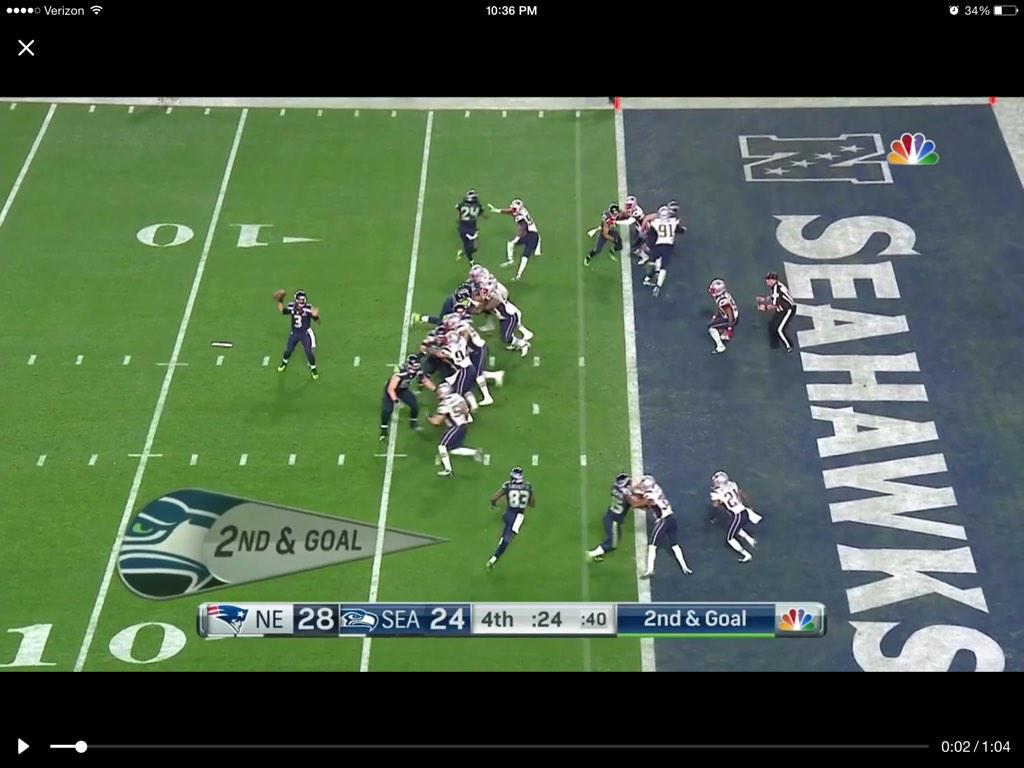
This is the most talked about play of the game, and rightfully so. From the moment the Patriots elected not to use a timeout to preserve time for their offense, I was almost completely confident that the Seahawks would win this game. I did not see the Patriots making a stop on the goalline, not against an offensive line that had been pushing them around for most of the game and a running back who specializes in fighting through contact. I certainly did not see them electing to throw the ball, and I never expected a game ending turnover.

To understand this play we need to take it step by step. The decision to pass the ball is being ridiculed by fans and writers across the nation, and there is some justification for that. Since joining the Seahawks, Lynch has converted on 48 percent of goal to go carries from the one yardline. The Seahawks were sitting on second down and needed a touchdown, and using these odds running the ball three times would leave them with only a 14 percent chance of failure. The Patriots have also been one of the worst teams in the league in short yardage situations over the past few years, and the odds were likely even better than that.

But there is an added factor that needs considered, and that is the clock. A touchdown would have only put them up by three points, and the Patriots still would have had an opportunity to move into field goal range to tie the game. Their first priority had to be scoring a touchdown, but they also couldn’t leave too much time for the Patriots. Because of this, they made the decision to run the clock down below 30 seconds before snapping the ball. With only a single timeout remaining, if they ran the ball on second and third down and failed to get in they might not have had time to run a play on fourth down.

In order to get three plays in they needed to throw the ball. You can quibble about their decision making and say that they should have thrown it on third down instead, but they had a good matchup with three receivers on the field against goalline personnel. And if you look at the play itself, it was very well set up. Lockette was clear on the slant, the defender was playing off the line, and there was no one in the passing lane. In almost every other circumstance, this becomes a touchdown.

Embedded image permalink

So what happened this time that was different? A pair of Patriots defensive backs made phenomenal plays. Malcolm Butler attacked the slant like few defenders can and made an incredible interception on a contested ball, the sort of pass that normally falls harmlessly to the ground. He was able to make this play because of the effort from Brandon Browner, who stonewalled Jermaine Kearse and prevented him from running a pick. Normally teams run this play with receivers moving on different levels, the back receiver providing enough of an impediment to open the underneath slant. But Browner’s size and strength was enough to cut off the rub route, giving Butler the lane he needed to make the play.

If you want to get mad at Seattle’s coaches, get mad at them for the play they called. Throwing the ball was an acceptable decision there, but they needed to be smarter about how they did it. The play made by the Patriots is a rare occurrence, but it is still a possibility that needs to be taken into consideration. Throws across the middle carry an inherent risk. The area is heavily congested, and footballs have a habit of bouncing in ridiculous ways (see the catch two plays earlier by Kearse). They should have run a safer route, something to the sidelines or the back of the endzone where the worst that can happen is an incompletion out of bounds. Instead they chose to run a play with a relatively high probability of disaster, and they ended up losing the Super Bowl because of it.

People will focus on this one play, and it was absolutely the biggest of the game. But the thing about close games is that there are dozens of plays throughout that could have swung the game. Lynch was stuffed on a third and short earlier in the game, forcing Seattle to kick a field goal. Kearse dropped an easy pass in the first half, and Lockette fell down while wide open on his route while the Seahawks were trying to run down the clock. And if things had gone the other way, there would be plenty of Patriots coaches and players kicking themselves for the plays they did or didn’t make. This game was as close as they come, and in the end the Patriots made more of these tight plays than the Seahawks.