Monday, March 23, 2020

2020 Wide Receiver Prospects


So a lot has been happening in the world these past few weeks, but one thing remains very true: draft season is upon us. What format the draft will take and how much the festivities will be dampened by, you know, everything, remains to be determined, but it does appear that the draft is still going to occur on schedule. Which means it’s time for me to start my annual prospect rankings.

For a couple years now we’ve been looking ahead at this receiver class as a particularly loaded one, and I expect by the time draft night rolls around we could see as many as seven wide receivers selected on the first night. I’m not as enamored with the top end talent in this class as other people seem to be, but the depth is impossible to deny. There will be some very good receivers available at the tail end of the first round, and possibly even sliding into the second.

Here are nine of the top prospects from this year’s class, listed in descending order of my ranking of them.

CeeDee Lamb, Oklahoma
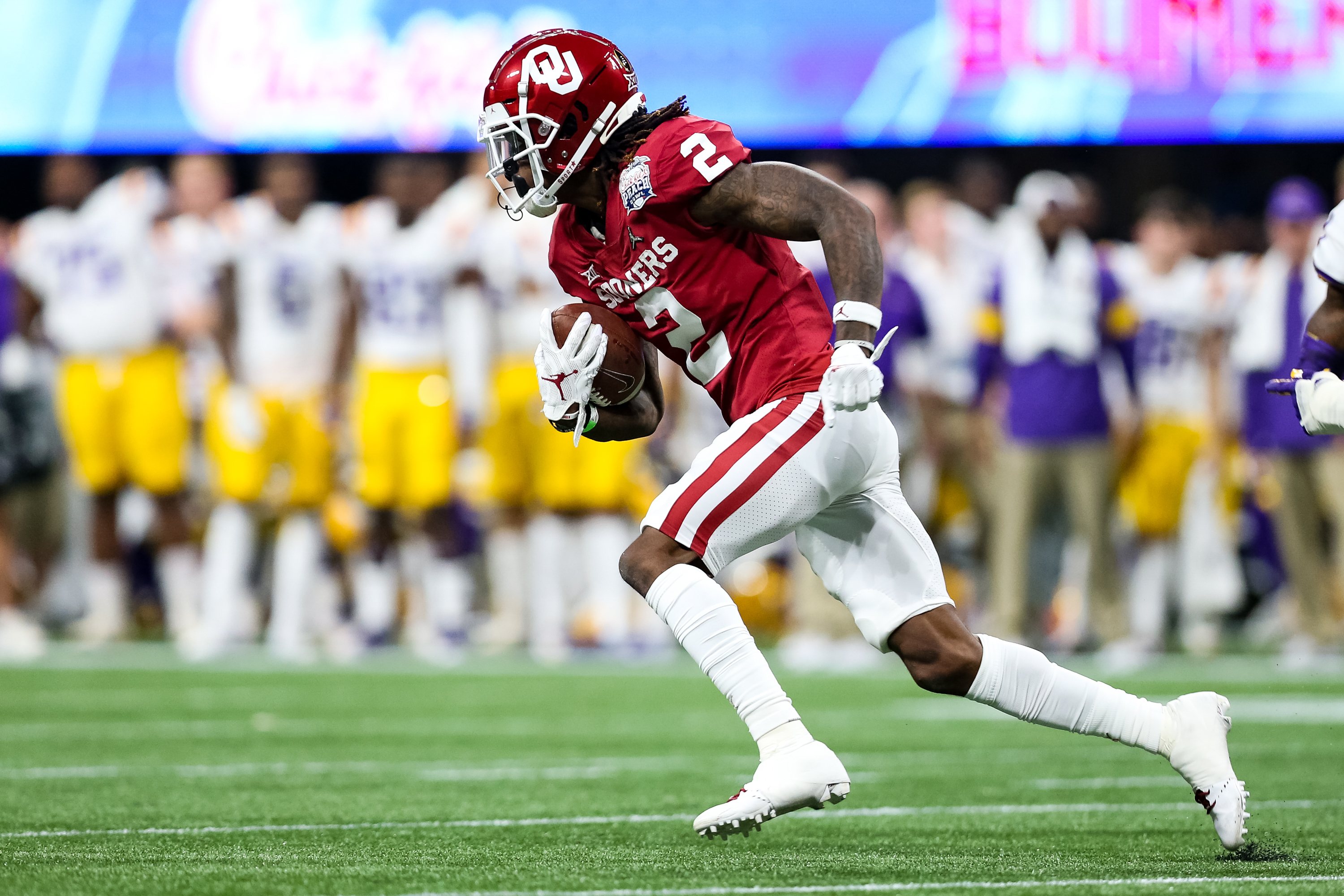
Image result for ceedee lamb
There is no one thing that Lamb does better than any other member of this class. There are faster receivers. There are receivers better at contested catches. There are better route runners. The one skill that most sets Lamb apart is his ability after the catch, but there are even better options there too. What makes Lamb the best receiver in this class is that he is above average in every single one of these areas, easily the most well rounded option available.

There are no clear weak points of Lamb’s game, but that isn’t to say that there is nothing for him to improve on either. Mostly what he needs is consistency, something I expect him to find at the next level. Consistency as a route runner, coming from a system that was based more on scheming receivers open than asking them to beat the coverage across from them. Consistency going outside his frame to make catches, from a player who could make spectacular leaping grabs but also struggle with throws slightly off target. I don’t expect him to come in and dominate in the NFL right away, but he’ll be a useful starter from day one, even if he does disappear every now and then.

Lamb is a rare prospect that is both high-floor and high-ceiling. Even if he doesn’t develop, his physical skills are enough to make him a danger that defenses constantly have to focus on. Get the ball in his hands, and he’s always a threat to take it the distance. Split him to the outside, and he can beat you either stretching the field or breaking it off with a sharp cut underneath. And if he can polish these skills, he has the potential to be among the best in the league at his position.

Denzel Mims, Baylor
Image result for denzel mims sideline catch
Mims is going to struggle to adjust to the NFL. His biggest weaknesses right now are off the line, and quality NFL cornerbacks will eat that alive. He’s tall at 6-4, and he plays high, meaning press coverage gets into his chest and stacks him up at the line. He's a mixed bag as a route runner, and he is going to have to rely on his physical gifts alone to separate until he develops a little more.

Fortunately, he happens to be the most physically gifted receiver in the draft. He’s tall as I mentioned before, and he is fast as well, blazing a 4.38 in the forty yard dash. Toss in a vertical jump, broad jump, and 3-cone drill that were all in the 84th percentile or higher, and he was one of the clear winners at the Combine. If nothing else, he will be an elite deep threat right away. His speed can take the top off defenses, he tracks the ball well in the air, and he has the height and body control to make leaping catches even if the defender can keep up with him.

And if Mims can round out his game, he has all the tools to be the best receiver in football. He’s dangerous after the catch, quick enough to make people miss and strong enough to power through tackles. If he can apply that quickness and that strength to beating press coverage, there won’t be much that cornerbacks can do to keep up with him. The upside is the best of any receiver in the class, and even with the risk it would be hard to let him fall past the middle of the first round.

Henry Ruggs, Alabama
Image result for henry ruggs
Ruggs is this year’s one-trick pony, but that trick he has is the most valuable one there is. He will be invisible for large stretches of games, but when he shows up it is as an explosion of unmatched speed. This is someone who ran a 4.27 in the forty yard dash at the Combine, and most people considered that a mild disappointment. He is by a comfortable margin the fastest player in this year’s class, and that speed is his primary tool in getting open.

Ruggs isn’t just a straight-line deep threat. His speed translates coming across the middle of the field as well in ways that break angles against both zone and man coverage. Whether it’s on a jet sweep sprinting around the contain defender, a drag route that leaves coverage helpless in his wake, or a deep post that warps the typical coverage rules of safeties, his speed is something defenses have to adjust for on every single play. Because if they let up for even a moment, he’s a threat to take any play sixty yards. He’s good at tracking deep balls in the air, and he’s decent after the catch, able to absorb light contact and accelerate past it into open space.

Every year there is at least one receiver whose game is built around its speed, and every year I find myself asking the same questions: what else can he do, and how much does it matter? Ruggs is a bit more well rounded than past players like John Ross and Marquise Brown, but there are still clear holes in his game. He doesn’t do much as a route runner, besides taking advantage of cornerbacks who are overly cautious because of the danger he poses down the field. He struggles on contested catches, and he can be overwhelmed by press coverage. But his game breaking ability is enough that, even in this deep receiver class, he is still worth a first round pick. If nothing else he’ll be good for a couple game-changing plays each year, and in the right situation he’s the sort of player who warps coverage in a way that a clever play designer can scheme to take advantage of.

Tee Higgins, Clemson
Image result for tee higgins jump ball
Higgins is another big receiver with a wide catch radius like Mims, just lacking Mims’s other physical gifts. Higgins is at his best when the ball is up in the air, when he can use his long arms and his wide frame to shield defenders and go get a contested catch. It’s a good thing too, because he often finds himself surrounded by defenders, as he doesn’t have the speed or the quickness to consistently separate down the field.

That isn’t to say he doesn’t have a place in an NFL offense, just that he probably will top out as a good number two option in a passing game. He doesn’t have the quick-twitch ability to become an elite route runner, but he has a good understanding of how to sell fakes with his head and his shoulders. He absorbs contact well coming off of press coverage, and most defenders will have to settle for simply running alongside him. And while we unfortunately didn’t get a forty time from him, his speed down the field looked sufficient enough that teams don’t have to ignore him as a deep threat.

Higgins would be a good selection late in the first round for a relatively complete team looking to round out their offensive arsenal. He has experience playing in a complex scheme at a high level, and his transition to the NFL should be relatively smooth. He can play either outside or in the slot, and he ran a broad route tree in college. He will come in having experience with advanced releases off the line, and he already knows how to take advantage of subtle little push-offs to get the separation he otherwise wouldn’t be able to gain. As an immediate contributor he is one of the better options in this year’s class, though in a couple years the team that selected him may regret having passed up better long term options.

Brandon Aiyuk, Arizona State
Image result for brandon aiyuk
Of the receivers on this list, Aiyuk is probably the best route runner at this moment. His natural quickness makes it difficult for cornerbacks to keep up with him, but his ability to gain separation is more than just sharp cuts. He’s subtle with the way he changes the angles of his releases down the field to move defenders where he want them, giving him space to work with when he finally does decide to break off his route. And when they do start sitting and trying to anticipate his path, he is a master of the double move, with explosive ability to break away over the top.

At the Combine Aiyuk measured in at six feet tall and 205 pounds, both decent numbers for a wide receiver. But he plays a lot smaller than that on the field. He gets manhandled in press coverage, and he’s mostly helpless if there is a defender near him at the point of the catch. He will go up high to get a ball above his head, showing off an impressive 40 inch vertical leap. But he doesn’t fight through contact on his routes or at the catch at all.

It’s always possible to add strength in the NFL, but for the most part I think this is who Aiyuk is. He is going to be pushed around when there are people around him, so he’s going to have to continue to stay as far from other people as possible (in this time of social distancing, he’s already an expert). His quickness does allow him to sidestep attempts at press coverage, and his route running ability means there usually isn’t anyone around him down the field.

I think this limits Aiyuk’s upside, but there’s enough here to make him a first round pick. He’ll have a role to play early on in the NFL, if only as a dangerous kickoff returner and a threat on quick screens. If he can improve his play strength, then he very easily could become a Pro Bowl caliber wide receiver. But even if he doesn’t I still think he’ll end up as a perfectly average number one receiving option.

Justin Jefferson, LSU
Image result for justin jefferson
Jefferson is a well rounded receiver who should transition to the NFL fairly easily, and in a year with lesser receiving talent it wouldn’t be a shock to see him go in the first round. It might not be a stretch this year either, though I think he’s probably a better fit on the second day of the draft. Where someone like Lamb is intriguing because he’s above average at everything, Jefferson is mostly just average at everything. A useful player to have, but maybe not worth taking when there are more exciting prospects on the board.

There are a few parts of his game where Jefferson does seem to excel. He pulls off a few truly beautiful routes each game, disguising his intention until the last possible second before breaking things off. Every release off the line looks the same, and even advanced cornerbacks won’t be able to jump his routes. He’s excellent at the catch point as well, fighting off contact and attacking the ball as it arrives to him.

The one interesting thing about Jefferson is his performance at the Combine. After looking like a serviceable but hardly extraordinary athlete, he exploded at the Combine, finishing in the top quartile in the forty yard dash and in both jumps. This looks nothing like the player I saw on the field, where he struggles to separate vertically and doesn’t offer much as a threat with the ball in his hands. Maybe this athleticism just hasn’t been realized yet, and he could still become an elite option. Even if he doesn’t, he’s a safe enough choice to make once the higher ceiling options are off the board.


Jerry Jeudy, Alabama
Image result for jerry jeudy
There are moments when I can see the player that most other people seem to think Jeudy is, the player he absolutely has the potential to become. He doesn’t have the same straight-line speed as his teammate Ruggs, but his first step burst is second to none, and a couple times each game he flashes a sideways hop that makes it seem like he simply teleported through space. It’s easy to imagine him applying this unique flare as either a route runner or with the ball in his hands, which makes it so strange that it rarely shows up in either part of the game.

Simply put, it just doesn’t seem like Jeudy has really figured out yet what he’s doing on a football field. For every time he jukes a defender into oblivion, there is also another play where he gets wrapped up on an easy tackle in space. At times he can release from press coverage with a sideways leap and then an explosion down the field, and at others he’ll just stand there and get manhandled by a defensive back.

Jeudy is not a complete player, and that’s okay. Very few players enter the draft well rounded, and I am more open than most to trying to project what a player can become rather than looking at just what he is now. If Jeudy can end up in a good situation with a wide receiver coach who can teach him the nuances of the game, he can become an elite route runner and a dangerous threat with the ball in his hands.

But even in the best case scenario, I think Jeudy’s ceiling is limited. He is just an okay athlete, and I rarely saw him do the things that truly elite receivers do consistently—win contested catches, expand his catch radius, separate at the point of the catch. And while I think he can expand the other missing pieces of his game, I don’t see anything in his athletic profile that suggests he’ll take the next level here. So I see him mainly as a developmental prospect with the best case scenario of becoming something like the 15th best receiver in the league, and I just can’t justify taking a player like that until the second round.


Jalen Reagor, TCU
Image result for jalen reagor
Reagor was one of the more interesting results to come out of the Combine. With decent size, a solid forty, an excellent performance in both the jumps, and a miserable outcome from both agility drills, his profile looks like what you’d expect to find from a field stretching vertical wide receiver. A smaller version of DK Metcalf from a year ago. Yet, strangely, that isn’t the sort of receiver I see when I watch Reagor on tape.

Reagor does have moments where his athletic profile shows up on the field. He can outrun cornerbacks down the sideline, and he makes some spectacular leaping catches, attacking the ball at its highest point. But most of the time when he gets open, it is due to his route running skills. He makes explosive breaks that he disguises right up until it’s time for him to turn, and he can make defenders look foolish on double moves. He’s effective once he gets the ball in his hands as well, able to make people miss in open space and accelerate to break a big play from a short completion.

So what does this dichotomy mean? Well, it can be one of two things. Either Reagor’s ability to separate won’t translate to the next level where everyone is quicker than him. Or his technique is already enough to make up for his lack of underneath quickness, and his vertical athletic ability just means he has even more room to expand his game. Reagor is a risky prospect, one who could emerge as an elite weapon in a couple of years, or be run out of the league entirely. It’s a gamble, but one I might be willing to make once the first round has run its course.

Laviska Shenault, Colorado
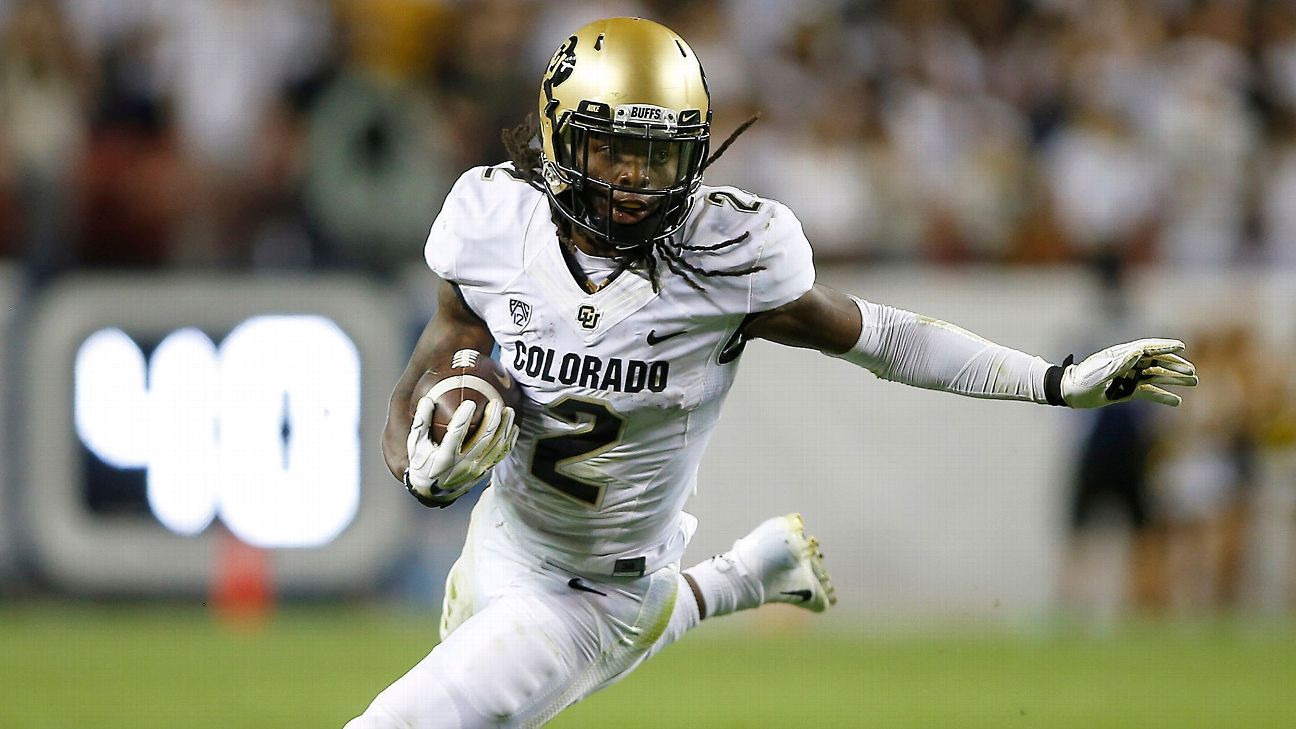
Image result for laviska shenault
Shenault is a weird wide receiver prospect to break down, because I’m not entirely sure if wide receiver is actually his best position. Once he gets the ball in his hands, he looks like a running back. He makes tacklers miss in open space. He accelerates through lanes with breakaway speed. And he has the strength to drag forward for an extra four or five yards with bodies hanging off of him.

As a wide receiver though, Shenault does basically none of the things I look for in a prospect. He doesn’t get clean releases off the line. He doesn’t run a versatile route tree. He doesn’t win contested catches, and he doesn’t go after jump balls in the air (he drew a weirdly high number of pass interference penalties in the games I watched, not due to anything he was doing that I could see though).

Shenault is going to enter the league as a major work in progress. And maybe he can develop the missing parts of his game and become a truly unique receiving threat. But I think the most likely outcome for him is to become a basically 90% version of Cordarrelle Patterson. And I mean that as a compliment, comparing him to arguably the best kickoff returner in NFL history. I’m just not sure how valuable that player is. A second round pick? Maybe, though more likely a good value somewhere in the third.

Monday, February 3, 2020

2020 Super Bowl Recap


Image result for mahomes touchdown run 49ers"
The 100th season of the NFL wrapped up last night with a Super Bowl game that, while I wouldn’t necessarily call it “good” was certainly interesting. What had the potential to be either a clash of a top notch offense against a top notch defense or possibly a shootout between two very different flavors of high powered offense turned instead into a slow grind of a game where both teams seemed frightened to make any sort of mistake. Right up until the fourth quarter, where the spark finally caught for Kansas City’s offense and they turned a double digit deficit into a double digit lead in less than ten minutes, as they are known to do.

For most of the game, however, it looked like San Francisco was the better team. They moved the ball well on offense, effective both on the ground and through the air. And, more impressive, they held the best offense in the league to 10 points through three quarters. It was the story of a dominant defense standing up on the biggest stage until, suddenly, it wasn’t.

How the 49ers (Almost) Shut Down the Chiefs
I underestimated San Francisco from the start of the season, and I almost did so again in the Super Bowl. I predicted them to finish 5-11, and even in the best case scenario I laid out for them, they were merely fringe contenders for a wild card spot. Their offense was better than I expected, but my biggest mistake was in not factoring in the impact of the additions they made to their defensive line, additions that nearly won them the Super Bowl.

San Francisco went in all-in on building their defense from the front back, and it paid off with the best defensive line in the NFL. Arik Armstead had a breakout season, and both Nick Bosa and Dee Ford were huge additions as pass rush threats in the offseason. Toss in DeForest Buckner, already a proven star, and veteran Sheldon Day on the inside, and there is no weak point on this unit.

Before the game I highlighted the interior of San Francisco’s defensive line versus the interior of Kansas City’s offensive line as the key matchup advantage for the 49ers, and this game backed that up big time. Pretty much from start to finish Patrick Mahomes was harassed with pressure in his face, as Buckner and Earl Mitchell split a sack early and Buckner added another by himself later in the game. The 49ers won nearly every time they got a one-on-one matchup on the inside, forcing Mahomes constantly off his platform and taking away easy throws across the middle.

I expected the Chiefs to lose this particular matchup. I did not expect them to get as thoroughly thrashed on the edge as they did, particularly on the left side. Eric Fisher has been a solid presence on the left end of their offensive line for years now, not the star that they expected when they drafted him first overall but an above average player. Against Bosa however, Fisher was toast. Bosa finished with only one sack on the night, a strip of the ball out of the quarterback’s hands as he was pushed by, but he was in the backfield on pretty much every opportunity, regularly wrecking Kansas City’s passing game. He generated pressure to get Mahomes off his spot, kept contain to prevent him from breaking from the pocket to the left, and made chase when he scrambled to the right.

Kansas City’s offense is predicated on their receivers challenging the defense down the field. With their speed and Mahomes’s arm strength defenses have no choice but to play soft coverage underneath, which naturally opens throwing lanes in these spaces. The relentless pressure San Francisco was getting from all directions just completely ruined that. Without the time for the receivers to get downfield, the secondary didn’t have to worry about being beaten over the top. And with the athletic linebacker duo of Fred Warner and Kwon Alexander, the 49ers were also able to erase most of the easy throws that Mahomes naturally went to as the pressure closed in. They tracked running backs going to the flat, blew up screen plays before they could develop, and on one notable occasion dropped right into the passing lane, forcing an uncharacteristic interception by Mahomes.

What makes Mahomes so incredible as a quarterback is that there are genuinely no weak points to his game. Typically a quarterback has to make some tradeoffs between the three main aspects of quarterback play, a “three-legged stool” as I’ve heard it described. Typically if a quarterback produces high yards per attempt and few interceptions, he makes up for it by taking a lot of sacks, like Deshaun Watson. Or if he avoids both sacks and interceptions he does so by throwing very short, very low risk passes, like Derek Carr. Or if he plays aggressive down the field and also avoids sacks he turns the ball over at a high rate, like Ben Roethlisberger.

Through his first two years Mahomes has been the exception to this rule. He makes aggressive plays down the field, but he rarely turns the ball over. He doesn’t throw interceptions, but he is also never sacked. In his last twenty games coming into the Super Bowl he was under six yards per attempt only once, sacked more than twice only once, and never threw multiple interceptions.

The good news is, we finally found a formula to throw Mahomes off his game. You just need to get pressure in his face, and pressure off his edge. You need to get it constantly, and hope that he makes more off target throws than he has at any other point in his career. Oh, and you also need to maintain this constantly from start to finish, because as we saw last night, even a single breath of life left in him is still too much.

What Changed?
I wish there was one easy answer to this. I wish I could point to something the Chiefs did different, some schematic brilliance cooked up by Andy Reid to kick his offense to life and finally win him the long elusive Super Bowl championship. But the truth is, Kansas City really didn’t do that much different in the fourth quarter from the first three, or at least not that much different from what they’ve been doing all season.

That’s something I feel like I need to address, because as much credit as you have to give San Francisco for their devastating pass rush, I also feel like the Kansas City offense we saw for most of this game was a strange shadow of the unit we’ve been used to seeing all year. After eighteen games of an aggressive, pass-heavy approach, the Chiefs went strangely conservative in this game, and it nearly cost them a championship.

During the regular season Kansas City faced 2nd down and 8 or more yards 127 times in the first three quarters (so excluding late game situations where the score dictates the play calling). On those plays they passed the ball 73% of the time, the third highest rate in the league. Most teams are so afraid of third and long situations that they try to pick up a small chunk when facing second and long, even though pretty much every analytic study has shown that this is a mistake. Kansas City is one of the few teams truly willing to risk a third and long situation, because they are confident that with two pass attempts to get there they will pick it up.

Until the Super Bowl, that is. Because in the first three quarters Kansas City faced this situation six times, and they only threw it twice. They were content to either hand it off to Damien Williams or, on one occasion, call for an end around that lost six yards. For whatever reason—perhaps because of the pressure on Mahomes, or perhaps because they saw something they liked in these matchups—they chose to keep the ball on the ground and out of their best player’s hands.

Until they had no choice, of course. The game swung on the 44 yard bomb to Tyreek Hill on third and 15 with just over seven minutes left in the fourth quarter. This was Kansas City’s first real deep pass of the game, and it came on a situation that is an exercise in futility for most teams. And, most interestingly, it came after they threw an incomplete pass on second and 15, a situation where many teams would have handed the ball off to try to make life easier on third down.

I’ve defended Reid a lot over the years, but if this game had gone San Francisco’s way, there would have been a lot of reasonable questions about him. But it didn’t, because of this deep pass, and one other later that set up the touchdown that gave them the lead. That was the biggest difference in the fourth quarter of this game. After failing to get the ball down the field to that point, the Chiefs hit two big shots that got them into the red zone where their clever play designs earned them touchdowns.

Of course, this is the constant problem with facing the Chiefs. Even when you play them perfectly, even when you think you have them contained, they are just one or two plays away from breaking it open. San Francisco played an excellent defensive game, and they still gave up 31 points. They had to understand coming in that this was the best case scenario for them. Which makes Kyle Shanahan’s conservative play calling earlier in the game so puzzling.

I do have to empathize with Shanahan’s situation. Three years ago he endured criticism for the Falcons blowing a 28-3 Super Bowl lead against the Patriots, with people complaining that he passed too much late in the game rather than running the clock out. And now he is bearing the brunt of the blame for losing another Super Bowl lead, this time for the opposite reason. Of course, the simple answer is that he did nothing wrong in 2017, and he completely screwed up this year. But I understand why it would feel to him like he's in a no-win situation.

The decision that is getting most of the attention is when he chose to run the clock at the end of the second quarter, to settle for going into halftime with the score tied rather than trying to grab points with their last possession. And while that was certainly a poor decision, I also want to call attention to what happened on the drive that followed. To open the second half San Francisco received the ball, and they drove down into field goal range, only to wind up facing a fourth down with two yards to go on the Kansas City 24. They settled for a field goal, a decision almost any NFL coach would make.

That doesn’t make it the right decision, of course. Contrast this with Kansas City’s first two scoring drives, both of which saw them convert a fourth down and one. The criticism of Reid over the years has always been about his game management, rather than the less immediately noticeable aspects of coaching. So it seems fitting that, even though he was far from perfect in that area during this game, ultimately one of the biggest differences between these two teams was that Kansas City’s coach was willing to make the bold calls, while San Francisco’s shied away from trying to build a lead they could actually hold onto.

The MVP Puzzle
Some years the MVP award is easy. This year was not one of them. It ended up going to Mahomes, despite what was undoubtedly one of the worst performances of his career. He threw two ugly interceptions and fumbled the ball twice—they recovered both, but one of these fumbles cost them a fourth down and the other was a major sack that killed a drive. This was the sort of game where it would have been easy to justify not giving it to the quarterback, if there was anyone better to give it to.

I’m not a believer that the MVP has to go to a player from the winning team. On one occasion in the early years of the NFL it was actually won by a member of the losing team, but I don’t think we’ll ever see that again. Still, if we’re discussion who should have won it, I’m not going to eliminate half of the players. But I think it should take an extra level of dominance for someone on the losing side to claim it.

The best player on the field last night was probably Bosa. He was all over the place from start to finish, and his dominance over Fisher was, as I discussed above, the biggest reason for their effectiveness stifling the Chiefs for the first three quarters. At the same time though, he ultimately recorded only a single sack, the forced fumble that Mahomes immediately fell on. On more than a few occasions he was just a step away, several of which resulted in an incompletion. But one of these plays was also the big pass to Hill that swung the game, where if he had been just a step quicker he could have ended the play in the backfield.

The only player on San Francisco’s offense who really had a case was Deebo Samuel, but he fell silent in the second half and finished just short of 100 yards from scrimmage. On the defensive side you could make a case for either Buckner or Warner, but ultimately I don’t think any player for San Francisco separated themselves enough to claim the prize in a losing effort.

So if it has to go to a Chief, who else are we going to give it to but Mahomes? Damien Williams had a good game with over 100 yards on the ground and a touchdown both receiving and rushing. But one of those touchdowns and a big chunk of those yards came after the game was more or less decided, when actually crossing the goalline did more harm than good for Kansas City’s chances of winning the game.

Watkins and Hill both provided big chunk plays, but neither reached the endzone. And while Kelce caught a touchdown, that was about all he managed most of the night. Defensively their best player was Chris Jones, who was disruptive in the backfield and swatted three balls out of the air. But he didn’t register a sack, and actually had only a single tackle. A good performance, but and I wouldn't have argued if it had gone to him. But no one for Kansas City really did anything memorable.

One other name I want to bring up is Kendall Fuller. In my preview of the game I picked a lesser known player from each of these units that would have a major impact on these games. The two for San Francisco were key contributors, with a touchdown by Kyle Juszczyk and the interception by Warner. For Kansas City Mecole Hardman did absolutely nothing, but it was their defensive player, Daniel Sorensen, who had the biggest impact on the game, and not in a positive way.

Sorensen is a special teams player forced into a starting role by the injury to promising rookie Juan Thornhill. And through the first two playoff games he performed admirably, a trend that unfortunately did not continue. He was brutal in the first half of this game, giving up the touchdown to Juszczyk in coverage and nearly giving up more points at the end of the first half with the long completion to George Kittle that was erased only due to a debatably borderline and unquestionably unnecessary offensive pass interference foul. Much of San Francisco’s offensive success came over the middle of the field, exploiting Kansas City’s unathletic linebackers and safeties to hit the gaps opened up by their play action game.

With Thornhill out and Sorensen struggling, the Chiefs had very few options at safety. But they did have Fuller, a nickel cornerback whose role was minimized by San Francisco’s tendency to load up with tight ends and fullbacks. So they threw him out there into the deep middle of the field, and he made a couple crucial plays late in the game.

In a four point game with just under two minutes left, he made a sharp break downhill to knock down a slant route on second and ten, targeting the same area they had been so effective in earlier in the game. Two plays later they turned the ball over on downs, effectively ending the game. And then, for good measure, he ended San Francisco’s last desperate gasp by intercepting a deep pass over the middle of the field.

Fuller wasn’t the best player on the field. But if you want to talk about value, it’s hard to beat a player shifting to an unfamiliar position in a crucial moment to shore up a weakness.

Ultimately though, I think they chose the right MVP, even if it wasn’t a clear cut case.

Patrick Mahomes
What is there to say about his performance that I haven’t already said? He was bad for a big chunk of this game. Both interceptions were awful throws by him, one of which cost the Chiefs points in the red zone. He nearly cost them points on another occasion by being reckless with the football, fumbling out of bounds and turning a first and goal into a fourth and one. Even right before the monumental third and fifteen deep ball, he missed an easy throw to a wide open Hill that would have made the ensuing conversion unnecessary.

But in the end, he did what his team needed him to do to win. I usually hate when people say that, since it’s usually an excuse for poor play. And while that’s probably true in this case as well, it’s also the best way to describe Mahomes’s performance. It wasn’t pretty, but it was enough.

The deep completion to Hill is a perfect encapsulation of his entire performance. Hill was wide open by twenty yards, but he had to stop and wait for a ball that was underthrown. Had Mahomes led him up the field, he had the chance to break away from the defense and turn it into a touchdown. But that may have been too much a task for even Mahomes’s impossible arm, as he was backpedaling in the face of pressure. He held the ball until the last second to trap the safety into turning the wrong way, and then he delivered a wobbly ball that was still enough to convert the third down and bring them into scoring range.

Even when he was struggling to move the ball through the air, Mahomes was effective as a runner. By the stat sheet he finished with only 29 yards rushing, but before taking several deep knees to run out the clock he was sitting at six carries for 44 yards (and yes, this lost a lot of people some money). Not Lamar Jackson numbers by any means, but effective. He picked up a few key first downs, and he scored a touchdown on their opening drive.

The first three quarters of the game were ugly. And the comeback wasn’t some sequence of brilliant passes. This game was a struggle for Mahomes, with more pressure than he had ever seen and higher stakes than he had ever faced. And on a few occasions, he wilted in the face of this. But on a few others he did not, and the Chiefs won the Super Bowl because of this.