There’s
one clear, easy choice among this year’s edge rushing class. After that, it
gets messy. There are a lot of different styles here, a lot of different types
of athlete, and a lot of upside mixed with a lot of downside. Some of these
players will probably develop into stars, while others will probably accomplish
next to nothing. Trying to pick out the former from the latter is basically one
giant game of minesweeper, and for once I’m glad I’m not the one responsible
for making these calls.
Chase Young, Ohio State
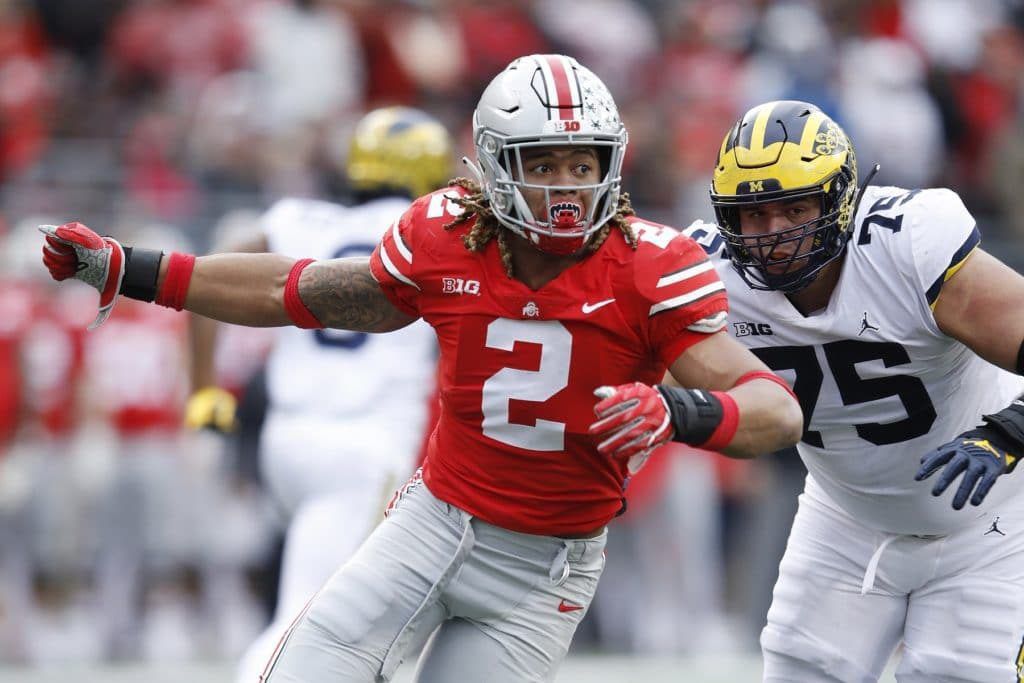
This
is the easy one. Young isn’t just the best edge rusher in the class, he’s the
best overall player in the class, and by a healthy margin too. Positional value
might make it worth drafting one or two of the quarterbacks ahead of him, but
if any other player from any other position goes before Young, that team is
making a major mistake. He is everything you want from an edge rusher. He’s
explosive off the ball. He has elite bend around the edge. He has an array of
counter moves to mix up his attack during the game. He is even comfortable
dropping into coverage, if for some reason you want him to do that.
If
you really quibble you can find a couple things to complain about. His strength
is merely above average rather than being spectacular like every other trait he
has. At times he can come in a bit too wide and leave a lane for a mobile
quarterback to step up beneath him. If he can cut down that corner even more,
he’ll go from being a consistent double digit sack producer to someone who could
challenge the single season sack record.
For
most offensive linemen there’s nothing you can do against Young. If he doesn’t
beat you clean with his first step, you have to try to strike him with your
hands to slow him down. But he has a dozen different ways to counter that. He
can swat your arms away and bend around the corner. He can absorb your blow as
if it was nothing. He can contort his upper body in ways that don’t seem
possible so your blow misses while his feet still stay on their normal route.
He can, and will, beat you every way possible. And he’s going to be dominating
NFL offensive linemen for a long time.
Yetur Gross-Matos, Penn State

If
Gross-Matos can ever develop a pure speed rush on the outside, he has the
ability to become an elite NFL pass rusher. There is some evidence that he
could add this to his game. He tested very well at the Combine, and there are
flashes of explosiveness on the field. Every now and then he erupts from his
stance and races past the tackle, often enough that it isn’t a fluke, but not
enough for me to call it a major part of his game. Maybe it’s something with
his stance, or something about how he’s viewing and reacting to the snap. Maybe
it’s something that could be cleaned up at the next level. But as it is now, this
will limit his ability to produce at the level of an elite pass rusher.
Even
if he doesn’t develop this part of his game, he still has everything he needs
to become a very good NFL player. At 6-6 and 266 pounds he has more than enough
size for his position, and he complements this with a shifty quickness that
makes him lethal in the running game. He does a very good job keeping himself
clean with his hands, and he is phenomenal with an inside move, darting beneath
a blocker and sliding through a gap. This skill shows up as a pass rusher as
well, though it will be harder to translate to the NFL where tackles will know
to sit on it, not fearing his ability around the corner.
Gross-Matos
is a solid pick with a fairly high floor. He’ll be a very useful starter for
what he can do in the running game, and he can produce enough in one-on-one
battles to be an effective second pass rusher. That alone would get him into
the end of the first round, and how high he goes above that depends on your
willingness to believe he can expand his game. Even if he develops his first
step burst I still have questions about his bend, and I think the most likely
scenario is that he tops out around 8-10 sacks a year. Which is a good player,
but maybe not what you’re looking for from a pass rusher in the middle of the
first round.
Zack Baun, Wisconsin
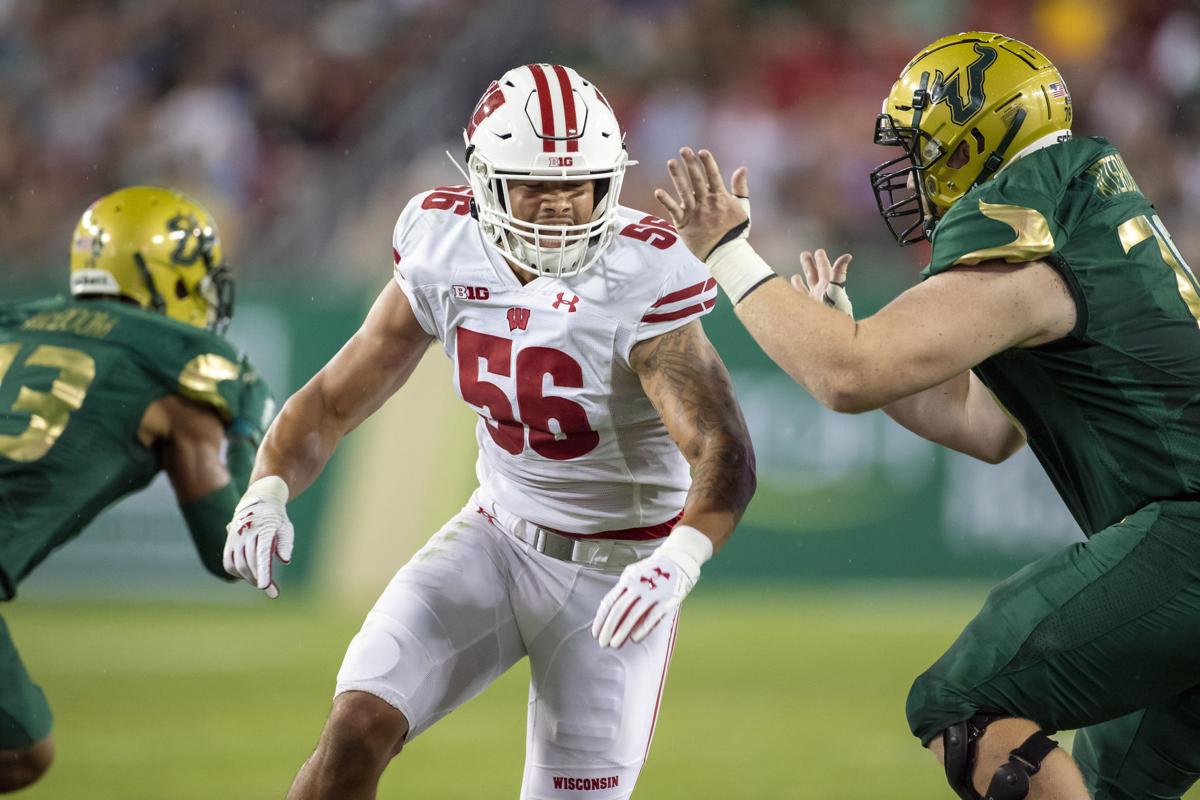
Baun
is on the smaller size for an edge rusher, at only 6-2 and 238 pounds. This
limits him somewhat schematically, but it also means the role he ends up in
will be more versatile than just chasing after the quarterback. He’s best
suited for a 3-4 scheme that uses him more in space than in tight areas around
the line of scrimmage. He’s skilled in coverage and at chasing plays down in
open space, but I wouldn’t want him fighting too much in the trenches.
As
a pass rusher Baun starts with good burst off the ball. He gets upfield
quickly, and if he can get the edge on the tackle he has the ability to bend
back to the inside and convert quick hitting sacks. He needs to get better at
establishing this edge, particularly in terms of using his hands to keep
himself clean. When a lineman with a good punch strikes him, Baun gets knocked
too wide to really do anything from that point on.
Still,
he’s not a one dimensional pass rusher. He has good quickness that he uses to
attack the inside after setting the tackle up to the outside, including a
spin move that can get him untouched into the backfield. It would be nice to
see him play with a little more power in his game. Obviously he’s usually going
to be facing players that outweigh him by 80 pounds, but there are ways to use
strength to his advantage even when undersized. This really isn’t part of his
game though, and likely never will be.
Josh Uche, Michigan

If
Baun is off the board but you want a similar style player, Uche is a very good
fallback plan. You could even make the case that he should go ahead of
Baun, based on his long term upside as a superior athlete. He isn’t as well
rounded as a pass rusher yet, and he doesn’t have Baun’s skills in coverage.
But his closing speed is breathtaking, and the plays he makes when out in space
show hints of the potential he has if he can continue to develop his skills as
a pass rusher.
Most
great edge rushers are on the taller side, using their length to engineer
separation. But there are a handful of shorter players who can succeed despite
this—think James Harrison, Elvis Dumervil, and Dwight Freeney. They do so by
using leverage to their advantage, getting underneath the taller and heavier
offensive linemen and driving them backwards. Uche has the skills to do this as
well. He isn’t the most explosive player up the field, but he strikes into the
blocker’s chest with precision and power, knocking him back a couple steps and
turning the advantage to the defense. From there he has the strength and the
flexibility to bend through contact and cut the corner short to get to the
quarterback.
It
will take a couple years of development for Uche to produce consistently as a
pass rusher. He has the agility to add a lethal inside move, but he doesn’t
really understand when or how to deploy it. I think he’ll get there, but until
that point he’s mostly going to have to contribute in other ways. That’s where
his versatility comes in, making him a functional cog of the defense he’s
dropped into. Stuffing runs towards him, working in coverage, and chasing down
plays from one side of the field to the other. He may not explode with big sack
numbers onto the NFL scene, and it’s possible those skills never develop. But
he will always have a role to play in an NFL defense.
K’Lavon Chaisson, LSU

Chaisson
is a long, rangy athlete who is at his best playing in space. His length
combined with his phenomenal lateral quickness make it almost impossible to get
around him, or to block him when he has room to maneuver. He has an outstanding
sideways hop that few linemen can keep up with, and he’s a particularly
dangerous rusher on stunts when he has time to loop around and build up his
speed.
There
are so many elite traits here that it’s hard not to look at him and see what he
could become, even if he is nowhere close to actually being that player yet. He
has decent size at 254 pounds, but he still gets pushed around like someone 20
pounds lighter. He shows very good flexibility that you would expect to
translate to bend around the corner, but it rarely does. He has a swat move
that shows he understands how to keep himself clean from blockers, even if he
never seems to really pull it off.
I
see two paths forward for Chaisson. The first is to continue building him as
the player he already is. Bounce him around the formation, keep him off the
ball, let him mix up where and how he attacks. Use him on stunts and inside
blitzes, and let him drop into coverage some, an area he has pretty good skills
in. Let him play in space, and let him do a dozen little things across the
game.
The
problem with this approach is that it puts a lot more emphasis on scheme.
Everything needs to be built around Chaisson, and he can’t just be dropped into
any normal play and counted on to serve a straightforward role. The alternative
would be to try to develop him as more of a traditional defensive end, which I
think does have some potential. His burst as an edge rusher isn’t great, but it
looked significantly better when he was coming out of a three point stance. If
he can add some weight and get more reps coming solely around the edge, he has
all the tools to be a threat in a pure pass rush sense.
I
don’t know which path is best for him to follow. I’ll leave that up to
whichever coaching staff drafts him, and I’ll be interested to see where it
goes. While he’s undoubtedly more talented than someone like Gross-Matos,
there’s just so much uncertainty around his style and his development that I
have to knock him farther down the board. An athlete like this should probably
still go in the first round, but I’d be very afraid if I was the GM who
selected him.
AJ Epenesa, Iowa
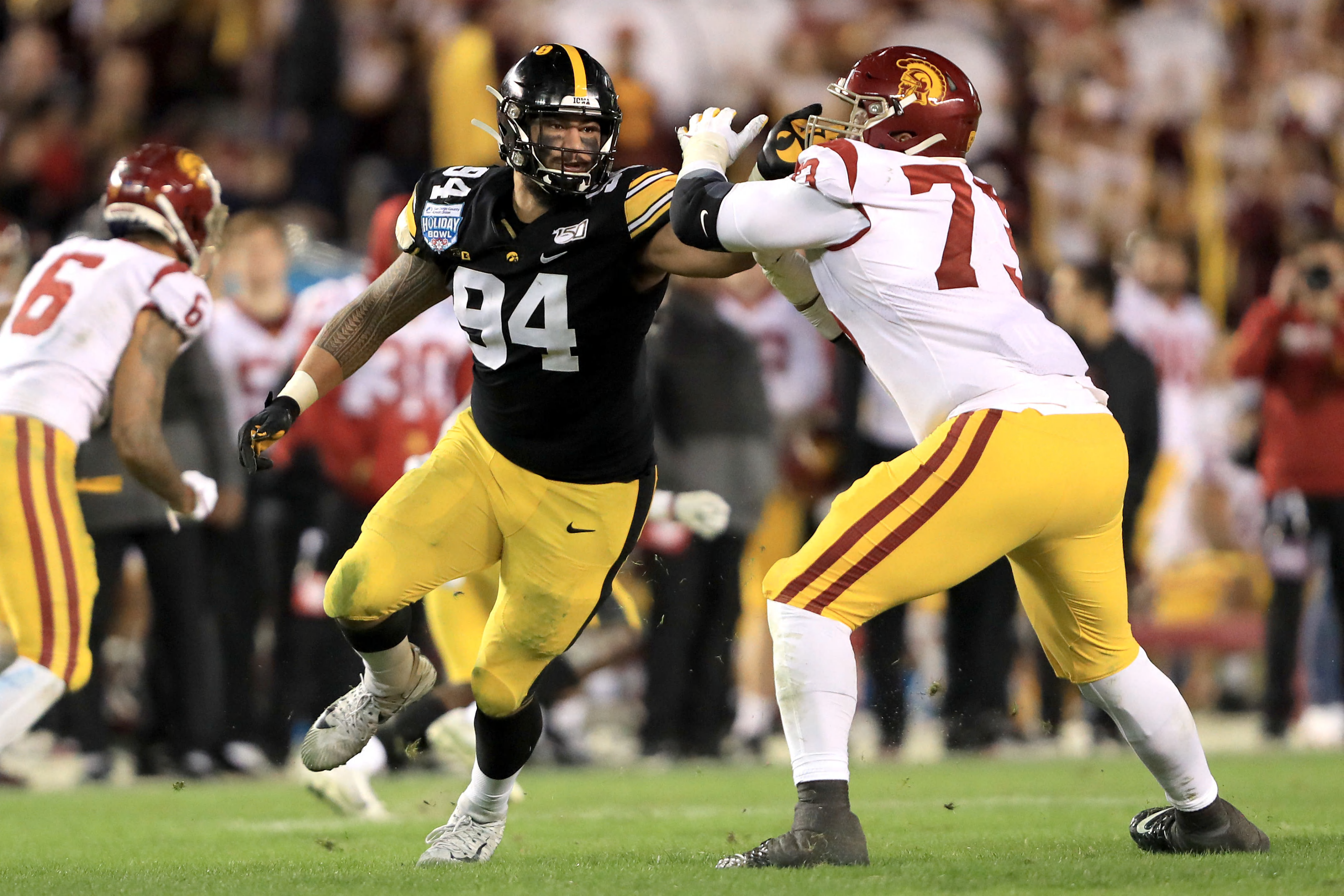
Epenesa’s
game begins and ends with power. He is easily the strongest edge rusher in this
class, and he uses that strength to plow lanes into the backfield. His initial
contact is enough to blast a tackle back on his heels, and from there he is
able to overwhelm him with a bull rush that collapses the pocket into the
quarterback’s lap. This sets up his most effective counter move, a downward
swat that clears the tackle’s hands. The tackle is so worried about the power
that Epenesa can bring that he isn’t worried at all about him trying to go
around the edge, which opens up possibilities for an otherwise uninspiring
speed rush.
Epenesa
is slow off the ball, and his second step acceleration is below average as
well. He lacks flexibility, and despite his strength he really isn’t able bend
himself and play through contact to get to the quarterback. When he tries to go
around the edge, he has to run a long way to get to his target, and even then
the quarterback usually has space to step up and dodge the oncoming Epenesa. He
produced good numbers in college with 22 sacks over his final two seasons, but
I think he’s going to have trouble translating that to the NFL. Even with his
bull rush he struggles to convert leverage into sacks, as he doesn’t get the
opposing blocker turned to open up an avenue to the quarterback.
At
defensive end Epenesa is a useful player with clear limitations. He’ll be a
strong presence in the run game with occasional effectiveness against certain
tackles, but he’ll never be a Pro Bowl caliber player. The one thing that makes
him interesting, and the reason I might be tempted to grab him in the early
picks of the second round, is the potential he has if he moved full time to an
inside rusher. He had limited snaps on the inside in college, and I didn’t see
anything from him that suggested he would dominate here. But he has the
strength to hold up on the interior, and his limitations would be better hidden
working in tight spaces. He would have to add 10-20 pounds to his frame and
would need to go to a situation with a coach willing to take some chances, but
I think it’s an experiment that could be worth trying.
Curtis Weaver, Boise State

Weaver
is a weird mess of contradictions on the football field. He’s short but thick,
with the sort of frame you’d expect from someone who wins by getting beneath
an opposing lineman and driving him backwards. But power is actually the
weakest part of Weaver’s game. He gets pushed around by pretty much any blocker
who can get his hands on him. This is a particular issue in the running game,
where he consistently either gets moved out of the hole or runs out of it
trying to dodge blocks. He’s a liability defending the run, and I doubt that
will ever change.
As
a pass rusher what he does best seems to change on every play. Sometimes he
wins by using unexpected lateral hops that get him around the blocker and give
him a lane to shoot into the backfield. Other times he can come around the
edge, not winning with his initial surge but bringing a secondary burst that
gets him to the corner. Once he gets there he can occasionally
bend back to the inside to finish at the quarterback, but just as often he gets pushed meekly
around as if he has no flexibility at all.
Sometimes
with inconsistency you can point to a player and say that this is just a sign
of what he can do, and he’s a little development away from being an elite
player. But there is so much weird inconsistency to Weaver’s game, and I have a
hard time imagining him sorting it all out. He’s a unique athlete, but I’m not
sure if he’s a good athlete, and it’s hard to project what to expect from such
a strange player. He was effective enough in college that I would take a shot
on him in the second round, but the possibility of him totally washing out when
faced with better talent is hard to look past.
Terrell Lewis, Alabama

I
never know how to handle injuries when writing these scouting reports. Usually
I just ignore them, because I don’t have access to the full medical
examinations that NFL teams do (also because I don’t feel like digging into the
full injury histories of 60 players). But with a player like Lewis, injuries
are such a part of the story that they really can’t be brushed aside. He missed
all but two games in 2017, then all of 2018 with a separate injury, before
returning to play 10 of a possible 12 games in 2019 (the two he sat out were
against Southern Miss and Western Carolina, so this may have been
precautionary). These injuries are a major part of why Lewis is not among the
top edge prospects on most draft boards, and part of why he is at the bottom of
my ranking.
Purely
on paper Lewis is a special talent. 6-5 and 262 pounds, he scored in the top
fifteen percent of all edge rushers in the vertical and broad jumps. His
explosiveness comes through on the field as well. His first step off the ball
is as good as anyone in the class (non-Young division of course), and when he’s
free in the open field he has the speed to chase down running backs and make
plays for big losses in the backfield. He moves well enough to play in pass
coverage, and he has all the tools you would want to see from a pure edge
rusher.
Part
of me wonders how much of his development was stifled by his injuries, and how
much that suggests he still has room to grow if he can stay healthy at the next
level. He isn’t all there as a pass rusher yet, but he certainly has a higher
ceiling than several of the players I listed above him. His fast first step
gets him in great position against opposing tackles, but things get a little
trickier from there. He has a nice long-arm that can get him separation from
the blocker, but not much else in terms of hand usage. He doesn’t have much in
the way of secondary burst, and he doesn’t bend well around the edge. His best
option at this point is usually a jump to the inside, which is admittedly a
very good move from him.
There
are multiple ways that selecting Lewis can turn into a disaster, which is why I
would steer clear until the second round. He could continue to struggle with
injuries throughout his NFL career. He could never develop into more than an
impressive but unpolished athlete. Or he could stay healthy and put it all
together and become one of the best pass rushers in the league. I probably
should have him ranked a couple spots higher on this list based on that upside
alone, but I don’t know how to properly handicap the risks here.

/cdn.vox-cdn.com/uploads/chorus_image/image/66495689/1175479228.jpg.0.jpg)