One
more week of NFL action is behind us, four more teams were sent home for the
season, and I think my lifespan was shortened by a good 2-3 years. All four
games were incredibly close contests, with two not being decided until overtime
and with the losing team having a shot to either take the lead or tie in the
final two minutes in the others. It was probably the most exciting weekend of
playoff football that I can remember.
But
do you know what it wasn’t? High scoring. Eight teams total, and none of them
managed to eclipse 20 points scored in regulation. During the regular season
this year the average game saw 45.6 points scored. The only game to reach that
mark was the Vikings-Saints contest that hit 46 only after Minnesota scored the
winning touchdown in overtime. The four games together averaged 37 points
scored. For reference, the NFL hasn’t seen a season with games that averaged so
few points since 1978, the first year after defensive backs were no longer
allowed to make contact more than five yards downfield.
It's
easy to write this off as an expected result of the postseason, when teams lock
down and scoring gets more difficult. After all, in New England, Buffalo, and
Minnesota we saw three of the league’s top five scoring defenses in action this
weekend. But the offenses are typically better in the postseason as well, as we
saw five of the league’s top ten scoring offenses on the field. We couldn’t
have expected these performances coming into the weekend, and how they happened
says a lot about both why the losing teams fell short and what we can expect
from the winning teams going forward.
Dead Men Walking
First,
the Eagles. Because they are in kind of a category of their own, as no one
could have expected them to score easily with the circumstances they were facing this weekend. They entered the
game missing their top three wide receivers, one of their top running backs,
and two All-Pro caliber offensive linemen. Their starting tight end was playing
two weeks after suffering a lacerated kidney. The only thing their offense had going
for it was the presence of Carson Wentz, and he made it less than a quarter
before suffering a concussion that forced them to turn to Josh McCown.
The
fact that they managed to move the ball at all is remarkable, and it says a
little bit about the Seahawks defense they were facing. They bogged down in the
red zone, settling for three field goals and turning the ball over on downs
twice in Seahawks territory late in the game. But they did a good job moving
the ball, avoided turnovers, and had a shot to tie things up late in the game.
McCown
wasn’t spectacular, but he performed admirably for a 40 year old quarterback
thrust into an unenviable situation in a postseason game. I really have nothing
more to say about the Eagles, except that you should check out these highlights
of McCown playing basketball, and remember that he is one of the best pure
athletes to play in the NFL over the past two decades.
Eating the Clock
It’s
an antiquated philosophy to believe that controlling the game on the ground and
grinding out the clock is a path to success in the NFL. Running the ball is
generally less effective than passing it in pretty much every situation, and
offenses are able to strike quickly enough that “keeping the ball out of their
hands” really doesn’t do much unless it’s at the very end of the game. And yet,
a couple teams this weekend managed to pull off a version of this, to some
degree of success.
Minnesota
and Tennessee were among the most productive teams on the ground this season,
and they lived up to those expectations in the first week of the playoffs.
Going on the road against teams that were heavy favorites, they managed to do
what every underdog dreams of: pound the ball on the ground, get out to a lead,
and shorten the game.
These
two teams pursued this strategy for different reasons. For Minnesota the prime
focus was to keep the Saints offense off the field. Drew Brees remains an elite
passer, and Minnesota’s secondary was shaky even before being banged up.
Minnesota had more success on defense than I expected for reasons we’ll get
into below, but when push came to shove late in the game the Saints were able
to pass the ball down the field.
This
wasn’t the case on the AFC side of things. The Patriots offense is not
intimidating anyone at this point, and the main goal for Tennessee was figuring
out how to attack the terrifying New England defense. Trying to throw the ball
against Stephon Gilmore and company is a nightmare proposition, and that proved
to be the case again this weekend, as Ryan Tannehill managed only 72 yards through the air. But
they didn’t need him to throw, because once they got Derrick Henry going, they
were content just giving the ball to him and letting him churn downfield.
Henry
isn’t the shiftiest back in the backfield, but give him space to work up his
speed and he is terrifying to tackle on the second level. Tennessee dominated
New England up front, and Henry had all the space he could want on his 34
carries that took him for 182 yards. Let’s say that again: the Titans gave the
ball to Henry on the ground 34 times, a number that no running back has reached in the
past two seasons. They only ran 57 plays total, six of which were punts, and
with a completion to Henry thrown in, that means he touched the ball on 69% of
Tennessee’s offensive plays.
When
you keep the ball on the ground, time is going to trickle off the clock faster.
There will be fewer plays run, and fewer points scored. And when a team is
facing an opponent that is likely better than them, the more plays run mean
more chances for this difference to assert itself. So a low scoring game in
these situations will favor the underdog, and it is unsurprising that both six
seeds managed to win following this strategy.
Conservative Decision Making
One
of the biggest reasons that no one put up big numbers was because the teams
that got leads in these games were uninterested in stepping on their opponents’
throats. Time and time again this past weekend we saw teams play as safe as
possible, in what seemed like a competition of escalating cowardice that
culminated with Minnesota nearly blowing the game against the Saints.
With
some of the people involved this past weekend, this wasn’t a particular shock.
Pete Carroll and Mike Zimmer are consistently among the most overly cautious
coaches in the league, the biggest flaws on what are otherwise sparkling
resumés.
Mike
Vrabel is still young enough in his coaching career that it’s hard to say
anything real specific about him, though he vaulted himself high up this list
on Saturday with his reluctance to challenge New England on fourth downs. It
reached a peak late in the fourth quarter when he chose to punt on fourth and
five from the New England 41, a decision only slightly mitigated by the
hilarious sequence of deliberate penalties that followed that allowed him to
bleed nearly two minutes off the clock.
There
is no such saving grace for Minnesota. Twice they got the ball with the lead in
the fourth quarter, and twice they ran six plays before punting the ball away.
The first of these drives was the most egregious, as after picking up one first
down they elected to run the ball twice for minimal gains before throwing an
incomplete pass on third and eight.
The
final drive is the one that got more heat, but I think it’s a bit more
complicated than that. They moved the ball through the air to pick up the
initial first down, and then they tried to run the ball on first and ten, not a
terrible decision. But that play was a disaster, ending with them losing seven
yards.
At
that point, I don’t hate the decision to hand the ball off. Second and 17 is a
huge task, and even throwing the ball twice their odds of converting were slim.
It would have been nice if they could have broken the first play, set up a more
reasonable third down. But instead they lost two more yards, and on third down
Kirk Cousins ate the ball for a sack rather than throw a low percentage ball
down the field.
Strangely,
the entire weekend was redeemed at the very end by the coach who is usually
among the worst offenders. Not that Carroll was impressive throughout the whole
game. Russell Wilson was tearing the Eagles defense apart the entire day,
averaging more than ten yards each time he threw the ball. He even ran the ball
for 45 yards on nine carries, most of them scrambles on called pass plays. Yet
the Seahawks continued to try to grind the ball on the ground, even as their
two running backs combined for 19 yards on 17 carries.
And
yet at the very end, when it seemed inevitable that they would choose to punt
the ball away to give Philadelphia another chance to tie the game, they went
the opposite direction. They dialed up a deep ball to DK Metcalf, their best
performing skill player the entire game. And in man to man coverage he burst
down the field and then exploded for a leaping catch, sealing the victory and
letting the Seahawks run out the clock.
Poor Quarterback Play
I
don’t want to linger on this too much, but the truth was we saw some extremely
mediocre quarterbacking this weekend. Wilson was great, and both Watson
and Cousins redeemed themselves in overtime. McCown gets a pass, and Josh
Allen was pretty much what we expect from Josh Allen, both the wild highs and
wild lows. And as much as Tannehill struggled, I find it hard to blame him for
being unable to pass, for reasons I'll elaborate on below.
That
leaves two other quarterbacks to discuss, the two who have already locked up a
place in Canton. Tom Brady and Drew Brees went out this weekend with the hopes
of one final run to glory, and they absolutely folded. Both quarterbacks played
arguably the worst games of their playoff careers and cost their offenses any
hope of being successful.
For
Brady this wasn’t a huge surprise. He has faded hard as the season has gone
along, and his performance against Miami a week ago was just grim foreshadowing
for what would happen when he faced a real NFL defense. And now there is no
escaping the questions about his future. If he comes back next year, the
Patriots are going to have to follow a very different approach on offense for
him to be successful.
No
longer can they trust him to hit tight windows with precise timing to a cast of
receivers tossed away by the rest of the league. They need real talent on the
outside, something they still seem to be searching for even after spending a
first round selection on N’Keal Harry and trading a second rounder for Mohamed
Sanu. And that means likely playing the free agent game—either trying to grab a
free agent like Emmanuel Sanders or AJ Green, or taking a gamble on upside with
someone like Breshad Perriman, or swinging for the fences with Amari Cooper.
The
Saints should be in that same market as well. Because this passing game has
become far too dependent on Michael Thomas, and when the Vikings managed to
hold him in check there wasn’t much that Brees could do. They have a lot of
speed on this offense, but they never really threatened Minnesota down the
field. Whether this was because of the pressure or because Brees’s arm has
started to fade, it is hard to know. But they would benefit from finding
another weapon to help them in the intermediate range, someone besides Thomas
they can count on to win one on one matchups through anything other than pure
speed.
Defensive Strategy
Of
course I would be remiss if I didn’t mention that three of the best defensive
minds in the league were involved in the games yesterday. Bill Belichick is
obviously a mastermind, and both Mike Zimmer and Sean McDermott have
consistently produced elite defenses as both coordinators and head coaches. And
with the stakes raised in a win-or-go-home ssetting, these three coaches put together brilliant gameplans.
Buffalo’s
defense faded some as the game went on partially due to schematic adjustments
made by Houston, but for most of the game they had the dangerous Texans offense
on their heels. DeAndre Hopkins was silent in the first half, as the Texans
tried to keep him away from Tre’Davious White by playing him out of the slot.
But the Bills were ready for this, and with their safeties they were able to
keep him in check and force Houston to bounce him back outside.
They
also did a tremendous job generating pressure on Deshaun Watson. He was
efficient when he managed to get the ball out of his hand, but this didn’t
happen all that frequently, as he was constantly besieged by blitzing
linebackers and safeties. Even when he managed to break away from the rush, the
Bills were always waiting with a spy, usually the freakishly athletic Tremaine
Edmunds who could keep up with him sideline to sideline. It was only a great
individual play that finally managed to beat them in overtime, when Watson broke
away and found his running back for the big gain that set up the winning field
goal.
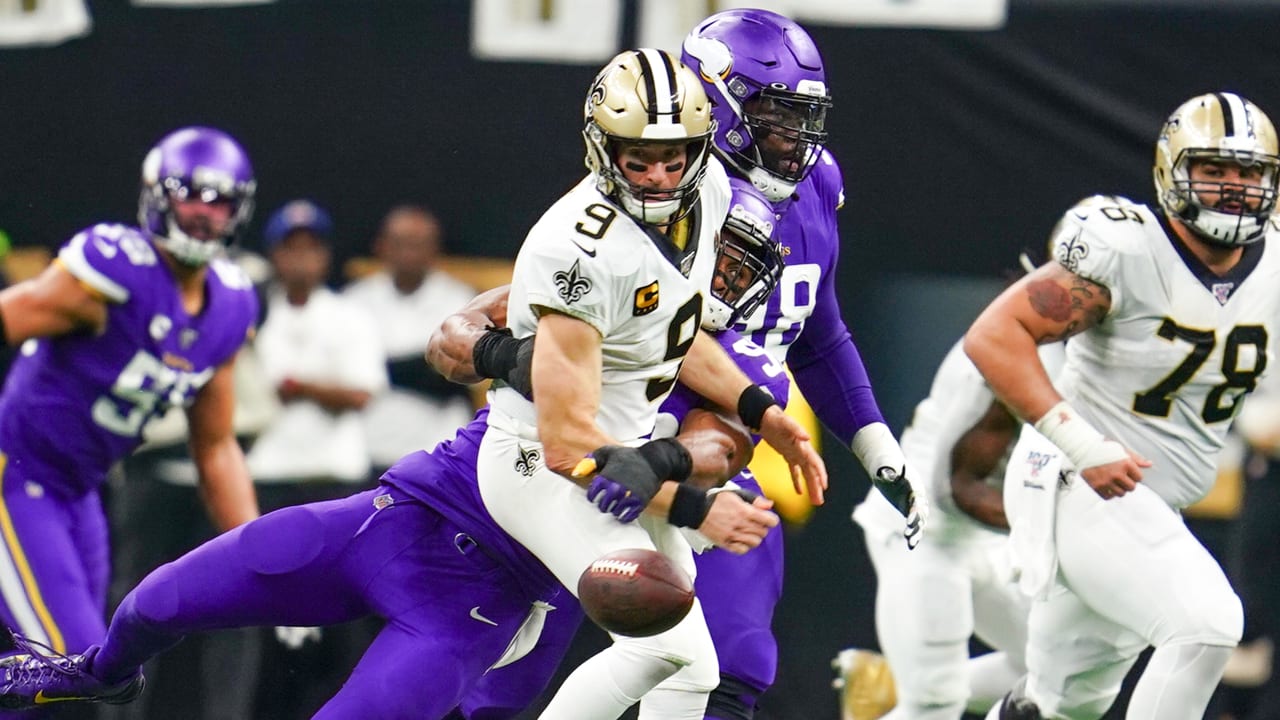
Zimmer
also managed to draw up a scheme to stifle the opposing offense based on
getting pressure in the quarterback’s face. Going into the game it seemed like
a perfect matchup, possibly the best pair of defensive ends in the league in
Minnesota going against a pair of tackles who hadn’t surrendered a sack all
season. But Zimmer brought a wrinkle into this game the Saints weren’t
expecting. On passing downs he moved Everson Griffen and Danielle Hunter in
over the guards, giving them favorable matchups against the weaker part of New
Orleans’s line.
They
actually didn’t run that many plays with their stars rushing from the middle,
but they did it early and aggressively enough to fluster Drew Brees. He spent
most of the day checking the ball down in panic, and the Saints mustered no
down the field passing attack until very late in the game.
The
case in New England is a bit more interesting. I mentioned the success Henry
had above, and while it certainly helped Tennessee manage the game, I expect
they would have hoped to score more than two offensive touchdowns if they had known they were going to get
180 yards on the ground from their starting running back. And while I don’t
think we should take any credit away from Henry or this offensive line, it
strikes me that this may have been exactly what the Patriots wanted.
There
are different ways to approach strategy in a football game. You can try to
attack an opponent’s strength, a tactic Belichick has become notorious for
employing over the years. He could have stacked the box to stuff up the run and
challenged Tannehill to beat him through the air, trusting his secondary to
hold up on islands.
In
this game, however, he used the strength of his defense to attack the weakest
part of Tennessee’s offense. He knew that with his normal defense the Titans
would have a battle to move the ball through the air, so he went all in on
defending the pass, closing off any hope they had of sustaining a passing offense.
He basically challenged them to run as much as they wanted, and prove that they
were capable of winning a game running the ball alone. And they were, though in the end their victory had more to do with New England's inability to score points than their effectiveness on offense.