I’ve
spent the past three weeks working my way through the best prospects in this
draft class, and now we finally get to the group that actually matters. 2018
isn’t a great class, but the quarterback position has the potential to salvage
it. This group is strong at the top, and it is deep as well, offering five
potential future starters for teams to add in the first round.
Josh
Rosen, UCLA

In
a year with a very strong and very deep quarterback class, Rosen is clearly the
best of the bunch, and he should be the runaway choice as the top player taken
in the draft. He might be the best pure thrower of the football to enter the
league since I started scouting players five years ago. The ball comes out of
his hand with more than enough zip, able to beat closing cornerbacks on out
routes deep along the sidelines. He combines this strength with pinpoint
precision, consistently nailing tight windows across the field and putting the
ball in the perfect place for his receiver to catch it.
When
everything is operating smoothly around him, Rosen looks just about
unstoppable. He is a natural in a clean pocket, working across the field on his
reads with his feet constantly moving beneath him. He is always in position to
deliver the ball, and he can get it out of his hand in a hurry to hit timing
routes the moment they come open. He made NFL reads and throws on a regular
basis in college, and he’s ready to start day one, only improving from that
point on as his chemistry and timing develops with his wide receivers.
There
are things to nitpick about Rosen. He can be a bit too aggressive down the
field at times, especially when he gets into the red zone. He needs more
experience recognizing and reading blitzes before the snap, and complex
defenses in college were able to fluster him. He’s up and down as a deep
passer, capable of some beautiful balls but also making mistakes on what should
be routine throws.
These
are all correctible issues that he should buff out over his first few years in
the NFL. The much bigger concern I have, and the one that keeps me from putting
him among the truly elite quarterbacks I’ve scouted, is how he handles
situations when the play breaks down. Rosen is a below average athlete, and he
struggles when he has to move off his spot. He doesn’t make plays outside the
pocket, and he doesn’t have a good sense for where to slide up to buy himself
more time and space. He is willing to stand in against pressure and take a hit,
but more often than not the ball doesn’t go anywhere near where he intends it.
His arm is good, but it isn’t enough to make spectacular throws from shaky
platforms, and if you can generate pressure on him he will likely be unable to
complete the play down the field.
Rosen
will be a very good starting quarterback for whichever team drafts him, and in
the right circumstances he can perform like one of the best in the league. But
I don’t see a player good enough to elevate a mediocre supporting cast, and I
think it’s unlikely he’ll ever be a consistent All Pro player. In a stronger
draft class I might be able to argue a non-quarterback over him, but this year
I think teams should be happy to grab a solid, if limited upside, starting
quarterback.
Lamar
Jackson, Louisville

I’ll
get this out of the way to start. There’s been a lot of discussion around
Jackson this year, much of it surrounding the position he will play at the next
level. Some people have said he would be better at wide receiver, and part of
me can see where they’re coming from. Jackson is a one of a kind athlete, and
it would be almost tragic if we were robbed of the ability to watch him with
the ball in his hands just because he couldn’t cut it as a quarterback. But in
the end I do think quarterback will be the position for him in the NFL, and I
think he has what it takes to stick there long term.
There’s
no denying what Jackson can do as a runner, and I think people are making too
muchout of the questions raised about him as a passer. He played in a system in
college that required him to make a lot of NFL style dropbacks and reads, going
through multiple progressions across the entire field. He usually makes the
right decision with his reads, even if he does need to pick up the pace and
throw with anticipation rather than waiting to see the receivers come out of
their breaks. He’s capable of fitting the ball into tight windows over the
middle, and while his arm strength isn’t extraordinary, it’s more than enough
to succeed in the NFL.
But
there’s also no denying that there are a lot of issues Jackson has to clean up
to become an effective passer. His accuracy is all over the place, largely due
to erratic footwork in the pocket. He is usually on target when delivering the
ball to his first read, but his accuracy drops drastically off as he’s forced
to move deeper through his progressions. Unlike Rosen he doesn’t reset his feet
as he bounces in the pocket, and he’s left in awkward positions that lead to
passes sailing nowhere near his target.
Footwork
isn’t the only thing Jackson has to clean up to succeed as a quarterback in the
NFL. He doesn’t have great instincts for varying the velocity of his ball, and
he will often leave it floating when he should fire it through a tight lane or
give it no arc when it requires more touch. He’s a tremendous athlete, but he
doesn’t handle pressure well, often bailing out of the pocket too early or even
running into sacks. Jackson needs to do a lot of work to reach the bare minimum
of NFL quarterbacks, and even if he can fix 90 percent of his flaws he will
still top out well below the best NFL passers.
I
see this, and it doesn’t really bother me one bit. Because as many plays as
Jackson may leave on the field with his erratic accuracy and poor instincts, he
will create just as many running with the football. The moment he steps on a
field he will become the best rushing quarterback in the league, and there’s a
reasonable argument to be made that he will be the most dynamic ball carrier at
any position period. His agility seems to break everything I think I know about
the game of football, turning sure tackles into whiffs that don’t make sense. He
may have higher variance than most NFL quarterbacks, but the value he brings is
just as real, and even with all his flaws I would absolutely draft him in the
top ten.
Josh
Allen, Wyoming

A
prospect somehow even more contentious than Jackson, Allen is the most
love-him-or-hate-him prospect I think I have ever scouted. The first thing
about him that jumps out is obviously his arm strength. He can make any throw,
and he can make it from any platform, and a couple times each game he will pull
off a play that very few quarterbacks at any level would even consider. And
when I talk about arm strength I’m not just talking about deep passes. I’m
talking about fitting balls into tight windows over the middle and reaching
deep out routes on the far sideline. Allen can do it all in a way that very few
quarterbacks can.
A
lot of people have made a big deal about his stats, particularly his sub-60%
completion percentage. But stats are just about the last thing I take into
consideration when scouting. In fact, if others hadn’t mentioned it I doubt I
would even know what his completion percentage last year was. I didn’t look up
any stats from any of these players this year, and I don’t think I would have
gained much if I had.
I
know what the numbers say, but when I watch Allen on the field I don’t see an
inaccurate passer. He isn’t at Rosen’s level of precision, and he makes some
catches more difficult than they have to be for his receivers. And he has some
of the same issues as Jackson when he gets deep in his progressions, if not as
extreme. But when the ball comes out on time, it usually goes where he intends
it.
There’s
no denying that he’s raw as a passer. He will misread some coverages at times,
and he relies a bit too much on his arm strength to make up for shaky
anticipation. His biggest issues appear when he is under pressure. He can make
some nice subtle moves through the pocket, though they often seem more like
accidents than anything else, as he doesn’t do a great job sensing pressure
before it closes in. He will bail out of clean pockets at times, running into
trouble and forcing him to attempt a difficult throw with his feet not set. Put
him behind a bad offensive line and things could get ugly quickly.
I’m
usually not a fan of the philosophy that a quarterback has to sit to learn, and
I don’t think Allen is an exception. He might benefit from a year building up
muscle memory in a controlled practice environment, but I also think he can
(and will) pick that up on the fly. I think he is capable of starting right
away, and while I think he has enough inherent flaws to keep him from becoming
one of the top quarterbacks in the league, I think he has enough upside to
warrant a top ten selection.
Sam
Darnold, USC

Unlike
the passers I listed above him, Darnold is at his best when things get messy.
He has some work to do on his feel for the pocket (especially when it comes to
protecting the ball from being swatted out of his hands), but he is a very good
athlete who can make difficult throws from unusual platforms. His physical
gifts are what make him special, and he takes full advantage of them as an
improviser, scrambling around behind the line and then lasering a difficult
throw into a tight window down the field.
Darnold
isn’t nearly as reliable when he stays in the pocket. His biggest problem is
footwork, as his feet come to a dead stop at the top of his drop. He doesn’t
shift his hips to follow his eyes as he goes through his reads, and he has a
tendency to fade away rather than stepping into his throws. This causes some
accuracy issues, and it robs the ball of velocity which, along with his big
windup, allows defenders time to cut underneath and intercept the pass. It
doesn’t help that he has a tendency to miss late rotations in coverage, which
regularly leads to passes thrown right into a safety or linebacker’s chest.
Darnold
can make any throw you ask of him, which is why it’s so frustrating that he so
often doesn’t. His deep ball comes out low and flat, usually sailing over the
receiver’s head. This can be fixed at the next level, and it was noticeably
better in the bowl game than during the regular season. But there are a lot of
little things like this—both in the mental and physical game—that need cleaned
up for Darnold to reach his potential.
But
potential is what Darnold is about, and it’s hard to argue with the vision of
what he could become. He has the highest upside of any quarterback in this
class (barring Jackson becoming some unholy dual threat terror that
revolutionizes the sport of football), but he also has the best chance of
flaming out in less than three years. I can’t put him above any of the surer
choices, and I would be terrified to take him in the top ten. But for a team in
the middle of the first round, the possibility of landing a superstar
quarterback will probably be too much to pass up.
Baker
Mayfield, Oklahoma
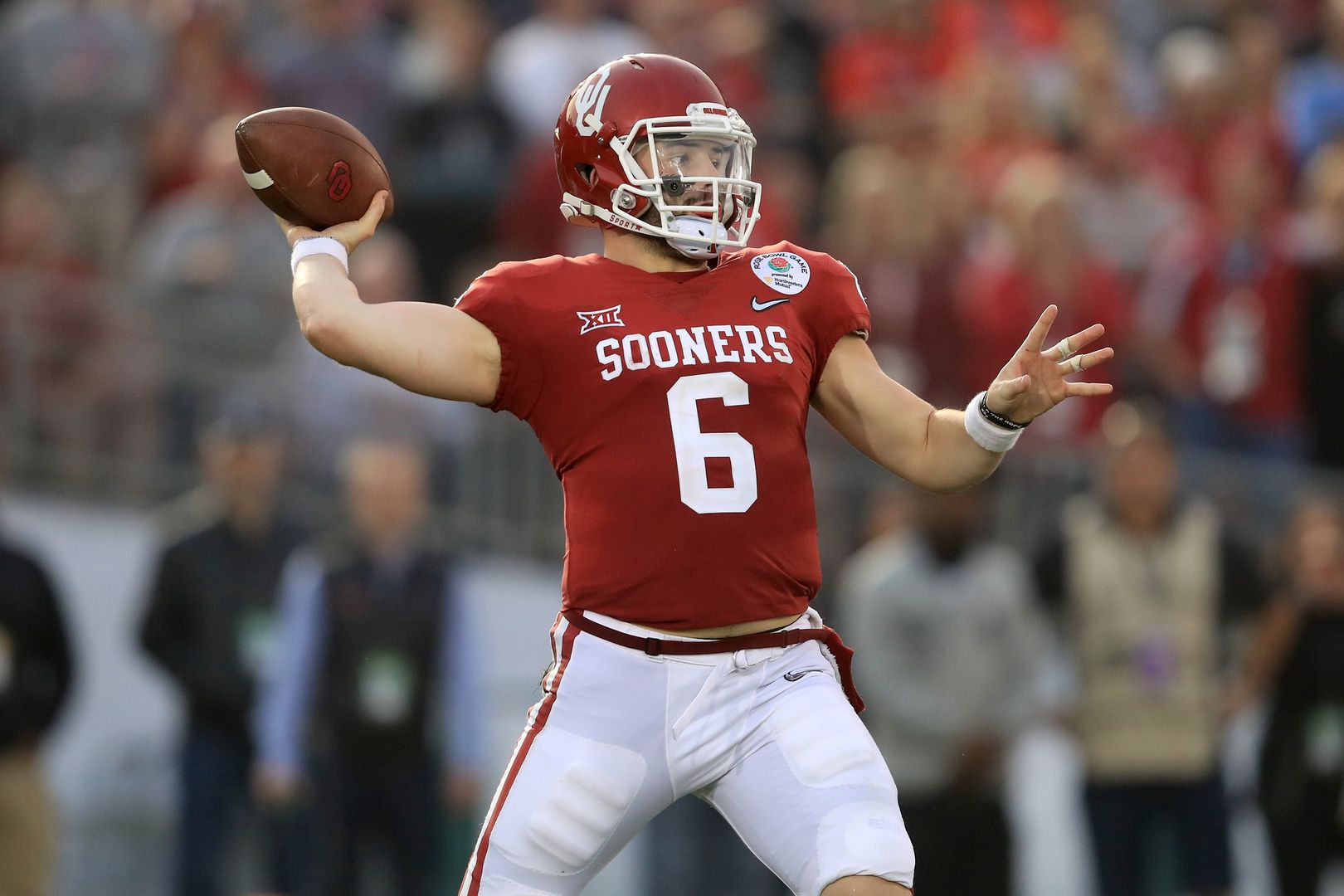
Of
the top quarterbacks in the draft, Mayfield will have the toughest transition
from college to the NFL. The scheme he was in at Oklahoma was as simple as they
come, usually asking him to make a quick throw based entirely on the presnap
alignment of the defense. And in these circumstances he usually excelled,
getting the ball into the hands of his talented receivers in space. But this
also caused him to lock on to individual receivers at times, and to stick with
them even if they ended up covered and leaving himself no choice but to force
the ball somewhere it shouldn’t go.
Mayfield
needs a lot of work to learn how to read and operate in an NFL system, though
parts of his game are weirdly polished. He does a good job varying the velocity
of his passes, lofting the ball over the top of defenders with good touch into
the hands of his receivers. He has good instincts for avoiding pressure, either
breaking outside of the pocket to make a play on the run or stepping up into an
open seam in the middle. Mayfield is a decent athlete, and even though I don’t
think he will make many plays as a rusher in the NFL he is creative enough to
wreak havoc behind the line of scrimmage.
There
are reasonable concerns about Mayfield’s arm strength. He consistently leaves
the ball short on deep passes, both due to a lack of strength and hesitance to
wait and see the receiver come open. He never really fires the ball into tight
windows, and occasionally shaky accuracy makes this an even riskier
proposition. And as natural as he is moving in the pocket, he never resets his
feet when he gets to his new spot, and he rarely completes passes after dodging
pressure.
Mayfield’s
instincts and playmaking ability give him the potential to develop into a
middle of the pack starter down the road, but I don’t see much more upside than
that. The right offensive scheme could turn him into a dangerous weapon, but
I’m not sure you can draft a player high just hoping he winds up in the perfect
situation. Still, he is a capable long term solution at quarterback, and that
is very hard to find in the league, so I wouldn’t be averse to selecting him somewhere
near the end of the first round.
Mason
Rudolph, Oklahoma State

There
is a big dropoff from the top tier of quarterbacks to the rest of the class.
There are five quarterbacks coming out this year who have good potential to
become long term starters at the position, and then there are a bunch of guys
who are almost assuredly backups. Rudolph does have some upside as a potential
starter, which puts him at the head of the latter class, but I think it’s much
more likely that he fails to ever reach that height in the NFL.
Rudolph
isn’t particularly gifted with athleticism or arm strength, and both of these
show up on the field. He can make some nice movements behind the line, but he
doesn’t throw well on the run and is more or less dead when he escapes the
pocket. He can’t fire the ball with much zip, and he rarely challenges tight
windows in the defense. He needs his receivers to be wide open to throw it to
them, because he can’t reliably count on the ball going exactly where he
intends it. His accuracy isn’t great, and it’s especially bad trying to throw
to the outside of the field, where the ball regularly sails pointlessly over
his receiver’s head into the sideline.
These
limitations will hang around Rudolph for most of his career, and they’re the
reason I wouldn’t take him before the fourth round. But there are other parts
of his game that could make him a particularly dangerous option off the bench.
Despite his limited arm strength he is an excellent deep ball thrower, and he
can provide a spark of big plays to make up for the smaller plays he leaves on
the field. He’s willing to stand behind the line and hold the ball as long as
he needs to (too long some times), setting up big plays down the field as his
receivers work themselves open.
Rudolph
comes from an offense that pretty much never asked him to make NFL reads or
throws, and it will be a while before he’s ready for any game action. He has a
tendency to lock in on a single receiver, and he doesn’t really do anything to
diagnose or manipulate coverages after the snap. In two or three years it might
be worth some team giving him a shot to fill in as a starter for a couple
games, even if it will likely end with them deciding he’s better in reserve.
Luke
Falk, Washington State

Falk
is the least physically gifted of the quarterbacks I looked at in this draft,
and his lack of tools more or less eliminates any hope he has of becoming a
regular starting quarterback. He is an atrocious deep passer, without the arm
strength to stretch the field or the accuracy to hit windows between the
coverage outside the numbers. His balls float to the sideline with no zip, and
his receiver regularly have to wait and let the defense close in as the ball
arrives.
There
are parts of the field that are just inaccessible to Falk, but where he is able
to hit he is a perfectly competent quarterback. He fits the ball nicely into
tight windows across the middle, and the ball comes out perfectly timed on
quick hitting routes. He moves his feet well to stay balanced as he goes
through his reads, and though he isn’t a good athlete, he’s able to make some
moves in the pocket to keep himself alive. He’s a good decision maker and does
a good job locating a running back as an outlet when pressure closes in,
negating some negative plays.
Falk
will likely be a very good backup in the league for the next ten years. He can
make enough plays to keep a team alive in spot duty, when the defense won’t
have much time to scout and take advantage of his clear weaknesses. But I would
be shocked if he was ever the presumed starter on a team, and even more
astonished if he actually made that work long term. There is virtually no
upside here, and I wouldn’t even look at him until the fifth round.


