Courtland
Sutton, WR – SMU

It’s
hard not to watch Sutton and think that he should be better than he is.
Physically he has the tools of a receiver that would
wind up in the top ten of the draft. He’s huge, standing 6-3 and weighing 218
pounds, and he put up insane numbers in the agility drills at the Combine. His
forty wasn’t anything special, but at 4.54 it’s not like we’re talking about
Laquon Treadwell here. He has the tools to be dominant, and he flashes them at
times on the field, but he is too maddeningly inconsistent to justify a pick in
the top half of the first round.
There
are things on the field that Sutton does extremely well. As his numbers at the
Combine showed he has insane agility for a receiver his size, and those quick
cuts show up with good route running ability. He can get squeezed towards the
sideline too easily, but as long as he keeps himself clear of there he is an
above average route runner. He is dangerous after the catch as well, strong
enough to break tackles and quick enough to make people miss in the open field.
A
receiver of this size you would expect to dominate at the point of the catch,
and it’s frustrating that Sutton doesn’t do so more often. Occasionally he can
make ridiculous plays using his height and strength to snatch the ball out of
the air, but far too often he seems passive about attacking the ball. His lack
of speed makes it difficult for him to truly separate from defenders, and he
has a habit of pushing off to try to generate that space. He catches too much
with his chest, and will drop some passes that should be easy completions.
Winning
the catch point is something that can be improved with coaching, but a lot of
it is instinctive as well. And as much potential as Sutton has in that area,
I’m not convinced he will be the player the team that drafts him expects. He’s
a good receiver, and I think he’ll be a capable starter for years to come. I’m
just not sure he’ll ever find himself among the best in the league.
Calvin
Ridley, WR – Alabama
/cdn.vox-cdn.com/uploads/chorus_image/image/57737409/usa_today_10318882.0.jpg)
Ridley’s
game begins with his speed. His first step off the line is explosive, and he
only builds from there, consistently challenging defensive backs over the top.
He ran well at the Combine with a 4.43 forty, but he plays even faster than
that on the field. Without safety help over the top a cornerback has no choice
but to back off, and Ridley’s ability to sell a route deep before coming to a
sudden halt sets up a lot of easy completions on comebacks underneath.
The
problem is that there’s not much else to Ridley’s game. Weighing only 189
pounds he is often overwhelmed physically, both coming off the line and at the
point of the catch. He shows flashes of good work with his release, and he can
get more development at the next level to make it more difficult for
cornerbacks to press him. But if a cornerback does get his hands on Ridley’s
chest, there really isn’t anything he can do to break free.
There
are parts of Ridley’s game that are as frustrating and inconsistent as
Sutton’s. He will occasionally go outside his frame to make a difficult catch,
but just as often he misses out on balls if they aren’t perfectly thrown. He
excelled running a small number of routes, but he wasn’t asked to run a full
route tree, more work he will have to do to adjust to an NFL offense. And while
he can be dangerous with the ball in his hands, he can also run himself into
trouble and cost his offense crucial yards. There are more flaws here than most
people seem to acknowledge, and there is a lot of risk that he won’t develop
into a complete receiver. And even with his down the field speed, I’m not sure
there’s enough upside to justify that risk until late in the first round.
James
Washingon, WR – Oklahoma State
Washington
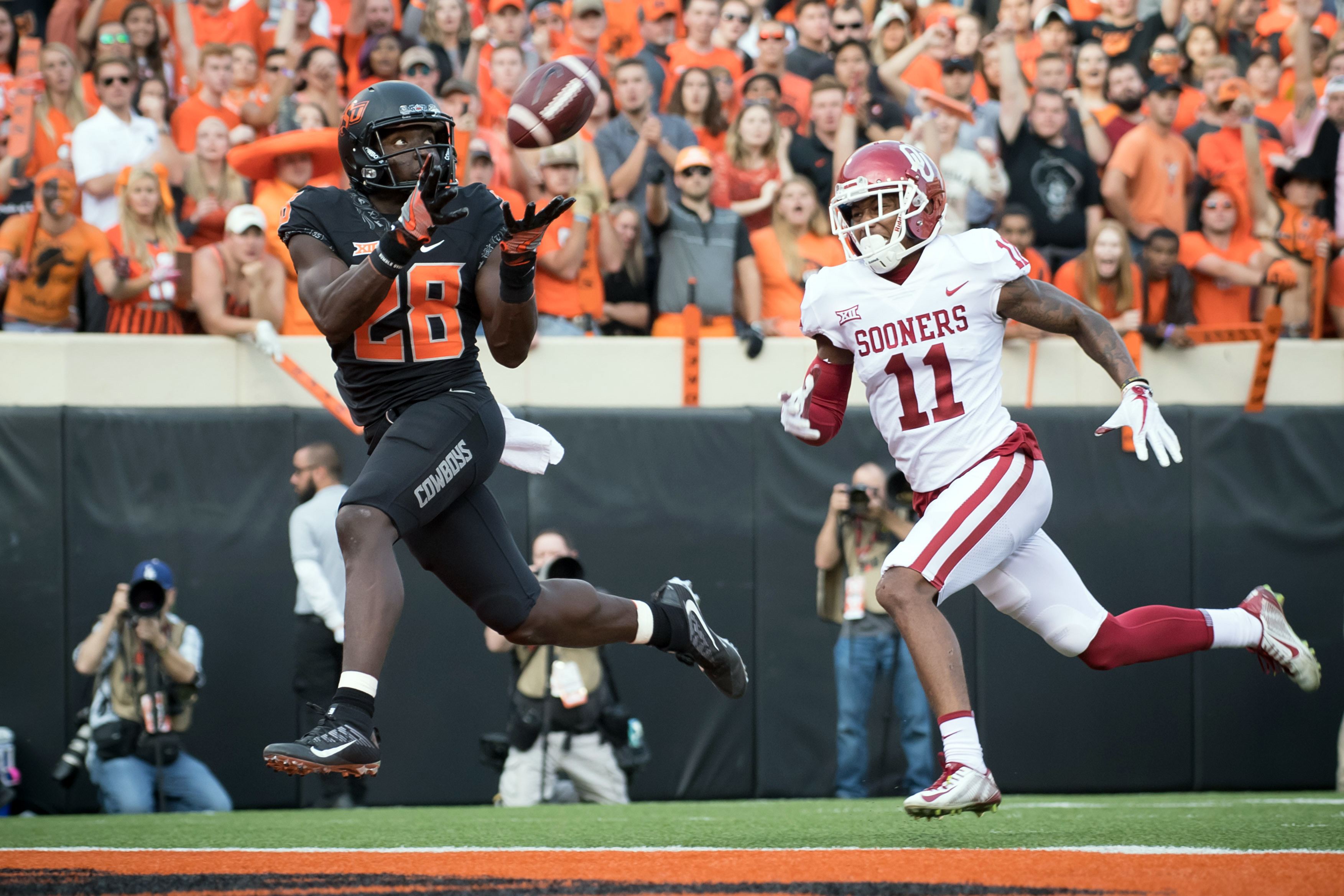
is a bit of a one trick pony, but if there’s a trick that a wide receiver can
build a career around, being an elite deep ball receiver is probably the best
one out there. Washington underwhelmed at the Combine, performing below average
in every single drill, but he plays a lot faster on the field than his 4.54
forty (the same time as Sutton, a player who looks significantly slower than
Washington). He doesn’t explode off the line in the same way Ridley does, but
he ramps up his speed well, and he can work his way
free once he gets ten to twenty yards down the field.
Being
a good deep ball receiver is about more than just speed, and Washington has the
other traits down. He is a master at tracking the ball in the air, and he does
a very good job using his body to shield defenders from being able to make a
play. He gives himself space to work when running down the sideline, and he can
twist his body to make difficult catches over either shoulder.
It’s
possible for a receiver to make a career as a deep threat without really
offering much else, and I think that’s the most likely course for Washington.
In college he ran almost nothing but vertical routes, and he doesn’t have the
sort of quickness or make sharp cuts that would help him develop his route
running abilities. He doesn’t do much with the ball in his hands, and he rarely
jumps to high point a ball. He really is just a deep receiver, and as good as
he is down the field I don’t think such a limited player is worth a first round
pick.
DJ
Moore, WR - Maryland
/cdn.vox-cdn.com/uploads/chorus_image/image/58904355/858767366.jpg.0.jpg)
Selecting
Moore is selecting based on upside. It wouldn’t be shocking if a couple years
from now he proves to be the best receiver in this class (considering this
class, that wouldn’t be a great achievement), but right now he is far behind
the three receivers I have listed above him. But he tore apart the Combine,
running a 4.42 forty and performing better than the 80th percentile
in the broad jump, vertical jump, 20 yard shuttle, and 60 yard shuttle. And on
the field he shows flashes of elite ability that could definitely develop into
something dangerous.
Right
now Moore is held back by a lot of little things. He’s a decent route runner,
especially when he’s working straight up and down the field on either fades,
comebacks, or double moves. But he gives away where he’s going before he
reaches the break point, and NFL cornerbacks will eat his tendency keys alive.
He needs to get a lot better at attacking the ball at the catch point rather
than waiting and letting it come to him, and he lets too many balls hit his
chest, leading to drops and allowing defenders to make a play.
But
even with the things that hold him back, there are signs of the player he can
be. In college he had a habit of making ridiculously athletic snags along the
sideline, catches that didn’t count because his route didn’t give him enough
room to work with. On some plays his catch radius looks much bigger than his
6-0 height would suggest, and on others he looks uncomfortable any time he has
to reach outside his frame.
There
is potential here, and there is plenty of reason to believe he’s capable of
taking advantage of it. As much as the little things hold him back, there are
other areas of the game where he shows good dedication to hard work. He is an
excellent blocker, and he absorbs contact well going over the middle. He’s
tough after the catch as well, willing to stick his head into tight areas to
pick up extra yards. He has quite a ways to go, but he’s probably the only
receiver in this class with the potential to become a number one threat. And
for that reason I could maybe see him sneaking into the first round, even
though I think his risk should knock him into the early second.
Dallas
Goedert, TE – South Dakota State
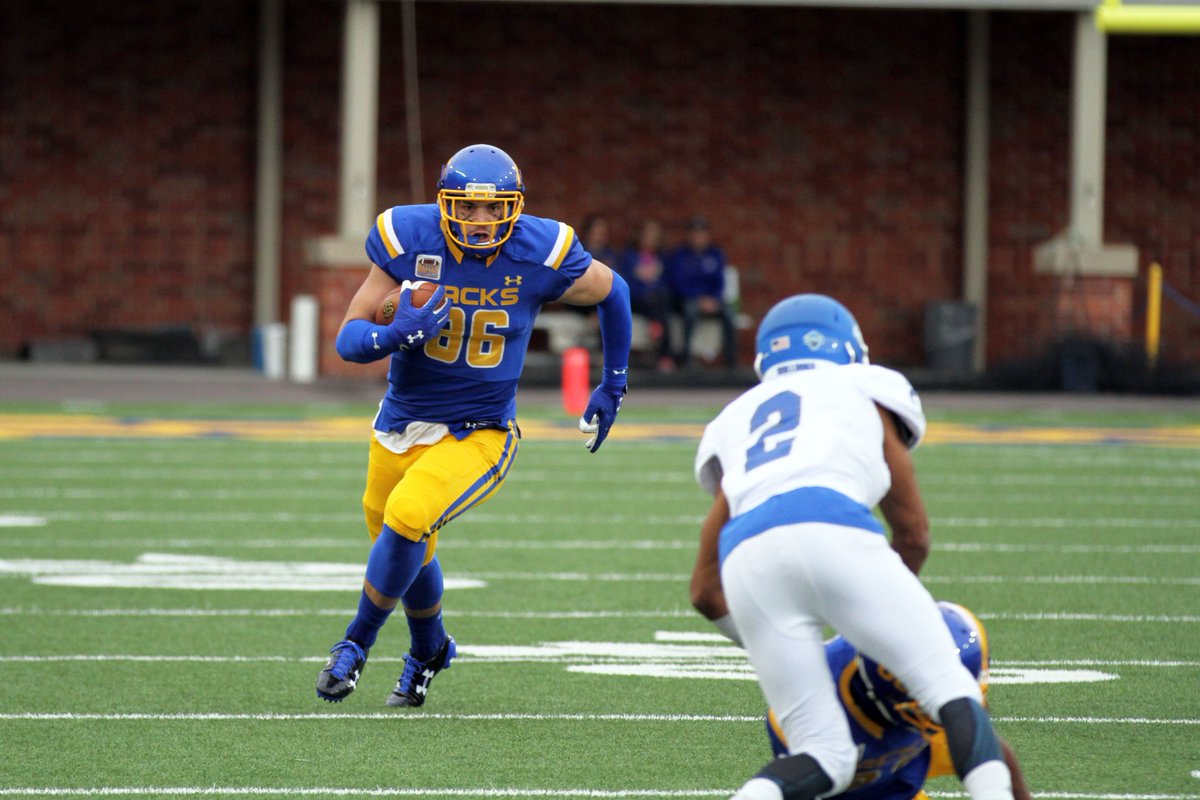
Goedert
is as traditional a tight end as we see coming out of college football these
days. At South Dakota State he lined up all over the field and was asked to
play a variety of roles, from stretching the defense down the field, to
offering a safety blanket underneath, to blocking in the running game, even
catching an occasional screen pass. His athleticism was dominant for the level
he played at, but it won’t translate to the NFL, where he will likely have to
find other ways to get open besides just outrunning defenders down the field.
Goedert
has decent speed for a tight end, and he can make some difficult catches in
traffic that you like to see from your tight ends. He needs to get a lot more
consistent doing this, but the tools are there to develop with experience. He’s
a capable blocker when asked to attack someone in the box in the running game,
though he could do a better job latching on and sustaining so the defensive
lineman doesn’t break away when the back comes by. But he usually gets good
push along the edge, collapsing the defense and opening a wide lane for the
running back.
Goedert
will never be one of the best tight ends in the league, and for that reason I
wouldn’t take him in the first round. He drops a few too many passes, and he
doesn’t make the sort of accuracy erasing plays that the best tight ends
consistently do. But as a plug and play contributor he’s the best at the
position in this class, and I could see him holding down a starting role in an
offense for five to ten years.
Mike
Gesicki, TE/WR – Penn State

Gesicki’s
Combine performance was the sort of thing that will be remembered for years to
come. He scored better than the 95th percentile among tight ends in
the vertical jump, broad jump, 3 cone drill, 20 yard shuttle, and 60 yard
shuttle. He also ran a 4.54 forty, all of this while standing 6-5 and weighing
247 pounds. He is a freak by every definition of the word, and likely the most
athletic overall player in this draft class.
Now
the problem: not all of this athleticism shows up on the field. His leaping
ability is definitely there, and he will instantly be a threat in the NFL on
jump ball targets. He also has sneaky agility when running his routes, seeming
to lull defenses into a false sense of security and then breaking into an open
patch of field. But he struggles to separate over the top, and he doesn’t do
much after the catch, leaving him stuck fighting for contested catches or
settling for ineffective dumpoffs over the middle. Physical defenders push him
around on his routes, giving him trouble getting off the line and disrupting
his breaks.
Gesicki
wasn’t nearly as effective a receiver as his physical tools would suggest, but
an even bigger concern for me was his utter inability to function as a blocker.
I listed him above as both a receiver and a tight end because despite his
official designation, I really cannot imagine him playing a traditional tight end
role in the NFL. He isn’t just a bad blocker, he’s also an unwilling one,
shying away from contact and at times even clogging up the lane he’s supposed
to be opening. Any team that drafts him has to realize that they cannot just
slide him into their normal tight end role, and I would be tempted to not even
bother giving him that designation.
Gesicki
is much better as an athlete than he is as a football player, and unlike Moore
I’m not optimistic about his development. He definitely can have a role on an
offense, but not as a feature piece. He’ll be useful on jump balls in the red
zone and a reliable safety blanked in the middle of the field. But unless he
suddenly translates his skills to the field in a way he never showed in
college, he won’t be the game altering player his numbers suggest.
Christian
Kirk, WR – Texas A&M

Of
all the prospects I studied at every position there may not be a more sure
thing than Kirk, and I mean that in both a positive and a negative light. He
does enough little things well that I’m comfortable saying he’ll lock down a
role in an NFL offense for years to come, but I don’t imagine he will ever be
more than a role player. With his short stature, his poor performance at the
Combine, and the overall inconsistency of his game, I think he projects as a
number two receiver at best, and I wouldn’t consider taking him until the
latter portion of the second round.
Kirk
played mostly out of the slot in college, though I’m not sure if that’s the
best use of him in the NFL. He doesn’t have the quick twitch ability I like to
see out of slot receivers, and his most effective tool is his down the field
speed. He runs a wide variety of routes and does a good job shielding off
defenders with his body at the point of the catch, but on the whole he’s a poor
route runner better suited to a spot where his speed will shift the structure
of the defense.
Kirk’s
agility was enough for him to be productive as a primary weapon in college, but
he doesn’t have the ability to make NFL defenders miss in the open field. His
strength will help him pick up a few yards after the catch, but he’s going to
have to adjust his game to play at the next level. He has good instincts for
getting open against a variety of defenses, and I think he can become an above
average route runner if he learns how to sell his fakes better and make more
precise cuts. But no matter what he is always going to be physically limited,
and I just don’t see much upside in selecting him.
Mark
Andrews, TE - Oklahoma
/cdn.vox-cdn.com/uploads/chorus_image/image/57878227/884533666.jpg.0.jpg)
Andrews
was a productive receiver in Oklahoma’s spread offense, but I really don’t see
anything to suggest that he’ll be more than a rotational piece in the NFL. He
is a subpar athlete with limited experience as an inline blocker, and there
were very few areas in college where he really seemed to excel. His production
was based more on the scheme he was in than anything he did himself, and I
wouldn’t bother to draft him on either of the first two days of the draft.
Andrews
did a decent enough job in college varying his pace and finding holes against a
zone defense, giving his quarterback easy dumpoff opportunities. But he is more
or less helpless when faced with man coverage. He doesn’t have the speed or
quickness to separate, and his lack of athletic ability was reinforced by the
Combine. He gets overwhelmed by physical defenders, and he rarely goes outside
his frame to make difficult or contested catches.
As
a blocker Andrews is merely average, capable of getting in people’s way in
space but not of physically winning battles. He struggles to sustain contact,
and he gets lost looking for people to block when he’s in the box. With a
couple years of development he might be able to grow into a league average tight end. But that is his clear ceiling, and not worth any kind of
real investment.


/cdn.vox-cdn.com/uploads/chorus_image/image/59162397/usa_today_10392292.0.jpg)

