Monday, March 26, 2018

2018 Draft Prospects: Cornerbacks


The NFL Draft is now officially one month away. For you the excitement may just be beginning, but for me the draft has taken up a huge chunk of my free time for the past month and a half. As I’ve done the past few years, I chose roughly sixty of the top prospects to look at this year, watching three games of each in order to form my opinions of the players likely to go in the first round of the draft.

As I’ve done in the past, I will be ranking each of these players within their position groups, starting today with the cornerbacks. The players below are listed in the order I would select them, accompanied by summaries of their strengths, weaknesses, and potential. I factor in both film and athletic numbers for these rankings, and I am generally a big fan of athletic upside when it comes to the draft.

There’s one more thing I would like to call attention to before I dive in. For most of the players I will try to give some sense of where they deserve to go in the draft, whether that’s a top five selection, a mid-second round prospect, or the latter stages of the first round. A key thing to keep in mind when you see this is that these descriptions are based not just on this year’s draft class but on every class I have studied. This is a particularly weak year at the top of the draft, and I don’t believe there are ten worthy top ten caliber players, or twenty top twenty, or thirty-two first rounders. So keep that in mind when the time rolls around for me to post my mock draft, when I’ll have no choice but to select players higher than they truly deserve to go.

And now, without further ado, the first position group of my 2018 Draft breakdown: the cornerbacks.

Denzel Ward, Ohio State
Image result for denzel ward
There are a lot of things to like about Ward’s game. His athleticism is immediately evident, both on the field and in workouts. At the Combine he ran a 4.32 forty and put up 39 inches on the vertical, speed and explosiveness that translate to tracking receivers over the field. He doesn’t allow himself to get beaten over the top, and he closes hard on underneath routes. He allows a few more catches than you’d like to see, and he could be even better if he put on some strength to play with physicality at the catch point. But even when the ball beats him there he is almost always immediately on the receiver to make the tackle, eliminating any yards after the catch.

Ward didn’t do any of the agility tests at the Combine, but if he had he likely would have excelled there as well. His balance is excellent, and he mirrors receivers with precision off the snap. He has experience playing both on the outside and in the slot, and there will be a role for him on any team immediately in the NFL. He can play in zone, but he’s at his best in man to man, tracking receivers through congested patches of field and matching them stride for stride and cut for cut.

All that said, there are very clear holes in Ward’s game, holes that I don’t think he is every likely to fill. He doesn’t have the elite size that has become popular in recent years in the NFL, and he doesn’t challenge receivers physically on their routes. He never gets his head around to find the ball, and good receivers can make catches against him even when they’re covered.

Ward is the best cornerback in the draft, but that’s as much about the class as it is about him. He isn’t at the same level as someone like Jalen Ramsey or Marshon Lattimore that we’ve seen come out over the past couple years, and I don’t see him ever becoming more than an above average starter in the NFL. There’s definitely value for him, but I’m not sure I see him as a top 20 player.

Mike Hughes, UCF
Image result for mike hughes ucf
Hughes doesn’t boast the remarkable athleticism of Ward, but he brings a similar level of polish. He is light on his feet and extremely flexible, and there is never a moment where he looks truly out of control in coverage. When a receiver tries to blow past him over the top, he is able to flip his hips without any wasted motion, keeping stride for stride with all but the fastest receivers down the field. He uses the sideline as a tool to hem in receivers, and he sticks with men crossing the middle so he’s in position to break in front of them and knock away the pass.

Hughes is sound in coverage, but the issues present themselves either at the line or at the point of the catch. He can get pushed around physically when he tries to challenge the release of receivers, and if he gets knocked off balance he doesn’t have the speed necessary to recover. Wary about being beaten over the top, he will give some passes up underneath, and he doesn’t have the same closing speed that makes Ward so effective. He’s a poor tackler—but to his credit, a willing one—and it’s easy to imagine a team baiting him underneath until they can break one for a longer play.

The athletic limitations will restrict Hughes’s ceiling, but I have no doubt he’ll be a quality starting cornerback in the league. He shows a good understanding of route design and combinations, and he can comfortably slide right away into any scheme. He’s a good pickup late in the first round, for a team that wants a ready to contribute piece and is okay sacrificing a little long term upside.

Josh Jackson, Iowa
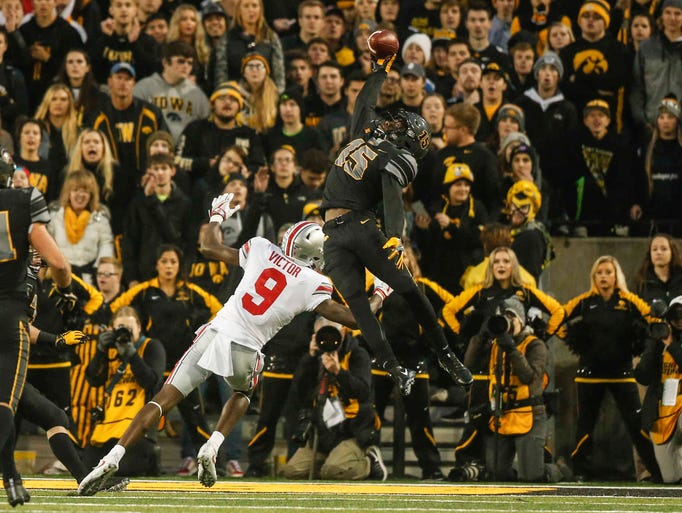
Image result for josh jackson iowa interception
Over the past couple years some of the best cornerbacks in the NFL have been players who converted from wide receiver during their time in college. Richard Sherman and Xavier Rhodes are big, physical players who attack the ball in the air as if they believe it’s theirs. Jackson isn’t quite in that some mold physically, but he has a similar background as a wide receiver, and it shows up in his aggressiveness and ability to make plays to take the ball away from the offense.

There is a lot of upside with Jackson, but there is a lot of downside too. He is still incredibly raw in coverage, and it shows up when he is asked to play tight at the line. He opens his hips far too early on vertical releases, and he doesn’t have elite closing speed to stop underneath routes. And he lets receivers cross his face with no real contest, often turning the wrong way and giving the offense an easy completion over the middle of the field.

It is going to take some time for Jackson to harness his potential, but he can still contribute as he develops. He will be beaten regularly over his first couple years, but he can also turn the game around with a timely interception. He is always looking to jump an underneath route in zone, and when he’s matched up man to man he is able to make freakishly athletic plays to steal the ball out of the air. And with an excellent performance at the Combine (aside from a 4.56 forty that doesn’t reflect his speed on the field), he showed that he has the ability to develop into the best cornerback in the class, even if it comes with risks that would make me wary about picking him before the end of the first round.

Carlton Davis, Auburn
Image result for carlton davis press
Davis is either a coach’s dream cornerback or their worst nightmare, depending on what they want out of the position. If they’re looking for someone to match receivers step for step and track them across the field, Davis isn’t their guy. He isn’t particularly nimble, and he will struggle his entire career with smaller, quicker receivers. There is no way he can play in the slot, and quarterbacks with good timing on back shoulder throws will be able to eat him alive underneath if he can’t disrupt the route. He doesn’t stop well, and his closing speed is subpar, meaning any separation the receiver can generate is likely to result in a catch.

But if a coach is looking for someone to get physical with receivers on the outside and disrupt the entire timing of an offense, Davis may be the best I’ve seen in five years of doing this. He routinely makes wide receivers look like they’re made of paper, stacking them up at the line and preventing them from ever getting into their routes. He is insanely strong and uses his long arms to their full advantage, at times straight up shoving receivers out of bounds to erase them from the play.

Obviously a player this physical will need some time to adjust to the NFL’s more stringent rules. He also needs to get better at finding the ball in the air and making a play on it as it arrives. But he has the skills to grow in this last area, with long arms and good recognition of when a receiver is going for the catch. He is also physical enough that at times receivers can’t even gather their balance enough to make a play on the ball.

Davis needs to go to a team that will use him properly, and give him time to adjust to his new situation. A bunch of teams shouldn’t even consider selecting him, not when there are similarly talented and better suited players on the board. But for a handful of other teams he may be exactly what they’re looking for, a bargain to be found early in the second round.

Isaiah Oliver, Colorado
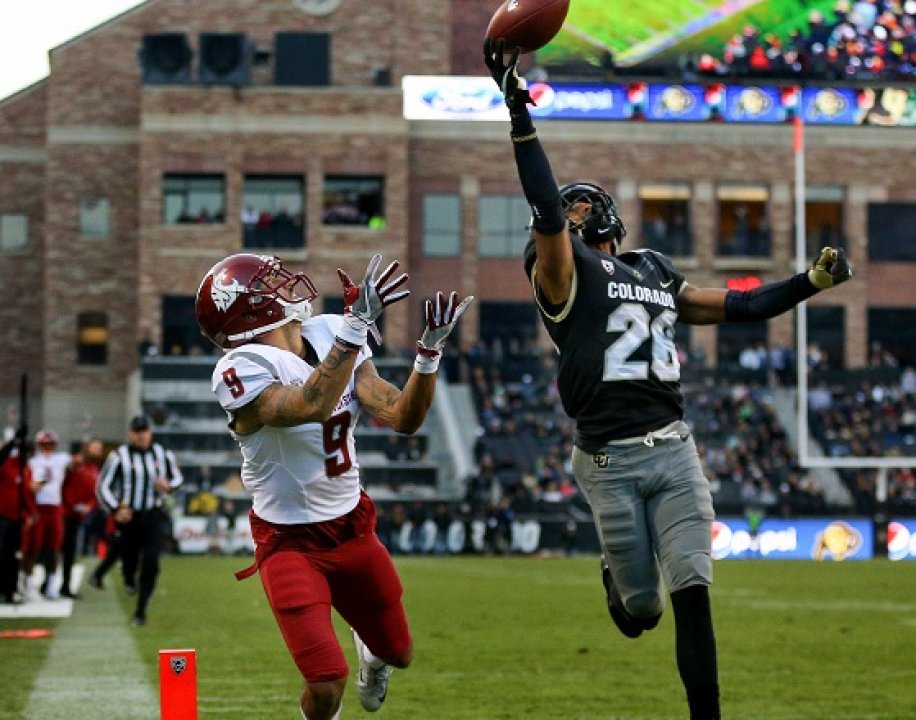
Image result for isaiah oliver
There are a lot of pieces that go into playing cornerback, but very often it comes down to what a player does at the point of the catch. Excellent coverage can be erased by failing to knock the ball out of the air, while long arms and well timed leaps can make a bad play look great. Oliver is a player who often falls into the latter category. He can be beaten in coverage, but he has the ability to make plays to erase these mistakes.

Speed is one issue that Oliver regularly faces. He ran only 4.5 in the forty yard dash, and this shortcoming shows up on the field, where he struggles at times to get his hips flipped around and can be outrun over the top. He doesn’t explode downhill in the way the best cornerbacks do, though he has good anticipation and understanding of route concepts to make up for this, often making his break before the ball is even thrown. He’s an extremely smart cornerback, and he is rarely beaten by double moves.

At the point of the catch is where he excels, though he has some work to clean up there as well. He can get too physical with receivers, and he will draw some flags simply due to body to body contact. But he’ll avoid other penalties by consistently getting his head around and finding the ball, and more often than not making plays to knock it out of the air. With some refinement and in the right scheme he can become a well above average cornerback, even if he doesn’t have the skills to consistently lock down an opposing receiver.

Jaire Alexander, Louisville
Image result for jaire alexander pass defense
Alexander is another that you will either love or hate depending on what you want from a cornerback. In fact the order I’ve placed the last three likely says more about my preferences for the  position than it does about the players themselves. Davis, Oliver, and Alexander all belong somewhere in the early second round, and whichever is taken first is ultimately a reflection of what the drafting team wants from the position, not the talent of the player.

Alexander is in a lot of ways the opposite player of Davis. He’s small, but he is incredibly quick, able to match the breaks of the opposing receivers as quickly as they make them. He impressed at the Combine with a 4.38 forty, but that speed doesn’t always show up on the field, where he is vulnerable to being beaten over the top. He can occasionally get physical with receivers, but mostly this is just to knock them off their route for a step or two, before they recover and move on.

Alexander is a bit undersized at only 5-10 with short arms, and it’s possible to complete passes over the top of him. He doesn’t time his jumps particularly well, though he does a good job playing around receivers to swat away passes over the middle of the field. He plays with too much aggression and can be badly burned by double moves, something that I’m not sure even coaching will fix at the next level. A very mixed bag as a player, the upside is undoubtedly there, but there are clear limitations and questions that prevent him from joining the top prospects in this class.

Tuesday, March 13, 2018

The Cost of a Quarterback


The NFL offseason officially starts tomorrow, but it’s already been a very busy year. The past month has seen more activity with player movement that I can honestly recall from any offseason, with seemingly each day bringing a new shocking trade of a big name player. Beginning with Alex Smith and working up to Cleveland’s frenzy over the past week, trades are suddenly all the rage.

The NFL is notoriously averse to trades, especially compared to other professional sports leagues. The most exciting deals we usually see are simply swaps of mediocre players for midround draft picks, the sort of deals you usually forget until you notice that a player you rarely think about has switched teams. The events of the past month are highly unusual, and it’s raised plenty of eyebrows from people wondering why the sudden frenzy of activity.

There are all sorts of reasons for teams to make trades, but they can all be summed up pretty simplistically. A trade happens when two teams value each other’s assets more than they value their own. There are all sorts of reasons why this could happen. Poor schematic fits, different windows for competition, varying needs on the depth chart. These are the reasons most trades have happened in the past, but they don’t explain why this offseason has seen such a breakout.

The sudden explosion in the trading market is due to a new source of value inequity, one that dates back to the lockout that happened prior to the 2011 season. There were a lot of factors that went into this labor negotiation, but probably the most significant consequence was the institution of a rookie wage scale. Prior to 2011 rookies were able to negotiate any contract they wished, and the teams that drafted them had no choice but to pay up or risk the player entering the following season’s draft again.

This negotiating leverage led to some extremely undesirable results, from the perspectives of both the owners and the players. The owners didn’t like having to shell out $68 million to JaMarcus Russell and then watch that investment go to waste, and the veteran players didn’t like seeing draft picks like Eric Berry become the highest paid player at his position without playing a single snap. So the new collective bargaining agreement instituted a rigid scale around rookie salaries, reducing the risk to owners and (theoretically) freeing up more money for veterans.

(Of course the people who got screwed in this deal were the college players who suddenly saw their first contracts drop by up to 75%, but they had no leverage and no spot at the negotiating table. They’re just lucky the NCAA makes sure they’re fairly compensated.)

These were the reasons behind this change, and they are arguably good reasons. But the real, and likely unintended, consequence was to radically alter that way teams are constructed. In a capped league salary is a wildly significant piece in how players are valued, and having an entire class of players with their salaries restricted changes how both rookie and veteran players are viewed.

The effects of this are visible at every position in the league, but nowhere is it more clear than at quarterback. The importance of the quarterback position is at an all time high, and that has led to some very uneven negotiating terms, resulting in a skewed and ridiculous compensation distribution. Now any quarterback who can claim to be a reliable starter is able to demand to become the highest paid player in the league (as we’re seeing with Kirk Cousins, an average quarterback who is about to sign the first fully guaranteed contract in NFL history), while backup quarterbacks are seen as having virtually no value.


A proven starting veteran quarterback is going to earn more than $25 million a year in the NFL. Matthew Stafford, Derek Carr, and Joe Flacco have all signed contracts in excess of $100 million over the past few seasons, and no one would consider them superstar passers. But on the other end of the spectrum we have an entire class of quarterbacks still on their rookie contracts. Mitchell Trubisky will count only $6.6 million against Chicago’s cap in his second season. Jared Goff and Carson Went are both looking at cap hits between $7 and $8 million. On the open market these players would likely receive more than twice what they are costing their current teams.

Together these classes of quarterbacks have led to extreme disparities in how teams are paying their quarterbacks. The chart below shows the Average Annual Value of the contracts for every quarterback on each team’s roster last season. See if you can spot where things drop off.


There is a general slight downhill trend among the first half of teams, followed by an immediate and sharp dropoff. The only two teams in the middle were Cincinnati and Buffalo, with a pair of middle of the pack quarterbacks they were able to convince to take rare moderate contracts. Below them we see teams whose main starting quarterbacks last year were either on rookie contracts or unwanted veterans who managed to hold off the mistakes of drafts past. (I see you, New York and Denver).

I’m sure you’re all very interested in the minutiae of NFL contract structures, but now you’re wondering what this has to do with the recent flood of trades. Well if you look closely, you will notice a couple consistent trends. Many of the teams trading away veteran players are on the left side of the chart, and many of the teams acquiring them are on the right.

This disparity in the cost of the quarterback position means that teams with signed veterans and teams with players on their rookie deals are essentially playing two completely different games when it comes to team building. A team like the Rams, the Bears, or the defending Super Bowl champion Eagles have essentially $20 million extra in cap space. And looking at the distribution of teams above, it doesn’t appear that quarterback expense has that much to do with value received from the position, as teams like Arizona and Detroit sit near the top of the list while Green Bay, Seattle, and New England fall in the middle.

Let’s just run through a few examples to see what I’m talking about. The clearest case is Michael Bennett, traded from the Seahawks to the Eagles. Seattle could no longer afford his contract, and despite how valuable he is to their defense, they decided they needed the money more than they needed him. Fortunately the Eagles were there with plenty of cap space to absorb him, adding another talented pass rusher to their already extremely deep front.

A similar deal happened between the Broncos and the Rams. Both teams are among the lower paying class, but while the Rams appear set in the near term with Goff at quarterback, Denver is still desperately in need at that position. And because they (erroneously) believe they are one quarterback away from competing, their plan is to jump into the higher paying class, adding Case Keenum at a cost of $18 million a year. To clear the space for this they had to ship away Aqib Talib, a starting cornerback the Rams were happy to accept.

In both cases a team facing a cap crunch made a decision to let a veteran star go in exchange for an unproven, but much cheaper, draft pick. On the other end, the space saved by the rookie quarterbacks allowed the Rams and the Eagles to add a costly veteran to their already deep roster.

Not every trade falls into this category, but you can see strands of the same thinking throughout. Cleveland has plenty of cap space, so they were able to absorb Tyrod Taylor as a bridge option while the Bills search for a cheaper rookie passer. The Browns also sent away a couple of draft picks for Jarvis Landry, a quixotic receiver who is going to be able to demand a lot more money than he deserves. Such a player doesn’t have a place on the team that paid the most money to quarterbacks in the league last year, but for a Browns team with nothing but cheap rookies and a mid-level expiring veteran, he is worth the gamble.

A player like Marcus Peters was dealt away for off the field reasons, but the Rams were able to take him because of Goff’s contract. And the Chiefs sent away a proven veteran quarterback in Alex Smith largely because they want to move from the left group into the right, enabling them to bring in Sammy Watkins. (Don’t ask me to explain why the Giants traded for Alec Ogletree or the Panthers traded for Torrey Smith. Sometimes teams are just stupid.)

We are now seven years into these new contract structures, and teams are beginning to figure some things out. Last season the Eagles were able to win the Super Bowl largely because of the space saved for them by Wentz. They were able to add veteran free agents like Chris Long and Alshon Jeffery because of this cap space, and they traded for players nearing the end of their rookie deals like Timmy Jernigan and Ronald Darby because they had the cap space to keep them around that their original teams did not.

We saw the benefits of this depth clearly in their NFC Championship matchup against the Vikings. Minnesota is one of the few teams that can match up one for one with Philadelphia along the defensive front, with a pair of double digit sack producers and a run stuffing defensive tackle. Early in the season it was a very reasonable argument which team had the more disruptive defensive line.

The difference between the two became clear as the season went along. While Philadelphia was able to pull players like Chris Long and Derek Barnett off the bench, the Vikings were stuck using largely the same front on every play. Of all the Eagles defensive linemen, Brandon Graham played the highest percentage of their defensive snaps at 64%. All four Vikings starters eclipsed that number. Unsurprisingly, their effectiveness waned as the season went along, and by the time they reached the championship game, Nick Foles was able to stand comfortably in the pocket while Case Keenum was running for his life.

Seven years in we have already seen one full cycle of development under the rookie quarterback scale, and we are now seeing a strategic shift across the league in response. The first real guinea pigs for this new system were the Seahawks, and they handled things about as well as you could imagine. In 2012 they stumbled upon a pot of gold with third round pick Russell Wilson, a franchise quarterback that cost them less than $3 million total over his first four years. Obviously finding draft steals like Richard Sherman and Bobby Wagner helped as well, but the presence of an affordable quarterback made it possible for them to swing for the fences and add players like Bennett, Cliff Avril, and Percy Harvin (some additions worked out better than others).

Obviously this core won the Seahawks a Super Bowl in 2013, and it set them up for as good a sustained run of success as we’ve seen in recent memory from a non-Patriots team. But it also had a very clear time limit. In 2015 Wilson signed a four year deal worth $87.6 million, fundamentally altering the entire makeup of Seattle’s roster.

They did their best to lock up their stars, but they no longer had the money to keep around useful contributors like Bruce Irvin and Golden Tate. They tried to compensate by paying almost nothing to their offensive line and hoping Wilson could work magic behind them, a strategy that came back to bite them as they failed to make the playoffs in 2017.

Seattle put it off for as long as they could, but this offseason the bill has come due. In addition to trading Bennett, the Seahawks have also released Sherman, the first steps of what will likely be a major dismantling of the core that won them their Super Bowl. Wilson is still there for the long term, but the team they are going to build around him is going to be brand new, built on cheap young talent they have to hope can replace their proven but expensive veterans.

A starting quarterback on a rookie contract is the most valuable commodity in the league, but it doesn’t last forever. There is a very defined window for competition, when a team can build depth around a budding star and make a run. Philadelphia hit this window a year ago, and they’re doing as much as they can to make the most of the remaining two years. The Rams are trying to do the same in the two seasons they will have before Goff’s inevitable extension forces them to carve apart their roster.

The math of building an NFL roster has fundamentally changed since the rookie wage scale went into effect, and teams are still figuring out the best strategy to take advantage of these new rules. It raises all sorts of interesting questions going forward about whether teams will rethink things that until now have been taken for granted. Will the Titans and the Buccaneers just hand Marcus Mariota and Jameis Winston huge contract extensions if they continue to have up and down performances, or will they try to find something more cost effective? Should the Giants be more willing to part with Eli Manning for a chance to get a true franchise option? Did teams pass up on the Cousins sweepstake knowing that the 4-5 depth pieces they could add with that money may be worth more than the difference between him and an unproven rookie?

These consequences weren’t intended when the league instituted the rookie wage scale, but they’re happening nonetheless. And while we can definitely debate the merits and the ethics of the system they’ve set up, we can’t deny that it’s brought an interesting spark to the NFL offseason. A new market inefficiency has opened up across the league’s rosters, and the activity we are seeing this offseason may be only a taste of what we will see in the years ahead.