Friday, April 15, 2016

2016 Quarterback Prospects


So far I've covered the cornerbacks, wide receivers, defensive tackles, running backs, and edge rushers available in this years draft, but by now we all know that there is really only one position that matters. After the stunning trade by the Rams on Thursday, it now appears almost certain that the first player off the board will once again be a quarterback, with a decent chance that another goes immediately after. And since we’re on the topic, I’ll drop in two quick thoughts on the trade.

1)      Great deal by the Titans, terrible move by the Rams
2)      In the rough draft of this post, I referred to the Los Angeles Rams as “St Louis”. So yeah, apologies for when that happens again in the future.

Quarterback is a very difficult position to analyze because so much of it happens on a level we can’t see. It’s impossible to know what is going through a quarterback’s head on each play, what he is asked to do versus what he ends up doing. But we can still get some sense of how he reads the field by watching him play, and we can study all his physical tools as well. A quarterback needs to be able to endure pressure, to move to give himself lanes to throw, and to fit the ball into tight windows with touch and with power.

And yes, arm strength does matter. The best quarterbacks aren’t limited in any way by the field in front of them and can make throws from sideline to sideline. The real question with arm strength is not whether it matters but how exactly it does, whether there is some minimum threshold that needs to be met after which additional strength provides only marginal return. I don’t know the answer to this, but I think you’ll figure out what I believe by reading through the breakdowns of the six players below.

Jared Goff, Cal
The race for the top quarterback in the draft is a two man show this year, so it shouldn’t be a surprise that I have Jared Goff and Carson Wentz ranked number one and two. They are at the top, and then there is a big gap to get to number three. But from my perspective, I think there’s a decent sized gap between the top two as well, and I am firmly in the Goff camp in this draft.

A lanky, upright pocket quarterback, Goff is by far the most polished passer in this draft. He displays all the subtle nuances you want to see in a quarterback’s game. He’s light on his feet, and he moves well in the pocket, sensing pressure and shifting around to give himself a lane to throw the football. The ball comes out of his hand with good zip, slicing through tight windows across the middle of the field. His anticipation is spectacular, knowing exactly where and how the defenders are moving to get the ball to his receiver at the exact right time. Combine that with remarkable touch, and Goff is the sort of quarterback that will take your breath away with several throws in every game he plays.

This isn’t to say that Goff is a perfect quarterback. There are plenty of flaws to find with him, flaws that keep me from putting him in the same category as the top quarterbacks from last year’s class. He isn’t the most physically gifted quarterback ever, with only functional athleticism and some questionable arm strength. He doesn’t throw a great deep ball and, more concerning, his throws tend to dip as they approach the sideline. I’m reasonably confident he can make all the throws in the NFL, but he won’t be able to go above and beyond in the way some of the elite passers can.

The other major concern with Goff is the scheme that he came from. In college he ran a very simplified spread offense, usually getting the ball out of his hand almost as soon as it reached him. This system is one that has struggled to produce NFL quarterbacks in the past, and there are questions about how successfully Goff can transition to the next level.

These concerns raise some questions, but I think they’re a bit overblown in this case. Goff’s system asked him to make a lot of simple reads after the ball was snapped, but many of these simple reads were based on decisions made before the snap, an area Goff excelled in. When he was asked to go through multiple reads, he looked very comfortable doing so, possessing the ability to move defenses with his eyes to open up windows for his receivers.

The position of quarterback is at such a premium in the league, and it is difficult to properly pin down where a player like Goff should go. On talent alone I don’t think he’s one of the top ten players in this draft, but the scarcity at quarterback makes it very reasonable to push him into the top five. I worry that his ceiling might not be at a true superstar level, but I am comfortable with his floor as, worst case scenario, a league average quarterback.

Carson Wentz, North Dakota State
Carson Wentz looks like a quarterback. He is huge, and he has a cannon of an arm, capable of making any throw to any part of the field. The ball looks beautiful coming out of his hand, a perfect spiral that stays tight to wherever it finally ends up. His accuracy is excellent, lacking the splash of Goff’s but with more consistency. Add to this frame and this arm some quality athleticism, and he is in many ways built like a perfect quarterback prospect.

But, repeating what I said for Goff above, Wentz is not perfect. The tools are all there physically, and he is coming into the league out of a system that bears more resemblance to an NFL offense than any of the other passers I looked at. He spent a lot of time under center, he knows how to take a drop and how to run play action, and he should have an easier transition to an NFL scheme than most.

But there are problems with Wentz, issues that make me seriously concerned about whether or not he’ll be able to work out at all in the NFL. And most of it comes back to his level of competition. Playing at North Dakota State, Wentz likely has never faced a defense boasting anything near NFL talent, and the jump in competition will be a shock to his system. The easy path he’s had has allowed him to get away with a number of flaws that will be exposed at the next level.

There are a lot of little things that hold Wentz back from being a truly polished passer. Throwing the ball at North Dakota State, he usually had wide open windows to fit the ball into. This gave him plenty of margin for error, and he took full advantage of it, consistently struggling with ball placement. And despite playing in a pro-style inspired system, he wasn’t asked to make too many complex reads, and he had a habit of locking in on receivers. My greatest concerns are with his footwork, which can get very sloppy when not executing a straightforward timing pass. His feet have a habit of coming to a stop after his initial drop, leading to inaccuracy when he attempted to reset and issues escaping pressure. As athletic as he is, Wentz can become somewhat of a statue in the pocket, and he doesn’t offer much in the way of improvisational skills.

These are mostly small things, and each of them can be corrected at the NFL. But together they create a much bigger problem, the sort of thing that could stifle a career. Goff versus Wentz is another classic case of security versus upside, and while I normally think the value of a top tier quarterback is enough to justify a sizeable risk, I just can’t see Wentz being worth a selection in the top ten.

Christian Hackenberg, Penn State
Let me start by saying this: Christian Hackenberg is not a good quarterback. Of the six on the list, he would be the sixth I’d pick if I had to win a game tomorrow. He hasn’t been a good quarterback in two years, and there is no reason to think that will suddenly change upon his arrival in the NFL. Whichever team drafts him should do so with the intention of him being a project, someone they might turn to if everything breaks right a couple years down the road.

As a quarterback he doesn’t offer much, but as a project it’s hard not to get excited by what he could be. The story on Hackenberg is well known by now, a five star recruit who came into Penn State and had a stellar freshman year. But after the 2013 season, head coach Bill O’Brien left for the NFL, and replacement James Franklin brought with him a system that did not fit Hackenberg’s skills. Added to an offensive line that was so bad they might as well not have existed at times, it’s no surprise that Hackenberg was wretched in 2014 and poor in 2015.

This is the popular narrative, and there is some truth it. Hackenberg was put into a situation in which few quarterbacks would succeed, and even though he didn’t make the most of it, it’s hard to hold it against him. And the talent is still there, a better pure thrower of the football than either of the players I have ranked above him. For each of the quarterbacks I studied I watched three games, and of the eighteen games I saw, the most impressive came from Hackenberg his freshman year against Nebraska. The talent is there, and he could become a high caliber NFL quarterback.

But that is the best case scenario, and there are plenty of reasons to think he won’t reach this level. The situation around Hackenberg definitely played a part in his struggles, but it was never the whole problem. Hackenberg deserves some criticism as well for showing no ability to adapt himself to the situation, holding the ball as the pocket collapsed around him and half-assing his way through the offense he found himself in. Based on what I saw on the field and the reports I’ve read of his interviews, I would worry about his overall attitude, and I would have to have several long conversations with him before I was willing to turn my team over to him.

There are more specific football reasons as well to be skeptical of Hackenberg. His greatest asset is his arm strength, but at times it appears that this is the only tool he is aware he possesses. He can fire balls into tight windows like a superstar NFL passer, but he completely lacks any finesse to his game, regularly trying to fire rockets when the situation calls for touch. His footwork got progressively worse during his time in college, leading to egregious errors in accuracy, and it will take some time just to unlearn the bad habits he picked up over the past couple of seasons.

Is Hackenberg salvageable? I think so, but there’s no way to be sure. He needs an environment where he can spend time on the bench, where he can be the backup for a couple years before taking over as a starter. He needs a coach who will work with him and a team that will show him patience. And as talented as he is, he won’t find any of these things if he is drafted in the first two rounds. Hackenberg could be a superstar someday, but the downside of taking him high is impossible to ignore.

Cardale Jones, Ohio State
The only bigger puzzle in this draft than Hackenberg is Jones, another big and gifted passer with a missile launcher for an arm and not a whole lot else. It definitely seems strange that a quarterback who was benched in the middle of his final season would have any shot at the NFL, but nothing about Jones’s path to this point makes sense. Was it not for a couple of fluke injuries and a stunning run of luck, he would still be a backup at Ohio State known mainly for an ill advised tweet from his freshman year.

Reading down this list, it seems like the quarterbacks are getting bigger and stronger with each entry. Fortunately this trend doesn’t continue past Jones, since it isn’t possible to get any bigger or any stronger than he is. There’s a very good chance that he will have the strongest arm in the NFL from the moment he steps onto the field, and that arm translates to every part of the game. He can fire bullets, and he can launch balls soaring seventy yards down the field. He throws a gorgeous deep ball, and he can zip the ball from sideline to sideline through any window.

The question with Jones is whether or not he has anything beyond his arm, and there isn’t much of an answer to that. Like Hackenberg he struggles with trying to overthrow the ball, and when he misses, he misses by zipping the ball over his receiver’s head. He shows a little better touch than Hackenberg does, but it’s still not a strength of his game, and his footwork can get a little messy at the back of his drop, causing sporadic lapses in accuracy.

Jones has to be looked at as a blank slate of a quarterback. He’s coming out of college with only 269 career pass attempts, less than half a season by modern NFL standards. He’s shown flashes of having what it takes to be an NFL quarterback, and that might be enough to sneak him into the latter portion of the third round. But we just don’t know what he might be, and the last time we saw him, he was coming off the field in favor of JT Barrett.

Connor Cook, Michigan State
After two raw but talented specimens, we finally reach another quarterback who isn’t defined by his physical ability. In terms of simply throwing the football, Cook doesn’t measure up to any of the players listed above, but he did a lot of things well in college to get himself into the conversation in the second tier of quarterbacks in the draft. His physical tools aren’t amazing, but they aren’t necessarily a weakness either, and he can make any throw needed of him in the NFL. Coupled with years of experience in a system that played to his comfort zone, he could at times look as impressive on film as any quarterback in the draft, even if this conceals flaws that will prevent him from being a capable starter at the next level.

Many of the smaller things that hold back Hackenberg and Jones are what make Cook worth watching as a prospect. He is at his best working within the system, on timing routes that demand he release the ball as soon as his back foot hits the top of his drop. He gets the ball out when it’s supposed to get out, and he doesn’t hurt his team by trying to do too much and producing negative plays. He shows good instincts for when to fire the ball in and when to toss it with touch, and he does a very good job fitting the ball into windows over the top of one defender and underneath another.

I’m sure that somewhere among my slim readership, there are people shaking their heads at the thought of me ranking Hackenberg and Jones above Cook simply on arm strength. And while I understand this complaint, I think we need to take a step back and consider what Cook really is. Because for a quarterback whose entire upside is based on being a polished passer, he really isn’t that polished.

Cook’s accuracy isn’t as volatile as the two above him, but it is still a problem. He doesn’t suffer egregious misses, but he struggles with small accuracy. The ball will hit his target, but it won’t always hit the right part of his target, either coming in at the wrong shoulder or at the wrong level and forcing his receiver to make a difficult catch. He also isn’t very good at reading defenses. He tends to lock in on one receiver, and even if that receiver isn’t open, he’ll still fire the ball into tight coverage. This seemed to work for him at Michigan State, where his receivers bailed him out time and time again, and he deserves some credit for putting the ball in a position where they could make a play. But after watching three games, I saw little evidence that he knows how to identify openings in the defense of the sort he will need to succeed at the next level.

There is a fundamental lack of upside that comes with drafting Cook. At best he will be a spot starter, someone like Josh McCown or Ryan Fitzpatrick who can hold down a team for a year or two before something better comes along. A team looking for a long term backup might be willing to spend a fourth round pick on him, but even that seems like too much to give up to me.

Paxton Lynch, Memphis
Anyone with even slight awareness of the draft class this year has probably read through this list wondering where the hell Paxton Lynch is. Well, the answer is here, at the bottom. Lynch is another quarterback who boasts tremendous physical tools, a very intriguing combination of arm strength and athleticism. But he is somehow even less polished than Hackenberg and Jones, and I think his upside is probably lower than both of them as well.

First, let’s take a brief moment to discuss what Lynch does well. As I mentioned he has above average arm strength and athleticism, and though he will likely never be a major threat as a ball carrier, he can make some plays scrambling around behind the line of scrimmage. He shows the ability to throw the ball with a soft touch, and at his best he is capable of some excellent throws both in the pocket and on the run.

Now for the bad. Lynch has absolutely no idea how to play quarterback in the NFL, and if he’s forced into a situation where he has to play in his rookie season, it will be a disaster. He struggles with small area accuracy in the same way Cook does, and he has an elongated delivery that will give defensive backs an extra fraction of a second to jump underneath a route. When he gets in trouble in the pocket, he tends to retreat up the field, getting himself into even worse trouble as he goes. And when he moves, he has a terrible habit of throwing back across the middle of the field, including multiple instances in which I saw him jump while moving to his left, spin in the air, and throw back to his right. He has the arm strength to make this look cool against college defenses, but NFL defenders will simply laugh at him as they take the ball back to the endzone.

I’m in the minority on this opinion. Most people have Lynch ranked as the third best quarterback, and there’s a decent chance he goes in the first round. He could even leap all the way into the top ten if someone like San Francisco or Philadelphia gets desperate after Los Angeles’s jump up to the first pick. I don’t see Lynch as anywhere close to the sort of player worth that selection. He could turn out to be a quality starter someday, but that day is still several years down the road, and it will require an incredible investment of time and coaching to make something out of him.

Tuesday, April 12, 2016

2016 Edge Defense Prospects


Pass rusher is one of the preeminent positions in the NFL, and this year provides a class that combines top tier talent with quality depth. Many have called this the strongest position in the class, and while I’m lower on it than most, I still see a lot of talent from the beginning to the end of the first round.

When judging pass rushing prospects, athleticism is often the first thing teams look for. And while there is strong evidence that this is a reasonable approach, a talented athlete is all the more valuable if he comes with technique to go along with his natural skills. Pass rushers need to be able to explode up the field, but they also need to be able to use their hands to generate separation from the blockers. They need to be strong to bend against pressure to the middle of the field, and they need to have secondary burst to close on the quarterback. Lateral quickness and secondary moves are also major pluses, the sort of skills that can turn a player from a quality starter into a consistent producer of double digit sacks.

Joey Bosa, Ohio State
At various times over the past year Bosa was considered the top player available in the draft. His combination of talent and production is unmatched in the class, and he is among the safest options available at the top of the draft. But over the past several months his stock has begun to fall, and while he is still absolutely a top ten pick, there are now questions about whether or not he’ll be selected in the top five.

This isn’t a case of people overthinking themselves. There are very reasonable justifications for the drop in Bosa’s stock. After 13.5 sacks his sophomore year, he had only 5 in 2015, a drop in production that has brought back some uncomfortable memories of Jadeveon Clowney two years ago. There are no real similarities between the two players beyond this, but the drop in production has highlighted some reasonable concerns about Bosa.

Bosa brings a lot of things to the table as a defensive end, but explosiveness isn’t one of them. He isn’t the sort who is going to launch off the snap around the corner and beat the quarterback to the back of his drop. His first step upfield isn’t anything special, and he struggles with bending around the corner and making plays through contact. He needs to become a better finisher if he is going to be a superstar at the next level, and even then he may be limited by the absence of a speed rush.

Bosa is a rare case among college pass rushers. Many edge prospects come into the league bringing nothing but speed, raw talents that NFL coaches believe they can turn into complete players. Bosa doesn’t have the typical speed, but he is already far more advanced as a player than many established NFL stars. His hand usage is a step above everyone else in this draft class, giving him the ability to shed blockers and make plays after initial contact. Combine that with phenomenal lateral quickness, and he becomes almost unblockable at times. I watched three games of his and saw well over a hundred plays, and I can probably count with just my fingers the number of times he was truly handled by an opposing lineman.

Generating immediate pressure may never be a strength of Bosa’s game, but he can still collect double digit sacks a year with his secondary and tertiary moves. This skill makes him just as dangerous against the run, and in addition to being arguably the best pass rusher in this class, he is far and away the best run defender. While I may not be willing to spend the first overall selection on him, anything after that is well worth the pick, and if he does fall out of the top five someone will be getting an incredible steal.

Shilique Calhoun, Michigan State
I am pretty close to consensus opinion on Bosa, but after that I find myself disagreeing with popular opinion for most of the players in group. And there is no edge player that I disagree about more strongly than Calhoun. Most projections have him as a second round prospect at best, probably the seventh or eighth pass rusher off the board. After watching three games of him, this still doesn’t make sense to me, as I see the clearcut second best edge rusher and a reasonable top fifteen player in the draft.

Unlike Bosa, Calhoun’s game is all about speed. He bursts off the ball up the field, and if he can get the edge, he can close on a quarterback in an instant. He’s stronger than most speed rushers, and he plays with good bend, making it difficult for linemen to force him upfield and giving the quarterback very little room to step up. If that doesn’t work, he has excellent lateral agility, which allows him to come back inside when a tackle tries to play him up the field.

His skills as a pass rusher aren’t much more advanced than that, but they might not need to be. Watching Calhoun, I was intrigued by the possibility that the position he played in college might not be the one he’d be best at in the NFL. As explosive as he is as an edge rusher, his greatest asset is his quickness in tight areas. He flows through traffic incredibly well, and he makes excellent reads of the field in front of him.

The role I see for Calhoun in the NFL is as an Anthony Barr type player. An off the ball linebacker who can make plays in space, then bump down to rush the passer in certain situations. Rather than battling in the trenches on a play in play out basis, he can blind blockers with occasional glimpses of his speed. He won’t need to win the long game as a technical pass rusher, because he won’t have to play the long game. If he can pull this off, he could become the cornerstone of a defense, a playmaker that will be the steal of the draft for whoever ends up getting him after the rest of these players have gone off the board.

Noah Spence, Eastern Kentucky
You can’t discuss Noah Spence without discussing how he ended up at Eastern Kentucky. A former top recruit by Ohio State, he was forced to transfer after failing multiple drug tests and being kicked off the team. He proceeded to dominate at the lower level, but his background still raises concerns among some. But from all indications, he really has cleaned himself up, passing dozens of drug tests during his time at Eastern Kentucky and proving himself repeatedly off the field. There is always reason to fear a relapse, but every indication is that this will not significantly affect his draft stock.

On the field, Spence is an interesting prospect to try to figure out. His speed is jaw dropping, regularly winning from the very first step and bursting into the backfield. He explodes off the ball and races around the corner with good bend, usually giving the quarterback nowhere to go as he closes in on him. He mixes this up with occasional inside rushes, where his first step is enough to get him through a gap and into the backfield.

This is a great tool, and it will make him a dangerous weapon in the NFL. But it is also fairly one dimensional, and there are reasons to be concerned about whether he can do anything else. He does a good job using his hands to swat away a blocker once he’s won to the edge, but he doesn’t really use them in any other context. He has no ability to win if his initial move is shut down, and he isn’t going to be generating any sacks with relentless ability.

Against the run he can make some spectacular plays from the backside, but he is undersized and struggles to hold up at the point of attack. Working in an NFL training program will help him gain strength, but at least initially he will be confined to a role as a situational pass rusher. His speed is an asset worthy of a pick in the latter portion of the first round, but he is well below the more versatile options above him.

Leonard Floyd, Georgia
I seriously considered not including Floyd in this writeup and instead dropping him with the other linebackers in next week’s post. Though most projections have him listed as an edge rusher, he actually spent most of his time last year playing off the ball at Georgia. Part of this was by necessity, filling a more pressing hole on their defense, but part of it was an acknowledgement that he isn’t anything special as a rusher. Of the seven players on this list, he is the worst pass rusher, and if he makes it into the first round it will be due to the versatility he provides.

I don’t want this to sound like he doesn’t offer anything as a pass rusher. He absolutely does. He has good speed up the field, and he can beat blockers across their face through an interior gap. But his technique is raw, and he plays off balance, making it easy for good blockers to get into his chest and shove him aside. He finishes well through contact, but he struggles if the blocker stays in front of him, which is a problem for a player whose speed doesn’t measure up to Calhoun’s or Spence’s.

As a defender in space however, he offers enough intrigue to make him worth a late first round selection. His straight line speed isn’t fantastic, and he will struggle in coverage, but he makes good reads and flows to the ball well. He needs to be more aggressive at cutting through traffic rather than going around it, but in 2015 I saw a player succeeding at a mostly new position, a player who will only get better as he gains experience. Floyd is the sort of player any defensive coordinator could want, a jack of all trades who can slide into any number of roles. His ceiling is lower than most, and he won’t be collecting ten sacks a season, but he is absolutely the sort of player you would want to have filling a hole in your defense.

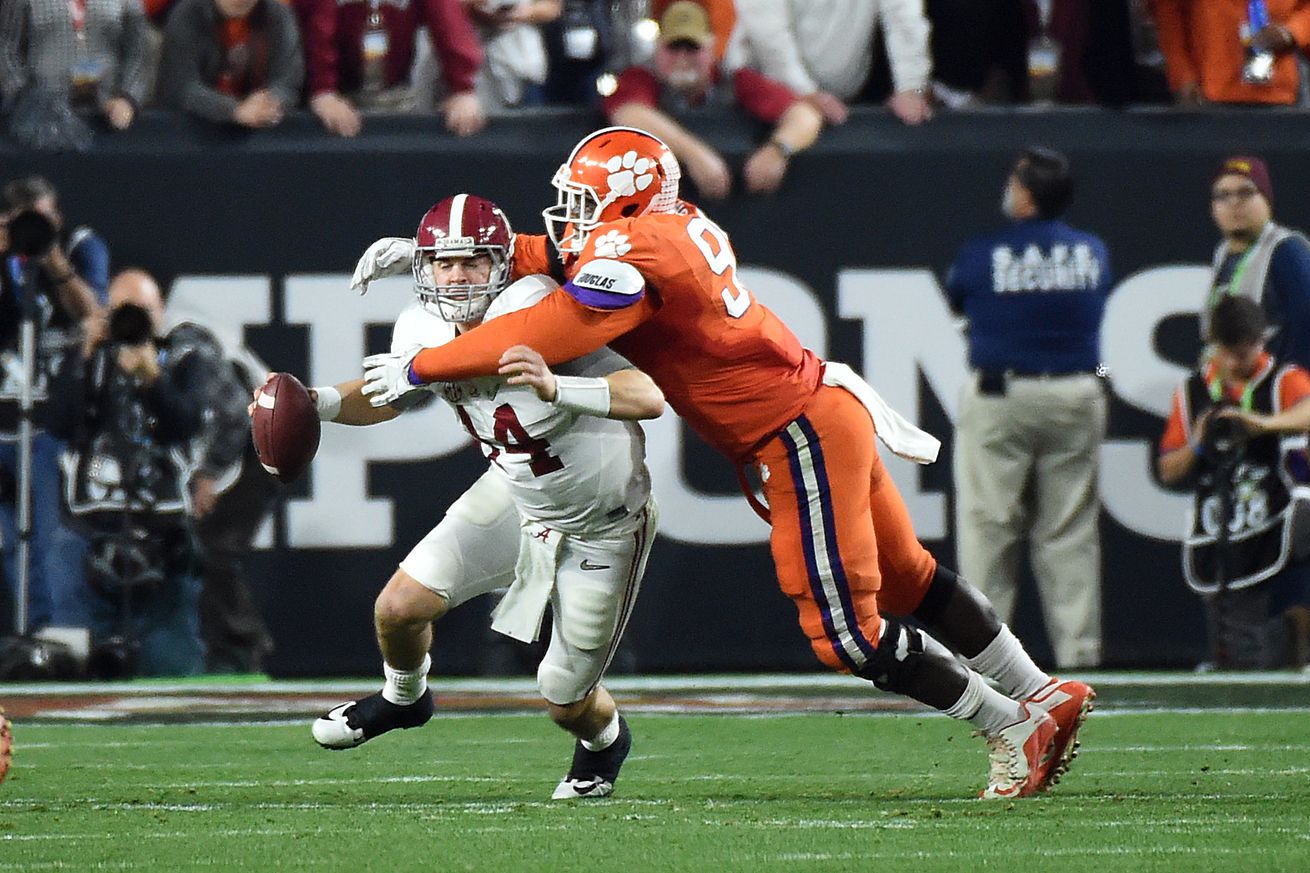
Kevin Dodd, Clemson


Speed is the most commonly praised feature of a pass rusher, and there is good reason for that. The essence of pass rushing is speed, beating a blocker to a point and gaining leverage to get to the quarterback. The most impressive plays are made with speed, when a rusher bursts untouched into the backfield and drags the quarterback down.

But as important as speed is as a tool, it often relies on power to be used properly. Fast rushers can be pushed aside if they aren’t strong, and strong rushers can make a big play out of a small gap. This is what Dodd brings to the table. He has decent burst off the line, and he can get around the corner, but he isn’t going to run circles around blockers. He doesn’t have the inside cutting ability of the four players I listed above, and he isn’t particularly technical in his rushing either. What he has is strength, enough to make something out of advantages that other players wouldn’t be able to use.

Dodd is at his best when he attacks into the shoulder of the lineman in front of him. When he tries to beat him upfield, he ends up bending too wide, leaving a lane for quarterbacks and running backs to escape underneath. When he tries to shoot a gap, he ends up pinned between two linemen. But when he attacks the player in front of him from an angle, he can bend blockers out of their path and give himself a small opening. From there, his strength can force him through that opening, leaving the blocker clutching helplessly at his jersey as he falls on the quarterback.

Dodd will never make the spectacular, untouched play in the backfield. He has a decent first step, but he is hurt by occasional slowness in reacting to the snap of the ball. What he can do, however, is finish through pressure, the sort of messy play that will be needed for any pass rusher to succeed in the NFL. His ceiling is a bit limited, and he probably won’t be able to contribute until he spends some time transitioning from college to NFL strength, but he is good enough at what he does to go in the latter portion of the first round.

Shaq Lawson, Clemson
After Bosa and Calhoun, the gaps between these rushers become harder to measure, and a team’s decision will ultimately come down to stylistic preference rather than actual talent. Do they want the explosive speed rusher in Spence, the versatile playmaker in Floyd, or the overpowering brute in Dodd? Or do they want Lawson, the high ceiling option who can do it all and yet struggles to do very much.

At first glimpse you could say that Lawson’s problems come down to consistency. A couple times during every game he will make a play that jumps off the screen, showing the potential that has some considering him a top ten selection. He has decent speed off the ball, and like his teammate Dodd he can power through contact into the backfield. He uses his hands to swat away a blocker’s arms as he rounds the corner, and he can keep himself clean as he makes a play on the quarterback.

But there are flaws in his game, and these flaws show up more often than the dominant moments. At times he can use his arms to keep himself clean, but far too often he rushes with his chest exposed, letting blockers get into him and control him. He can get into good position in the running game, but he struggles to disengage and make plays. Even when he does gain the advantage, he doesn’t have the burst to accelerate through it, and he will struggle to finish plays at the next level.

I’m about as low on Lawson as anyone is. I say the end of the first round is a good place for him, but in all likelihood he will go in the first twenty, and possibly in the top ten. And he could end up being worth it, if he can harness some consistency out of his flashes of brilliance. But when I watch him, I see a player who doesn’t have the overwhelming strength or quickness to consistently dominate in the NFL, and a few flashes here and there won’t be enough to turn him into a truly elite pass rusher.

Emmanuel Ogbah, Oklahoma State
Draft favorability is a zero sum game. What this means is, if I’m higher than most on players like Calhoun and Floyd, I must also be lower than most on a couple players to make up for it. There are only 31 first round slots available, and there are only so many teams that will go after a pass rusher. So some players must be downgraded, players like Lawson and Ogbah who are considered top fifteen prospects by other analysts ranked down near the second round by me.

On paper I see it with Ogbah. On the field, not so much. He has all the talent in the world, arguably the most physically gifted pass rusher in this draft class, but it only occasionally translates onto the field. His first step is explosive, and he has the power to fight through weak contact, and most of his success in college came through some combination of these skills, racing around the edge before the tackle could get into his pass set. This is a valuable ability, and it will translate to some extent at the next level.

But as gifted as he is, Ogbah should have been able to dominate much more consistently in college. He has all the tools, but they never seemed to come together on one play. He’ll fire out of his stance, but he’ll come out too high, letting the blocker into his chest. His long arms and leg drive can bend an opposing lineman backwards, but he doesn’t disengage or do anything with his leverage. He works well through traffic, but he never applies his lateral quickness to an inside move.

If Ogbah can put it all together, he can become a Pro Bowl caliber defensive end. And in other years that might be enough to make him worth a mid first round pick. But with the strength and depth of this year’s edge rushing class, it’s hard to justify the risk he presents. I wouldn’t take him until the other six above are off the board, which likely won’t occur until the second round.

Thursday, April 7, 2016

2016 Running Back Prospects


We all know the state of the running back position in the NFL. The past ten years have brutally stripped it of any value, to the point at which there have only been two running backs selected in the first round in the past three seasons (Todd Gurley and Melvin Gordon last year). There will probably be one more added this year, but for the most part teams believe this is a position that is better addressed later in the draft.

That doesn’t mean that the running back position is irrelevant, and that doesn’t mean we should ignore it heading into the draft. Running backs have fallen out of favor, but they can still play a huge role in an offense, and the ability to find a good one in the second or third round only sweetens the deal.

The role of the running back has changed, and with this so have the requirements to play it. Scouts still look for physical and fast runners who can break tackles and outrun defenders, but those skills now need to be supplemented by others. Running backs need better vision, need the ability to catch the ball out of the backfield, and need to know how to protect the quarterback. The era of the 20 carry a game bellcow may be behind us, but a new type of running back is on the rise, with the potential to rebuild the value of the position for the modern NFL.

Ezekiel Elliot, Ohio State
No position in this draft is as clearly dominated by one player as running back. Ezekiel Elliot is the best running back in the class, and it isn’t particularly close. It almost feels strange to construct this list as I have, with other players sitting just beneath him as if there is some argument to be made between first and second. In a lot of ways, Elliot is in a different position class altogether from the other running backs, and he almost deserves a post of his own.

Elliot’s running style is defined by its versatility. He boasts power, speed, and agility, and he uses them all with intelligence and instinct to carve his way through a defense. He bursts off his initial step and with each cut he takes, and once he hits the second level he is able to outrun everyone on the defense to the endzone. Tacklers slide off of him like he’s coated in grease, and he is quick enough that he never takes a hit square, always sliding to the side and finding a way to fall forward even if the tackler latches on.

There are two main criticisms that can be made of Elliot as a runner. The first is that he sometimes dances too much in the backfield, a common issue that experience and coaching can cure. The second is a bit more esoteric. While he does a lot of things well, there is nothing about his running style that is overwhelming or elite. He doesn’t have the power of Marshawn Lynch or the quickness of LeSean McCoy or the patience of Le’Veon Bell. He has a good combination of all of these traits, but there is nothing about him as a runner that screams of unmatched talent.

When discussing Elliot, he can’t be compared to the other running backs in the class. There’s no argument to be made there, and it isn’t worth the time. Instead we should focus on how he compares to other top running back prospects to figure out where he belongs in the draft. The easiest comparison is Todd Gurley, the only running back selected in the top ten in the past three drafts. And as a runner, there is no question that Gurley was a better prospect. Injury concerns dropped him lower than he probably should have gone, but his skills were still well beyond Elliot’s in the running game.

The running back position is interesting in the draft because of how much the value of the position has changed. In 2005—just eleven years ago—three of the first five players selected were running backs. But as the league has become more passing oriented, the position has lost almost all of its value. It now requires a rare talent—a Todd Gurley level talent—to make it into the top ten, a level of talent Elliot doesn’t possess.

But this is where things get interesting with Elliot. Because while he doesn’t stack up as a runner, the skills that are more valuable for the modern game are the skills that make him an elite prospect. Elliot is an excellent receiver out of the backfield, and he is quite possibly the best pass blocking running back I have ever seen. The team that gets Elliot will be getting a complete player, someone who can step on the field and contribute from day one. He is a very good runner, but if it was only for that, I’m not sure he’d be worth much more than the twentieth pick. Factor in his other abilities however, and you have the rare running back worthy of going in the top ten.

Paul Perkins, UCLA
If you don’t get Elliot in the first round, you’re going to have to wait until the second to find a running back. Fortunately, there are three quality backs worthy of a selection in that round. And of those three, Perkins is the best and most complete option, a back who combines power and quickness in a way that will make him an asset in any system in the league.

When looking at Perkins, it isn’t hard to see why he is less well thought of than Elliot (and why many projections have him ranked lower than I do). He is undersized at 5-10 and 208 pounds, and he isn’t particularly fast, running only 4.54 in the forty yard dash. He is not on Elliot’s level as an athlete, and he is probably below each of the next two backs on this list. But he plays larger and faster than he actually is, and he combines that with good instincts to be an effective runner.

I was actually surprised when I looked up the numbers and saw how small Perkins is, after watching him on tape break tackle after tackle. He plays with excellent balance, and tacklers regularly slide off his legs while he keeps churning ahead. He makes extremely sharp cuts in the open field, and it is difficult to get a square hit on him. At times he can leave defenders looking absolutely helpless as he turns what should be a sure tackle into a big play.

The speed is a concern, but it isn’t as big a deal as you’d initially think. When it comes to playing football there are really two types of speed. There is “long speed”, which is the ability to burst at the second level and run away from defenders, and there is “short speed”, the ability to ramp up to the highest level in just a few short steps. Perkins definitely lacks long speed, but his short speed is more than satisfactory. He can outrun defenders to the edge, and he can mess with tackling angles as he cuts through traffic. No, he won’t be breaking any sixty yard runs, but he can churn out ten to twenty yards with ease.

After Elliot I see Perkins as the most sure thing at running back in this draft. He has a polished game, displaying good vision and excellent patience in allowing his blocks to get set up in front of him. He wasn’t used much in the passing game at UCLA, but based on the limited activity I saw and his innate physical abilities, I think he could develop into a reliable option as both a receiver and a pass protector.

Alex Collins, Arkansas
Collins is another example of the difference between long and short speed, just in the opposite direction from Perkins. While he isn’t as extreme as some cases (see Derrick Henry a couple ranks lower on this list), he is much more impressive once he can get his momentum built up and break through the second level of the defense. He is an explosive runner who struggles at times to get through the initial level of the defense, the sort of player that will alternate moments of brilliance with extended periods of frustration.

Collins’s speed isn’t world breaking, but he has more than enough to run away from chasing defenders. He does a good job making the most of the speed he has, using subtle bends down the field to mess with pursuit angles. He can make a slight change of direction without losing speed, allowing him to escape safeties and pursuing linebackers and turn a good play into a great one.

The troubles he runs into are at the immediate level of the defense. He doesn’t move particularly well from side to side, and defenders in front of him usually end up bringing him down. He shows good vision and patience at times, but he still will sometimes try to dance too much, slowing him down and giving him even less hope of breaking through tackles. He doesn’t possess spectacular strength, and even though he can fall forward, he isn’t going to fight through contact to extend a run.

Collins benefited in college from a behemoth offensive line that was constructed solely with the purpose of opening holes in the running game. They carved a lot of space between the tackles, and he did a good job utilizing this space, even if it wasn’t a particularly difficult task. On the rare occasion there was nothing there for him, he was vulnerable to negative plays, a flaw that will be exposed in the NFL. Wherever he goes, he’s fated for a bit of a boom or bust career, and while enough boom could get him to play at a Pro Bowl level, I think a solid starter is the best that can be hoped for.

Kenneth Dixon, Louisiana Tech
The separation between number two and number four on this list is not that great, and depending on what you want from a running back, there could be a strong case made for Dixon as the second to go off the board. He doesn’t have the tackle breaking ability of either Perkins or Collins, but he makes up for it with elite elusiveness in the open field.

Watching Dixon run just looks different from all the other running backs on this list. His cuts are so much sharper, and his first step is so much quicker. He can dance circles through defenses while still gaining ground, almost seeming to hop as much as run as he maneuvers through traffic. His vision is phenomenal, and his burst just messes with the minds of the defenders trying to catch him.

Like all young running backs with his skillset, Dixon can dance himself into trouble. But he can dance himself out of trouble just as easily, making defenders miss both between the tackles and on the edges. He is already a good receiver, and he has the skills to become even better, the sort of weapon that a smart offensive coordinator will scheme into matchups the defense cannot hope to win.

Dixon can be great, and he has a higher ceiling than either of the two I listed above him. But as good as he is at making people miss, I can’t get over just how much his game relies on this. Dixon fights hard through contact, but there is only so much he can do with his physical ability. A player like Perkins can’t move in the same way Dixon does, but his ability to slide through arm tackles gives him much greater margin for error than a player like Dixon, who can be brought down with a single hand. Dixon can do awe inspiring things in the open field, but I get nervous about a runner who is so limited in his skillset, and I would hesitate to grab him until the latter portion of the second round.

Devontae Booker, Utah
For a team looking for immediate impact at the running back position, their best bet might be to grab Booker in the third or fourth round. Though his upside doesn’t match that of the players listed above, he has all the skills needed to contribute in the NFL right away. From day one he can find a role as a third down back, with the potential to grow into more as his career goes along, even if he’ll never be a top tier running back.

Physically Booker is nothing special. He doesn’t have breakaway speed, and he isn’t particularly powerful. He can break an occasional tackle, but for the most part he goes down as soon as someone can get a hand on him. He does do a good job of falling forward by sliding away from contact, and he’s good enough at finding holes that he could potentially contribute as a short yardage option.

Booker’s greatest asset is his ability to play through traffic. He isn’t going to break ankles in the open field, but he has good small area quickness, working with solid vision to give him the ability to cut through small gaps in the defense. This won’t turn a three yard run into a sixty yard run, but it can get him seven or eight.

Booker is a solid back with skill to make up for rather bland physical ability. He catches the ball well out of the backfield, and he is strong in pass protection. It would be nice if he didn’t dance so much in the backfield, but this won’t be a major hindrance if a team wants to slide him immediately into a role as a third down back.

Derrick Henry, Alabama
When Henry gets rolling, he cannot be stopped. This is what won him a Heisman Trophy, and this is what makes him intriguing as an NFL prospect. With huge stature and great long speed, he is a safety’s worst nightmare charging down the middle of the field. No player in this draft is better at breaking off an explosive run. It’s just a shame that this is Henry’s only skill.

Henry can be unstoppable when he gets going downfield, but outside of that he is very easily shut down. His biggest problems present themselves when he tries to change direction. He is incapable of sharp cuts, and he usually has to take two or three steps whenever he wants to go somewhere else. At times his feet come to a total stop, making it even harder for him to get back up to full speed.

And once his feet come to a stop, the less obvious of Henry’s flaws presents itself. For someone who is 6-3 and 247 pounds, he is remarkably easy to bring down. He doesn’t have great leg drive at the point of contact, and he takes every hit square on his chest. Occasionally defenders will get scared and go for his legs, allowing him to fall forward, but most of the time he is hit within five yards of the line of scrimmage, he does not go any farther than that.

Henry can’t make defenders miss, and he won’t break a lot of tackles around the line of scrimmage. He offers next to nothing as a receiver, and he is somehow just as boom or bust as a pass blockers as he is as a rusher, alternating powerful blitz pickups with excruciating failures. There is a place for a runner with Henry’s skills in the NFL, but that place is so narrowly defined. If his line and his coaches can get him to the second level consistently, he can be a very successful runner. If they can’t, he could be out of the league in four years.

Jordan Howard, Indiana
 
Howard is probably the least complicated runner in the draft. He takes the ball, he runs to the hole, and then he keeps running in that direction until someone gets in his way. He doesn’t change directions, he doesn’t make cuts, and he doesn’t run away from defenders. In a lot of ways he is a similar runner to Henry, just with slightly more power and a lot less speed.

Howard is most successful when he’s attacking downhill through a very clearly defined hole. He doesn’t get stopped for a loss very often, and he doesn’t break off more than ten yards very often either. He does a good job fighting through contact, but he doesn’t really slide out of tackles, just drags defenders for a couple extra yards before falling down. Unlike Henry though, he does this at every level of the field, including at the line of scrimmage and in the backfield. His power comes from leg drive rather than momentum, making him a more reliable option in short yardage situations.

The best role for Howard in the NFL will probably be as a backup and occasional short yardage specialist. If needed he can carry the load, but he’ll never be the sort of runner that will leave a team comfortable with the position. There is very little upside here, and I definitely wouldn’t take him before the fourth round, and probably not before the fifth.

Monday, April 4, 2016

2016 Interior Defensive Line Prospects

NFL defenses have become increasingly versatile over the past ten years, to the point that it has become difficult to define players by a single position in the front seven. Some players play at every position along the defensive line, while others switch from down in a stance to rushing as a linebacker. The traditional definitions of defensive end versus linebacker versus defensive tackle are no longer capable of defining the roles in NFL schemes.

Realistically you could divide front seven players into nearly a dozen categories, but I am going to be satisfied with just three: interior linemen, edge rushers, and linebackers. I'll get to the rest over the next three weeks, but today I’m starting with the interior defensive line. These players vary from space eating run stuffers to interior penetrators, but however they play, there are certain skills that translate across the position. They need to be able to hold up against double teams in the run, and they need to be able to fend off blockers with their hands. The ability to penetrate is also a plus, but it’s not as crucial as it is on the outside. More often than not, the key to playing on the defensive interior is consistency and reliability, with occasional splash plays viewed as a bonus.


DeForest Buckner, Oregon
Buckner’s best is by a decent margin the best of any player in this draft class, and he’s at his best often enough that you can make a strong case for him as the top player available. Physically he is as impressive as any player in the class, standing 6-7 and weighing 291 pounds. He can play just about any position on the defensive line, and he can fit into almost any scheme. If I was the Titans with the first overall pick, I would give serious consideration to using it on Buckner.

Buckner is a physical marvel, but what really sets him above other defensive linemen is the way he uses his hands. His most common move in college was simply to attack the opposing lineman with a devastating punch, bending them backwards with his strength and marching them into the backfield. From there he had a variety of techniques to get himself free, from rips to swims to clubs. He usually plays on the opposing side of the ball, and he is usually free to make a play if the ball comes his way.

The biggest issues I saw with Buckner come down to consistency. Part of this is effort based, and part of it is technique. At times he doesn’t use his hands to his advantage, and when this happens his towering frame can be a disadvantage, giving blockers access into his chest. He struggled to hold up against the run when placed between the guards, and if he plays there in the NFL it will probably be best in passing situations only.

There are definitely questions about Buckner going forward. He showed good burst in college, and he should be able to apply that to becoming more of a penetrator if the scheme asks, but that wasn’t a skill he commonly demonstrated. He may not make plays deep in the backfield like some of the best players in the NFL do. But even if he can’t take this leap, he is still worth a top five pick. At worst he’s a quality starter with occasional flashes of dominance. At best, he becomes one of the best defensive players in football, a monster who will devour offensive lines on a regular basis.

Andrew Billings, Baylor
Buckner is the best interior lineman in the class, but Billings is probably my favorite. A physical behemoth of a defensive tackle, his value is hurt somewhat by his lack of versatility. Billings is a classic nose tackle, and he does all the typical nose tackle stuff. He swallows up the middle of the offensive line, he stuffs running backs in short yardage, and he absorbs double teams like they’re nothing. But it’s what he does beyond this that makes him special.

A nose tackle isn’t worth much in the NFL these days. Most only play on first and second down, replaced by smaller, quicker rushers in passing situations. This may be the case for Billings as well, but I think he offers more versatility than the standard big man. He is remarkably quick on his feet for someone his size, and he shows excellent skill with his hands for someone who plays so much on the interior. Not only can he absorb blockers, he can beat them as well, and he can make plays in the backfield against both the run and the pass.

The fact that he makes these plays hurts him every now and then, as he gets too aggressive and exposes the defense to vulnerabilities a more traditional nose tackle wouldn’t leave. He sometimes tries to go around the offensive linemen, forcing himself into one gap and leaving a hole for a running back up the other. He does a good job riding the blocker laterally to cut off the running back, but he sometimes goes too far, leaving a running lane open behind him.

Billings looks like your traditional nose tackle, but closer examination reveals a much more dynamic player. At the same time, his size will pose some problems on the next level, and he still may not be an every down player. As much as I like him, it’s hard to justify spending a high pick on someone without the versatility to face all comers in the modern NFL. Billings is one of the few I would justify spending a first round pick on at all, and even then I’d be hesitant to take him in the top twenty.

Robert Nkemdiche, Ole Miss
The only thing more staggering than Nkemdiche’s talent is the uncertainty that surrounds him. A former top recruit, on paper Nkemdiche looks like one of the best football players in the world, and at times this even carries over onto the field. At other times, he looks like someone with no ability or interest in football, which combined with pressing off the field concerns has dropped him possibly into the second round.

Nkemdiche will make his money with his first step, which is far and away the best of the draft class. He gets off the ball and up the field with mind boggling speed, and he is capable of taking a runner down five yards deep in the backfield. When he can shoot through a gap clean, he is a disruptive force like no other. But when things don’t go perfectly right, there isn’t much he can do. He doesn’t fight past the initial surge, and he doesn’t finish well through contact, meaning that even on plays where he gets the initial advantage he can be pushed away before he can do any damage.

The part that makes Nkemdiche both frustrating and intriguing is that he shows flashes of being able to do more. When he uses his hands, he can create tremendous separation, which allows him to use devastating swim and spin moves to get into the backfield. He has the ability, but he doesn’t use it often enough to make a real difference.

The questions with Nkemdiche are nearly endless. Does he have the ability to make plays consistently in the NFL? Does he have the drive to become the best he can be? Can he keep himself clean off the field? Too many questions for me to spend a first round pick on, even with the talent he displays. Someone could very easily end up getting a steal in the early second, but I’d hate to end up with what Nkemdiche could turn out to be with a first round pick.

Sheldon Rankins, Louisville
Rankins is far and away the best pass rusher I saw among interior defensive lineman, and he is also far and away the worst run defender. He gets overpowered far more often than any 300 pound person should, and it happens both against double teams and single blocks. He will never be able to play a traditional nose tackle position, and he will struggle some if he has to weather play after play between the tackles.

As a pass rusher, it is a completely different story. His game begins with his initial step, which is often enough to beat an opposing linemen out of their stance and get him into the backfield. He can get skinny to slide through a gap, but even if he can’t find one, he isn’t defeated. He almost always attacks with his hands, and he boasts the most versatile set of moves in the class, attacking from multiple directions and angles to get himself towards the quarterback.

This ability with his hands gives him some hope as a run defender, even if it’s something he will have to improve on significantly at the next level. He shows flashes of being able to get into the backfield against the run, and he is a strong tackler when he gets near a ball carrier. His strength will always be an issue, but he has the ability to grow into a better player than he is right now. This potential might tempt me into using a first round pick on him, but I am still hesitant about grabbing an interior player who is this vulnerable against the run. A good coordinator will find a way to hide this, but it will require some work to take advantage of his full abilities.

Jarran Reed, Alabama
Reed is a very similar style of player to Billings, just without the dynamic ability that makes Billings worthy of a first round pick. He can stuff up the middle and hold his ground against multiple blockers, but he very rarely does more than that. In the past this would have been enough to make him a valuable player, but in the pass heavy modern NFL, this simply doesn’t cut it for an every down player.

Despite his shortcomings, Reed still does a lot of good things to make him worth a second round pick. He engages well with his hands off the snap of the ball, giving him separation that will allow him to continue to find success even against stronger opposition in the NFL. From that point on his hands don’t do much, and he struggles to break away from contact. But he can still stick an arm out when the ball carrier comes by, and with his strength that can be enough to bring a running back down.

The lack of pass rushing ability is his biggest problem, and it will likely remain that way his entire career. He isn’t explosive off the snap, he isn’t quick in tight spaces, and he can’t do much to shed blockers. He doesn’t even get push to collapse the pocket into the quarterback’s face. This is a major flaw in his game, and he doesn’t have the skills to correct it, making him a player with a definitely low ceiling. But he will still be a reliable option in the NFL for several years going forward, worth a pick even if that option disappears on third down.

A’Shawn Robinson, Alabama
Robinson is freakishly gifted physically, and it shows itself on the field just often enough to hide a mediocre football player. Early in the process I saw him projected in some cases as a top fifteen pick, but as things have gone on he’s fallen into a more appropriate slot in the second round. Flashes of ability make him at least somewhat intriguing, but I saw very little in his college tape to suggest he’ll be a consistent impact player.

Robinson isn’t explosive, and he isn’t particularly skilled either. He’s slow off the ball, and his hand usage is inconsistent. In college it wasn’t a problem when blockers got leverage on his chest, but NFL offensive linemen will be able to push him around if he can’t protect himself. He stuffed things up in college, but he could easily find himself moving backwards on a regular basis at the next level.

He doesn’t offer much as a pass rusher, and he doesn’t cover a lot of ground side to side. His athleticism is certainly enough for him to do so, and a lot of times it appears to come down to motor. This is what makes him interesting, because he has all the ability he needs to leap forward in the NFL. With good coaching and the right circumstances, he could turn into a player worthy of a first round selection. But right now, he spends most of his time as someone content to absorb blockers and stand in the middle while the defense makes plays around him.

Thursday, March 31, 2016

2016 Wide Receiver Prospects


On Monday I posted my breakdown of the cornerback position group. Today I’m coming with their offensive counterparts, the wide receivers. This year has a deep class of receivers that lacks the elite options available the past couple seasons. There is talent to be found here, but it won’t be as easy to sort out as in 2014 or 2015.

There are a lot of different ways to succeed at wide receiver in the NFL. Route running is a valuable skill, but separation can also be achieved through speed and explosion. Bigger, more physical receivers can outmuscle defenders for the ball, and smaller ones can run circles around tacklers. I look for all of these skills when I scout receivers, and the lack of one can be compensated for by the presence of others. In the end, it comes down to the ability to create separation, reliability in catching the ball, and the skill to make a play where other receivers wouldn’t be able to, however they go about doing so.

Laquon Treadwell, Ole Miss
Treadwell is the most complete receiver in the draft, even though there isn’t any one thing he does that jumps out over everyone else. His game is built around his strength at the point of the catch, but he complements that with quality route running and running ability with the ball in his hands. He is an excellent blocker, and from the way he throws himself around he looks like he actually enjoys it as well. He isn’t overly tall and doesn’t jump through the roof, but he can win balls over the top well enough to be a dangerous red zone threat.

Treadwell’s biggest questionmark is his speed. He raised some eyebrows when he elected not to run the forty at the Combine, and he only gave the doubters more fuel by running a 4.65 at his Pro Day. The issue of speed does present itself on the field, where he isn’t particularly dangerous over the top. He can get some good separation as his route develops, but he isn’t going to blow a defender away at the snap of the ball, and down the field he’s going to have to rely on his size rather than his speed to generate big plays.

But as nice as big plays are, they often get overrated. Treadwell is fantastic at the smaller plays, at creating separation underneath and producing across the middle of the field. He needs to get better at using his body to shield defenders from the catch point, but he has all the physical tools to become one of the best in the league at physicality.

Treadwell is quicker than any receiver as thick as he is has any right to be. A common way to deal with a receiver with his lack of top end speed is to play them tight to the line, not fearing being beaten over the top. But Treadwell is so quick with his initial moves that he simply cannot be pressed, and even if he can’t beat a team with one massive stab, he can kill them with a dozen smaller cuts. This quickness translates to after the catch as well, where he is almost as difficult to catch as he is to tackle.

Treadwell’s ceiling may be lower than some of the other top receivers in the league, but he can do enough things that I would consider him just outside the top ten in this draft. There is some risk involved, but overall I’d say he’s probably the safest receiver in this class. He’ll be a starter from day one in the league, with the potential to become a regular Pro Bowl player.

Josh Doctson, TCU
From the moment he enters the league, Doctson will be one of the five best jump ball receivers in the NFL. He possesses a rare blend of size, explosion, timing, and hand strength that sets him apart from even the best at going up and getting the ball. He tracks the ball remarkably well in the air, and he is an expert at timing his jumps and his reaches. If he can get behind a defender, the play is essentially over, as he waits until the very last second to extend his hands to prevent the defensive back from knocking the ball away.

Doctson’s leaping ability is a class above the rest of the receiver group, but it isn’t his only tool. He’s an effective if unspectacular route runner who was limited by an unimaginative offense at TCU. Most of his damage in college was done as a deep threat, where his speed and leaping ability produced a couple big plays each game. But he is capable than much more of that, able to generate separation underneath with sharp turns and deceptive moves.

Doctson does have some limitations to his game. As a deep threat he could do a better job to avoid getting pressed against the sideline, giving the quarterback a bigger window for the football and himself more room to jump. He is strong enough to shed an occasional tackler, but he doesn’t do much after the catch. There is definitely some risk that Doctson proves to be one dimensional at the next level, that he cannot develop the ability to exploit defenses underneath.

There is one more factor to consider with Doctson, and that’s his age. Due to four years of eligibility and a year sat out as a transfer, he is already 24 years old, older than established NFL stars like Allen Robinson and Amari Cooper. This isn’t a major problem, but it does pose questions about his development curve going forward. Is his ceiling lower than that for younger players? How much of his physical dominance in college was simply the product of being a year or two older than the players he was facing?

This isn’t a major factor, and it shouldn’t play a deciding role in the drafting process. But as a tiebreaker, I think it’s fair to take into consideration. On a strictly talent level, I’d have trouble choosing either of Doctson or Treadwell over the other. But with this as an extra factor (Treadwell will be 21 when the 2016 season starts), I slide Doctson a notch lower on my receiver rankings.

Michael Thomas, Ohio State
When studying a position like wide receiver, it often becomes difficult to know how to factor production into the analysis. There is so much data out there that it would be irresponsible to ignore (though some very good scouts still swear by this method), but there are also a lot of factors that can influence numbers that we need to consider as well. From a pure production standpoint, Thomas doesn’t measure up with the other top receivers in this class. So when looking at him we have to ask, why weren’t his numbers better? How much of it was the situation he was put in, and how much of it was Thomas himself?

From a physical tools perspective there may not be any more impressive receiver in the class. At 6-3 and 212 pounds, he boasts the size to outmatch any cornerback and the speed to explode over the top. His route running is also among the best in the class, and he can generate incredible separation with a simple, deceptive stutter that allows him to break in any direction without tipping anything to the defender.

From a physical perspective Thomas combines the strengths of Doctson and Treadwell without any of the weaknesses. He nearly matches Doctson’s height while also having the good bulk on his frame, and he has close to Treadwell’s strength without sacrificing top end speed. Were their situations reversed, it’s very likely that Thomas could have put up the same sort of numbers the other two did. But in a run first system at Ohio State, his ability to produce was limited.

There are a few other factors that have caused me to drop Thomas below the other two. He doesn’t have either player’s ability to win catches through traffic, and he catches with his chest too much. This didn’t translate to drops in college, but it could at the next level. He doesn’t show much interest in blocking, and he doesn’t go outside his frame to make a lot of catches.

Thomas’s lack of productivity raises some concern, and his other limitations drop him just outside the top twenty in my mind. But the talent is undeniable, and five years from now if you tell me that a receiver from this class is the best in the league, my money would probably be on Thomas (or one other receiver a little further down this list). His ceiling is less defined than the two above him, but his floor is a bigger concern.

Tyler Boyd, Pittsburgh
Sometime down the road there is a decent chance we’ll look back on the 2016 draft and wonder how the hell some team or other managed to steal Boyd in the second or third round. Every year it seems like we see a player like Boyd, someone whose physical abilities fail to measure up to his overall skill as a football player drops because he doesn’t fit the mold of what an NFL wide receiver looks like. Boyd disappointed at the Combine, and he has some off the field concerns that will keep him from rising as high as his talent says he should go, but he is still one of the top five receivers in this class.

Boyd does all the little things you can want from a wide receiver. He’s the best route runner of the receivers I studied, making sharp breaks and selling fakes with his entire body to create separation. He’s a good blocker, and he can make plays after the catch. He has good size, and his hands are as strong as any in the class, allowing him to consistently win contested catches.

What worries me is how frequently he had to rely on these contested catches in college. Someone with his quickness and route running ability should have been wide open far more frequently that he was, and this is where we really see the physical shortcomings come into play. He can create separation with his routes, but he can’t widen it with his speed, and cornerbacks with NFL skill can close the gaps he creates. He may struggle to get open against the more impressive athletes at the next level, and there isn’t much he can do to improve himself on this front.

If Boyd succeeds, he will become another example for the people who love to ridicule the draft process’s overemphasis on physical traits, joining a list that includes players like Keenan Allen and Allen Robinson. But if he fails, he will hardly be the first example of a receiver who couldn’t cut it physically in the league. I don’t think he will fail, but I think there’s a decent chance he will top out as a high caliber slot receiver. There is some value in this, but only enough to get him into the end of the first round.

Corey Coleman, Baylor
When discussing Michael Thomas I mentioned that there was one receiver farther down the list who I could see becoming the best player in the class. Well, that receiver is Coleman, without question the biggest boom or bust threat among this year’s receivers. At only 5-11 and 194 pounds, he doesn’t have the physical stature of the other receivers on this list, but his speed and quickness is on another level, enough to make up for other questionable parts of his game.

Before we go any further, I have to stress how difficult it is to scout Coleman. At Baylor he almost always did one of four things: run a go route, run a hitch, run a slant, or absolutely nothing. And by absolutely nothing, I mean absolutely nothing. There were plays where, as soon as the ball was snapped, he turned and looked to the sideline to get the next call. This reflects less on him as a player than on the scheme he was put in, a high tempo system that saves players’ energy by letting them take plays off. But it makes it even more difficult to project Coleman to the next level.

There is no more erratic receiver in the draft than Coleman. He can absolutely burn teams over the top, but he can also be knocked off his route by a simple shove. He is easily brought down when a defender can get a hand on him, but he can also be insanely elusive, with the sort of quick stop-start ability that almost looks impossible. He’s good for a drop or two a game, but he is also good for one or two spectacular plays.

I honestly don’t know what to make of Coleman. Both extremes of his potential scare the hell out of me. And it could ultimately come down to the situation he ends up in, whether the offense can use him properly and the coaches can develop his talent. I’d be hesitant to use a first round pick on him, but I would also feel as if I’m getting a tremendous steal anywhere in the second round.

Braxton Miller, Ohio State
We all know the story with Miller. A former superstar quarterback who transitioned to wide receiver after injuries, his production is limited by the same run first scheme that I discussed with Thomas above. But after being the most impressive player on the field at the Senior Bowl, most scouts seem convinced that Miller is capable of playing receiver at the NFL level, even if he’ll need a bit more work than other top prospects.

As a quarterback Miller was one of the most elusive and dynamic players in college football with the ball in his hands, and that is just as true at receiver. A smart offense will be able to use him right away in packages that get him out in space and let his athleticism take over. But as a receiver, he still has a lot of work to do. He is still learning how to harness his quickness as a route runner, and he has a pretty glaring false step off the line that makes it easy for defenders to get into his face and stuff him before he can get off. These little things can be worked on, but they limit his immediate impact and add an extra risk factor going forward.

At the same time, there are parts of his game that are tremendously advanced for someone just learning the position. He tracks the ball extremely well in the air, and he does an excellent job going outside his body to make the catch. His hands are not a concern, and his athleticism gives him tremendous upside. Miller is one of the most intriguing prospects in the draft, and it wouldn’t be a surprise to see him sneak into the end of the first round, even though I think it’s safer to take him somewhere in the early part of the second.

Leonte Carroo, Rutgers
Strong hands seem to be a consistent trend among this year’s receiver class, and Carroo fits that mold as well as any of the others. He is a big receiver who specializes in making catches in traffic, and whose lack of breakaway ability means he spends a lot of time in traffic. He can work into some decent speed if he has time to build to it, but he isn’t going to blow by defenders off the line, meaning that down the field he often has to rely on his ability to outfight defenders for the ball in order to make catches.

As a route runner he is nothing spectacular, but he is a smart player who can get open by adjusting his routes to the openings in the defense. Defenders can close on him quickly, but he is good at shielding them away with his body and at giving the quarterback a wide range to throw to. His instincts extend to what he does with the ball in his hands, where he can work himself through traffic and always seems to finish forwards.

Carroo’s upside is fairly limited, but he can make a good number two or three receiver in the league. He’ll win balls over the middle and occasionally make a spectacular play over the top, the sort of weapon any offense would happily take. Mid to late second round would be a good place for him, assuming some off the field issues have been cleaned up as I’ve heard. He’s nothing special, but if a team doesn’t get one of the players above, Carroo is a solid consolation.